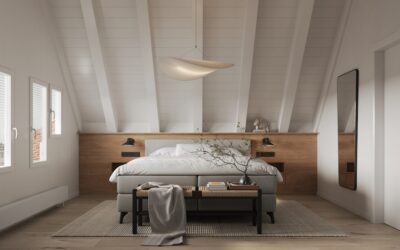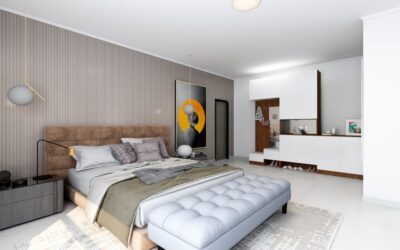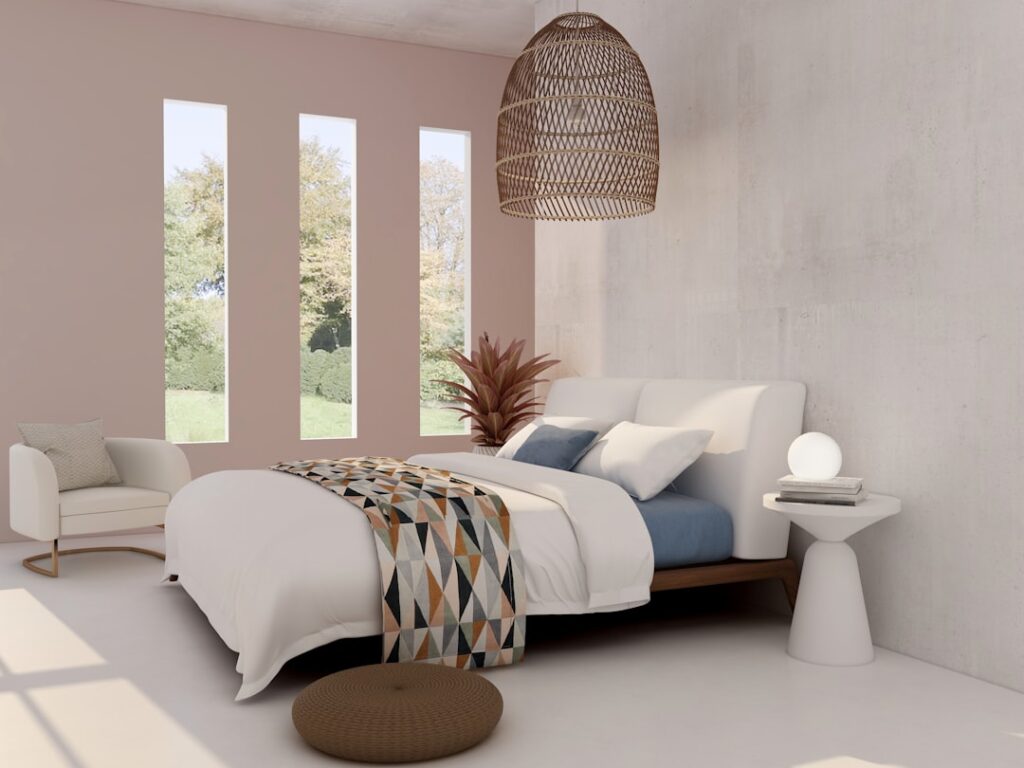
Slanted walls feel like a problem until you treat them as the defining architectural feature. Most attic conversions, dormer rooms, and old farmhouse bedrooms have angled ceilings that come down to 3 or 4 feet at the eaves — frustrating if you fight them, charming if you lean in. Knowing how to decorate a slanted wall bedroom means picking furniture sized for the actual ceiling line, using paint to either emphasize or hide the angles, and placing storage in the dead zones where standing height does not matter. This guide walks through the seven decisions that turn a slanted bedroom from awkward to intentional.
Decision One: Where the Bed Goes
The single most important call. A standard queen mattress sits 24 to 30 inches off the floor with the headboard reaching about 48 inches. That fits comfortably under most slanted ceilings as long as the bed is centered under the slope rather than tight against the lowest point.
Three placements work well.
- Headboard against the knee wall — bed sits under the lowest part of the slope; you sit up against a flat surface and look out into the high-ceiling part of the room.
- Headboard against the flat wall — bed faces the dormer or the highest point; great when you have a window or skylight to look at.
- Centered under the ridge — works in attics where the peak is in the middle and the slopes fall to either side.
A platform bed or a low Japanese-style frame minimizes vertical clutter and keeps the visual line of the slope clean. Skip tall four-poster or canopy beds in any room with a ceiling slope.
Decision Two: Paint Strategy
Paint changes everything in a slanted room. Three approaches.
- One color everywhere — walls, ceiling, and slope all in the same light shade. Sherwin-Williams Alabaster, Benjamin Moore White Dove, and Behr Swiss Coffee all work. The single color makes the slope disappear visually and feels airy.
- Accent the slope — paint just the slanted surface a contrasting color (a warm gray, sage, or muted navy) while leaving the walls white. This emphasizes the angle as a deliberate design feature.
- Dark cocoon — paint everything (walls, ceiling, slope, and trim) the same deep color like Hale Navy, Iron Ore, or Tarrytown Green. The room reads as one wrapped-up space and feels intimate rather than cramped.
Avoid painting just the ceiling slope a dark color — it pushes the angles forward and makes the room feel smaller. If you go dark, commit fully.
Decision Three: Lighting
Pendant lights and chandeliers do not work over the slope (you will hit your head). Instead use wall sconces, low-profile flush-mounts on the flat ceiling section, and floor lamps.
Specific recommendations: a wall-mounted swing-arm sconce next to the bed for reading ($60 to $200 each), a 4-inch LED wafer light recessed into the flat ceiling area ($25 per fixture), and a floor lamp in the corner under the slope for ambient light. Avoid bright overhead spots aimed at the slope — they create harsh shadows that emphasize every angle.
Decision Four: Storage in the Dead Zones
The space under the slope where you cannot stand up is perfect for storage. Options.
- Built-in cabinetry along the knee wall — typically 36 to 48 inches tall, 20 to 24 inches deep
- Low dressers (no taller than 32 inches) fit beautifully under the slope
- Stand-alone cubbies or open shelving sized to the slope angle
- Trundle bed or rolling under-bed bins for off-season clothing
A custom built-in along the entire knee wall costs $2,500 to $6,000 from a local cabinetmaker. IKEA Pax wardrobes can be modified by cutting the tops to follow the slope angle — much cheaper at $400 to $1,200 plus a couple hours of saw work.
Decision Five: Window Treatments
Dormer windows in slanted rooms are often small and angled. Skip heavy drapes that emphasize the awkward shapes. Use roller blinds, Roman shades, or simple cellular shades mounted inside the window frame. Bali, Levolor, and Lutron all make custom-sized shades for dormer applications.
For skylights, a battery-operated skylight blind from Velux ($150 to $400) lets you control morning light without climbing on furniture.
Decision Six: Mirrors and Visual Tricks
A single large mirror on the flat wall opposite the bed reflects light and stretches the perceived dimensions of the room. A 36 by 60 inch leaner mirror ($150 to $400) works better than several small mirrors that fragment the view.
Avoid mirror placement on slanted walls — you will catch unflattering angles every time you walk past, and the reflection of the slope itself does nothing to expand the room.
Decision Seven: Textiles and Layering
Slanted ceilings tend to absorb sound in some directions and bounce it in others. Soft layers balance the acoustics and warm up the space.
- A large area rug — at least 8 by 10 feet under a queen bed
- Heavy curtain panels at the windows (even if they are just decorative)
- A throw blanket and 4 to 6 pillows on the bed
- An upholstered headboard if the bed sits against a flat wall
- A reading chair with a soft fabric (boucle, velvet, or linen) tucked into the corner
Common Mistakes
Three pitfalls trip up most first-time slanted room designs.
- Buying a too-tall headboard. Measure the ceiling at your bed location before ordering anything taller than 48 inches
- Hanging art on the slope at standing eye level. Art needs to sit lower because the slope leans away from the viewer. Hang at seated eye level (around 48 inches from the floor) instead
- Cluttering the floor of the high-ceiling zone. Keep the open space airy; concentrate storage and furniture under the slopes
Final Touches
Add character with two or three intentional details rather than a dozen small ones. A single statement light fixture in the highest part of the room, one large piece of art on the flat wall, and one beautiful textile (a vintage rug, a hand-loomed throw) outperform a wall of small frames and accessories. Slanted rooms feel cluttered fast — restraint reads as luxury and lets the architecture itself become the star.