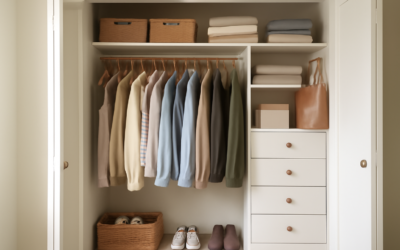
Most small closets waste half their volume, and it is almost always the same culprit: a single rod with a shelf perched above it, leaving three feet of dead air below the hanging clothes. The best small closet organizer ideas reclaim that vertical space and turn a cramped reach-in into a system that holds twice as much without adding a square inch of floor. You do not need a custom renovation to get there, just a plan that treats every inch, floor to ceiling and door to door, as usable real estate.
- Start With Small Closet Organizer Ideas That Go Vertical
- Modular Systems: Wire, Wood, and Track
- Use the Door and the Back Wall
- Shoe Storage That Does Not Eat the Floor
- Bins, Baskets, and Labels for the Top Shelf
- Small-Space Accessories That Punch Above Their Size
- Lighting a Small Closet
- Putting It All Together on a Budget
Start With Small Closet Organizer Ideas That Go Vertical
The first move in any tight closet is to think up, not out. A standard reach-in with a single rod at 66 inches wastes the space below short garments. Installing a second rod lets you double-hang shirts, folded pants, and jackets, instantly doubling hanging capacity for items under 40 inches long.
Set the upper rod around 80 to 84 inches and the lower rod around 40 to 42 inches, leaving room for both tiers of clothing. Reserve one section for long items like dresses and coats with a single full-height rod. This one change, splitting part of the closet into two hanging levels, typically adds the most capacity for the least money and effort.
Modular Systems: Wire, Wood, and Track
When you are ready to replace the builder-grade single shelf, a modular organizer system gives you flexibility. Three tiers exist at very different price points.
- Wire systems (ventilated shelving): $50 to $200 for a small closet, easy to install, airflow keeps clothes fresh. Brands like ClosetMaid dominate here.
- Track-based systems: a single wall-mounted rail holds adjustable shelves, rods, and baskets, letting you reconfigure as needs change, roughly $150 to $500.
- Wood or laminate towers: a finished, furniture-grade look with drawers and shelves, $300 to $1,200 for a small closet.
For most small closets, a track system hits the sweet spot: it is adjustable, cleaner-looking than wire, and far cheaper than custom millwork. Mount the track into studs and everything below hangs securely.
Use the Door and the Back Wall
The inside of the closet door is prime unused space. An over-the-door rack or a mounted organizer holds shoes, belts, scarves, or cleaning supplies without touching the closet interior. Slim over-door hooks handle bags and robes. For a swinging door, keep the profile thin so it does not catch the frame.
The back wall and side walls take adhesive or screw-in hooks, pegboard, and narrow shelves for folded items. A pegboard panel is especially handy for accessories, letting you rearrange hooks as your needs shift. Even a few well-placed hooks recover space that would otherwise sit empty.
Shoe Storage That Does Not Eat the Floor
Shoes pile up and swallow floor space fast. The fix is to lift them off the ground. A wall-mounted shoe shelf or a slim cubby tower keeps pairs visible and off the floor, freeing that zone for a hamper or seasonal bins. Angled shoe shelves show the toe of each pair and pack more into a shallow depth.
For sneakers and casual shoes, a stacked cubby or a tension-rod-and-hook combination works. Reserve clear stackable boxes for out-of-season or special-occasion pairs so they stay dust-free on a high shelf. The goal is simple: nothing on the floor except what genuinely belongs there.
Bins, Baskets, and Labels for the Top Shelf
The high shelf above the rod is perfect for items you reach for seasonally, but only if you contain them. Loose sweaters and bags become an avalanche; the same items in labeled bins stay tidy and pull down like drawers. Use matching bins for a clean look and label each one, spare linens, winter accessories, gift wrap, so you are not digging.
- Measure the shelf depth and height before buying bins so they fit snugly.
- Choose bins with handles for the highest shelves.
- Keep heavy items on lower shelves and light, infrequently used things up top.
- Label the front face of every bin, not the lid, so you can read them at a glance.
Fabric collapsible bins are cheap, around $8 to $15 each, and soften the look while corralling clutter.
Small-Space Accessories That Punch Above Their Size
A few inexpensive add-ons transform capacity. Slim velvet hangers take up roughly a third of the space of bulky plastic or wood hangers, so switching your whole closet to them can free several inches of rod length. Hanging shelf organizers add cubbies for folded items in a hanging section. Drawer dividers tame small accessories. A tension rod low in the closet creates a spot to hang spray bottles or clip skirt hangers.
Cascading or S-hook hangers let you hang multiple garments vertically from one hook, ideal for pants or tank tops. These small tools cost a few dollars each and compound: velvet hangers plus a second rod plus door storage together can nearly double what a closet holds.
Lighting a Small Closet
You cannot organize what you cannot see, and most small closets are dim caves lit, if at all, by a single bulb. Adding light transforms how usable the space feels and makes the contents easy to find. Battery-powered LED puck lights or motion-activated strip lights stick to the underside of a shelf or the top of the frame and switch on when the door opens, no wiring required, for $15 to $40 a set.
If the closet has a nearby outlet, a plug-in LED strip run along the top edge washes the whole space in even light and eliminates the shadows that hide dark clothing. Rechargeable motion-sensor bars are the easiest upgrade for a rental, since they peel off cleanly when you move. Good light also makes labels readable and keeps you from grabbing the navy shirt when you wanted black, a small thing that pays off every morning.
Organizing a small closet once is easy; keeping it organized is the real challenge, and it comes down to a couple of ongoing habits more than any single product you buy. The most effective of these is rotating your wardrobe with the seasons so the closet is never asked to hold everything you own at the same time. A closet stuffed to capacity with four seasons of clothing will defeat even the smartest shelving, because there is simply no room to see or reach anything. Homeowners who treat the closet as a living system, editing it a couple of times a year and moving off-season items out of the prime zone, are the ones whose closets still look tidy a year later. Think of the layout and accessories as the framework and the seasonal routine as the maintenance that keeps that framework working. Here is how to build that rhythm into your year without it becoming a chore.
A small closet stays organized only if it is not asked to hold four seasons of clothing at once. Rotating garments by season is the single habit that keeps a tight closet functional year-round. At each changeover, move off-season items, heavy coats in summer, shorts in winter, into labeled bins on the top shelf, under-bed containers, or a spare closet, freeing the prime hanging and shelf space for what you actually wear now.
Vacuum-seal bags shrink bulky comforters and puffer jackets to a fraction of their size for the top shelf. Twice a year, when you rotate, do a quick purge of anything you did not wear the previous season, because clutter creeps back the moment you stop editing. Keep a small donation bag on a hook and drop items in as you notice them. This ongoing discipline matters more than any single product; the best small closet organizer ideas only keep working if the closet is never overstuffed in the first place.
Putting It All Together on a Budget
You can transform a small reach-in in a weekend. Start by emptying it completely and purging what you do not wear, since organization cannot fix too much stuff. Then add a second rod, switch to slim hangers, mount a door organizer, lift the shoes off the floor, and contain the top shelf with labeled bins. That five-step plan runs $100 to $250 and often doubles usable capacity.
If you want a finished, adjustable result, invest in a track system and build it out over time. The best small closet organizer ideas are not about buying the most expensive system; they are about using the height, the door, and the walls that a builder-grade closet leaves empty. Treat every inch as storage, and even the tightest closet stops feeling small.