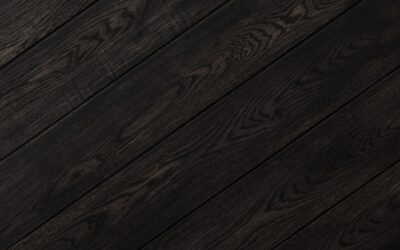
Unlike stained floors that rely on a surface pigment, smoked oak flooring gets its warm amber-to-chocolate tone from a kiln process that drives color into every cell of the board. Heat and limited oxygen react with the tannins in oak wood, producing rich honey browns to deep espresso depending on the intensity and duration of the smoke cycle. The result is a floor that resists fade better than any stained product, develops character without disguising the grain, and photographs beautifully under every lighting condition. This guide walks through how smoking works, the species and patterns available, realistic pricing, and the finish choices that preserve the look over decades.
How the Smoking Process Works
True smoking happens inside a sealed thermal chamber. Oak boards are held at 350°F to 450°F for 12 to 48 hours in a low-oxygen atmosphere. The heat breaks down tannins in the wood and drives browning reactions similar to what happens inside a roasting coffee bean or a seared steak. Longer exposure and higher temperatures produce darker final colors. Unlike fuming, which uses ammonia vapor, smoking does not leave chemical residues and is odorless after cooling.
The color change penetrates 1/8 inch to 3/16 inch into the board depending on process parameters. That means light sanding during a refinish reveals the same smoked tone underneath — unlike stained floors, where one pass with the drum sander exposes raw wood.
Smoked vs Fumed vs Stained
Smoked Oak
Color from heat. Even tone across every board. Dimensionally more stable because the thermal process also reduces internal moisture. Works with both natural oak and engineered construction.
Fumed Oak
Color from ammonia vapor reacting with tannins at room temperature. Deeper, more dramatic chocolate tones with gray undertones. Slightly more variation board-to-board. Takes 1 to 3 weeks of fuming for full color development.
Stained Oak
Surface pigment applied after milling. Unlimited color palette but only surface-deep. Scratches and wear reveal raw wood underneath. Refinishing requires re-staining to match.
For long-term color fidelity, smoked and fumed beat stained decisively. Fumed delivers darker final colors; smoked offers warmer amber and caramel tones.
Common Smoked Oak Styles
- Light Smoked Oak: Honey-amber with slight warmth. Kiln time 12 to 18 hours. Reads natural but elevated.
- Medium Smoked Oak: Rich caramel to chestnut. The most popular range. Kiln time 18 to 30 hours.
- Heavy Smoked Oak: Deep walnut-toned brown. Dramatic but still reads warm. Kiln time 30 to 48 hours.
- Smoked and Fumed Combo: Smoked first, then fumed for dramatic blackened-brown tones with maximum color depth.
Top Brands and Product Lines
DuChateau Atelier Smoked
European oak with a wire-brushed texture and UV-cured oil finish. Runs $12 to $18 per square foot for material. 8 inch wide planks in engineered construction.
Hakwood
Dutch manufacturer specializing in smoked, fumed, and combination finishes. Their Ade and Desa collections are widely specified in high-end US residential projects. $14 to $22 per square foot.
Lauzon Smoked Heritage
Canadian-made with Pure Genius air-cleaning finish. North American oak smoked for warm tones at a friendlier price point. $9 to $14 per square foot.
Mirage Admiration Smoked
Domestic availability with solid warranty support. Engineered construction, wide plank format. $10 to $15 per square foot.
Mafi Smoked
Austrian-made with natural hardwax oil finishes. Premium positioning at $18 to $28 per square foot.
Install Formats
Smoked oak comes in all standard formats. Wide plank (7 to 9 inches) dominates contemporary builds. Herringbone and chevron patterns in smoked oak are increasingly common in primary suites and formal dining rooms. Straight-lay is still the safest visual default.
Installation is identical to any engineered hardwood: floating over foam underlayment, glue-down over concrete with approved adhesive, or nail-down over plywood subfloor. Acclimate boxes for 3 to 5 days in the install room before cutting.
Pros of Choosing Smoked Oak
- Color does not fade. Thermal color penetrates the board, so UV exposure changes the color far less than stained wood.
- Refinishable without color loss. Sanding to clean the surface reveals the same smoked tone underneath.
- Dimensionally stable. The thermal process drives out residual moisture, reducing seasonal gapping and cupping.
- Natural wood character. Grain, knots, and figuring all come through. Never looks painted or artificial.
- Works with any design direction. Light smoked reads Scandinavian; heavy smoked reads traditional European. Versatile across styles.
Cons to Consider
- Premium pricing. Smoked oak costs 30 to 80 percent more than standard stained oak at comparable quality.
- Limited to oak and some ash. Hickory, maple, and walnut do not respond to thermal smoking the same way because of lower tannin content.
- Slightly more brittle after thermal treatment. Heavy smoking removes some flexibility; boards can chip at edges during rough installation.
- Spotting from water is more visible. Darker tones show white water rings from spills left overnight.
- Inventory is import-dependent. Many smoked oak products come from Europe; lead times of 6 to 12 weeks are common.
Installed Cost Ranges
Mid-tier engineered smoked oak runs $11 to $18 per square foot installed for straight-lay over a standard subfloor. Herringbone or chevron patterns add $3 to $5 per square foot in labor. Premium European imports like Hakwood or Mafi run $22 to $35 per square foot all-in. Custom wide plank exceeding 10 inches wide adds another $2 to $4 per square foot.
Expect subfloor prep to add $2 to $4 per square foot on concrete and $1 to $2 per square foot on wood subfloors requiring significant leveling.
Finish and Maintenance
Most smoked oak ships prefinished with UV-cured oil, hardwax oil, or water-based polyurethane. Oil finishes show more warmth and depth but need a re-oil every 3 to 5 years. UV-cured polyurethane is more set-and-forget, with 25+ year life.
Daily maintenance: dust mop or vacuum. Weekly: damp mop with Bona, Woca, or a manufacturer-specific cleaner. Never wax, never steam clean. Humidity between 35 and 55 percent. Felt pads on furniture, walk-off mats at exterior doors.
Bottom Line
Smoked oak flooring delivers the warm, rich European look that dominates high-end interiors, with better color fidelity than any stained alternative. It costs more up front than oak with a dark stain, but the color stays true across decades of sun, wear, and refinishing. For buyers who want depth without the fade risk of stain and without the full drama of fumed oak, smoked is the middle path that gets it right most often. Pick a reputable brand, plan for 6 to 12 week lead times on European imports, and commit to the finish maintenance schedule — and the floor will outlast multiple stain colors of the alternatives.
Prefer to explore on your own?
See how new flooring looks in your actual room in seconds — free, no signup.
Try the free Floor Studio →