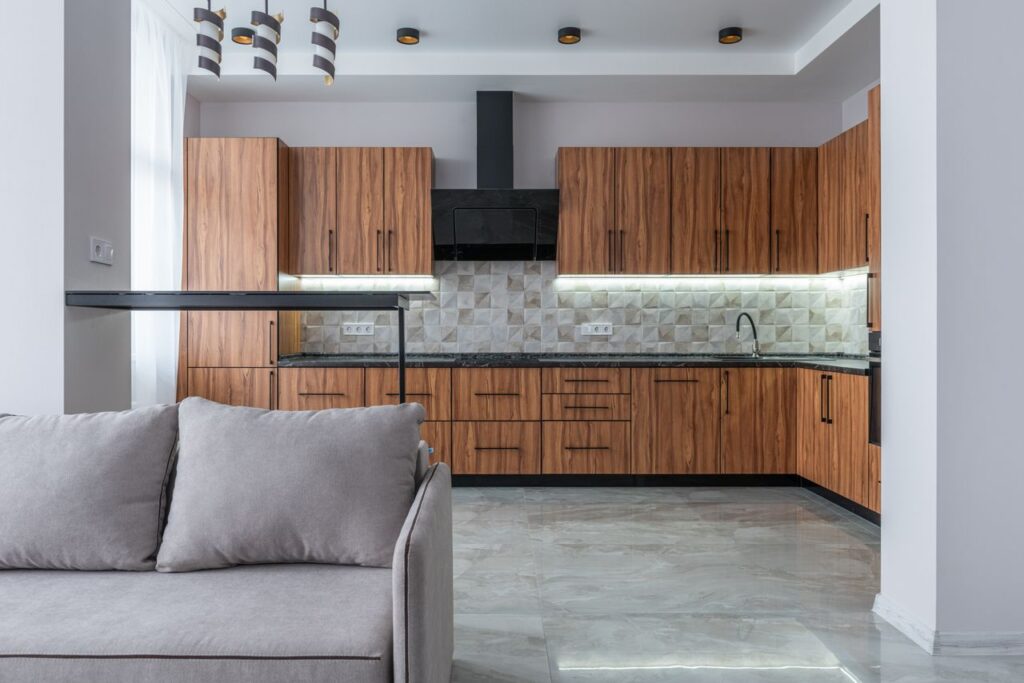
That satisfying, whisper-quiet way a high-end kitchen drawer glides shut on its own is not luxury magic, it is engineering you can add to almost any cabinet. Soft close cabinet hardware uses built-in hydraulic or pneumatic dampers to catch a door or drawer in the final inches of travel and ease it shut silently, eliminating slams, pinched fingers, and the long-term wear that banging causes. Once you live with it, the old slamming cabinets feel jarring by comparison.
Part of our Kitchen Remodeling guide — explore the full guide →
This guide covers the two main types of soft-close hardware, your retrofit options, how to install them, and what the upgrade costs.
How Soft Close Works
Every soft-close mechanism relies on a damper, a small piston filled with fluid or air that resists sudden motion. When you push a drawer or swing a door toward closed, the damper engages in the last inch or two, absorbing the momentum and slowing the movement to a gentle stop. No matter how hard someone shoves it, the door cannot slam.
This does more than reduce noise. It protects the cabinet joints and finish from repeated impact, keeps contents from shifting, and prevents the classic pinched fingertip. For households with kids, the finger-safety benefit alone justifies the upgrade.
The Two Main Categories
Soft-close hardware breaks into two families, matching the two ways cabinets open.
- Soft-close hinges: For doors. The damper is built into the hinge arm or added as a small adapter. European concealed hinges with integrated soft-close are the standard.
- Soft-close drawer slides: For drawers. Undermount slides with a damper at the back gently pull the drawer closed over the last stretch of travel.
You will typically want both to convert an entire kitchen: hinges for the upper and lower doors, slides for every drawer. Many homeowners tackle the drawers first since a slamming drawer full of silverware is the loudest offender.
Retrofit Versus Full Replacement
You do not always have to replace the whole hinge or slide. There are add-on dampers designed to bring soft-close to hardware you already own.
- Clip-on hinge dampers: Small cylinders that snap onto existing European hinge arms, adding soft-close for about $2 to $5 per door. A five-minute, no-tools upgrade.
- Adhesive or screw-on door dampers: Tiny pistons mounted inside the cabinet frame that cushion the door as it closes. Good for older hinge styles that cannot accept clip-ons.
- Full hinge replacement: Swapping in complete soft-close concealed hinges, best if your current hinges are worn or non-adjustable.
- Full slide replacement: Replacing drawer slides with undermount soft-close slides, which also upgrades you to full-extension travel.
Clip-on dampers are the fastest, cheapest path if you have modern concealed hinges. If your cabinets use old-style face-frame or wraparound hinges, full replacement usually gives a cleaner result.
Choosing Quality Hardware
Not all soft-close hardware performs equally, and the difference shows within a year. Look for hinges and slides rated for a high cycle count, ideally 50,000 open-close cycles or more. Premium brands like Blum, Grass, and Hettich set the benchmark for smoothness and longevity, though solid mid-range options cost less and satisfy most kitchens.
For drawer slides, decide on weight rating and extension. Standard slides handle 75 to 100 pounds; heavy pull-out pantries and trash bins want 100 to 120 pound ratings. Full-extension undermount slides let you reach the very back of the drawer and hide completely beneath the box for a clean look.
Installing Soft-Close Hinges
- For clip-on dampers, simply snap the damper onto the existing hinge arm and adjust its intensity dial if it has one. No tools needed.
- For full hinge replacement, remove the old hinge, noting the overlay and mounting plate style.
- Fit the new hinge cup into the 35mm bore in the door and screw it in.
- Attach the mounting plate to the cabinet frame, then clip the hinge onto the plate.
- Use the three adjustment screws to align the door with even 1/8-inch gaps.
Installing Soft-Close Slides
Replacing drawer slides is more involved. Remove the drawer, unscrew the old slides from both the drawer box and cabinet, then mount the new undermount slides to the cabinet sides, level and square. Attach the locking devices to the underside of the drawer box, slide it back in, and adjust the tilt and depth so the front sits flush. Measure carefully, since undermount slides demand precise drawer box dimensions to function.
What It Costs
Soft-close upgrades scale with how far you go. Clip-on hinge dampers cost $2 to $5 each, so converting 20 doors runs $40 to $100. Full soft-close concealed hinges run $3 to $8 apiece. Undermount soft-close slides cost $15 to $40 per pair. Outfitting an entire midsize kitchen with new soft-close hinges and slides typically totals $200 to $500 in parts if you do the labor yourself. Hiring a handyman adds $200 to $500 in labor. The clip-on damper route is by far the cheapest way to quiet an existing kitchen.
Adjusting and Fine-Tuning Soft Close
One of the underappreciated features of quality soft-close hardware is adjustability. Many soft-close hinges include a small dial or switch on the hinge arm that lets you set the closing intensity to one of two or three levels. Lightweight doors need a gentler setting so they still travel far enough to latch, while heavy solid-wood doors need the firmest setting to control their greater momentum. If a door starts closing but stops an inch short, back the intensity off; if it still closes too fast, dial it up.
Drawer slides have their own adjustments. Undermount soft-close slides typically offer tilt, depth, and side-to-side adjustment via small levers or screws near the drawer front. After installing, open and close each drawer several times, watch how the front lines up with its neighbors, and tweak until the reveals are even. Spend ten minutes per bank of drawers on this and the whole kitchen looks factory-built. Skipping the adjustment step is why some DIY installs look slightly off even with premium parts.
Troubleshooting Common Problems
When soft-close hardware misbehaves, the cause is usually simple. A door that slams despite a soft-close hinge often has a damper set too light for its weight, or a clip-on damper that has popped loose. A drawer that no longer self-closes may have a damaged or worn-out damper cartridge, which on quality slides can be replaced individually rather than swapping the whole slide.
Cold temperatures also affect performance, since the fluid inside the damper thickens in an unheated garage or cabin, making the close feel sluggish until the space warms up. If a mechanism fails entirely within its first year, check the manufacturer warranty, because premium brands like Blum back their hardware for the life of the cabinet. Most issues, though, come down to a loose screw, a misadjusted intensity dial, or a slide that has drifted out of square, all of which take minutes to correct.
Is It Worth It?
Few small upgrades deliver as much daily satisfaction per dollar as soft-close hardware. It silences the constant banging of a busy kitchen, protects your cabinets from years of impact wear, and removes a real pinch hazard for small hands. If your cabinets already have modern concealed hinges, clip-on dampers make the doors quiet for pocket change in an afternoon. If you are willing to invest more, full soft-close hinges and undermount slides bring your kitchen up to the standard of custom cabinetry. Start with the noisiest drawers, feel the difference, and you will likely convert the whole kitchen before long. Whichever route you choose, prioritize quality hardware rated for a high cycle count, take the time to adjust each door and drawer for even reveals, and you will enjoy quiet, gentle-closing cabinets that feel every bit as refined as a custom kitchen.