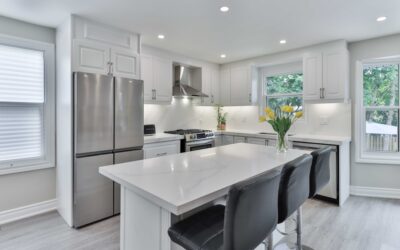
For a clean, minimalist kitchen with no visible handles, push to open cabinet hardware is the mechanism that makes handleless design possible. A light touch releases the door or drawer, which pops open enough to grab. This guide explains the types, how they install, what they cost, and how to keep them working smoothly so your handleless kitchen stays as effortless as it looks.
Part of our Kitchen Remodeling guide — explore the full guide →
- How Push to Open Works
- Magnetic vs Mechanical Systems
- Push to Open for Doors vs Drawers
- Compatibility With Soft-Close
- Typical Costs
- Installation Basics
- Adjusting the Mechanism
- Advantages of Going Handleless
- Drawbacks to Consider
- Maintenance and Longevity
- Troubleshooting Common Problems
- Best Applications for Push-to-Open
- Choosing the Right Spring Strength
- Combining With Handleless Design
- Retrofitting Existing Cabinets
- Frequently Asked Questions
- Longevity Compared to Handles
- The Bottom Line
How Push to Open Works
The system relies on a spring-loaded catch mounted inside the cabinet. When you press the closed door, the catch releases and a spring pushes the door outward an inch or so, enough to slip your fingers behind it. Push it closed again and the catch latches. On drawers, the mechanism mounts to the slide or the back of the cabinet and works on the same press-to-release principle.
Magnetic vs Mechanical Systems
There are two main technologies. Mechanical push latches use a spring and a heart-cam catch, the same principle as a retractable pen, and they are inexpensive and reliable. Magnetic push latches use a magnet to hold the door and a spring to eject it, offering a smoother, quieter action and often better durability. Magnetic systems typically cost more but feel more refined and resist wear over many thousands of cycles.
Push to Open for Doors vs Drawers
Doors usually use a simple push latch screwed to the cabinet interior that engages a strike plate on the door. Drawers more often use push-to-open drawer slides, where the entire slide mechanism has the spring built in, or a separate push mechanism mounted behind the drawer box. Drawer systems must be rated for the drawer’s weight, so heavy pot drawers need heavier-duty push slides than light utility drawers.
Compatibility With Soft-Close
A common question is whether push-to-open works with soft-close. The two can conflict, because soft-close resists the outward pop that push-to-open needs. Manufacturers solve this with integrated push-to-open soft-close slides that combine both: press to launch the drawer, and it glides shut gently. If you want both features, buy a hardware system designed to pair them rather than mixing incompatible parts.
Typical Costs
Basic mechanical push latches for doors cost just 2 to 6 dollars each. Magnetic push latches run 5 to 15 dollars. Push-to-open drawer slides cost 15 to 40 dollars per pair, and combined push-to-open soft-close slides can reach 30 to 60 dollars per pair. Outfitting a full handleless kitchen adds a few hundred dollars over standard hardware, a modest premium for the streamlined look and the elimination of pulls.
Installation Basics
Door push latches mount to the cabinet side or top with two screws, positioned so the latch aligns with a strike plate on the door’s back. Precise placement is critical; too shallow and the door will not latch, too deep and it binds. Drawer push slides replace standard slides entirely and mount to the cabinet sides and drawer box like any slide. Always follow the manufacturer’s drill template for consistent depth.
Adjusting the Mechanism
Most quality push latches have an adjustment screw that sets how far the door pops open and how much pressure triggers release. If doors open too aggressively or barely crack, turn the adjuster in small increments until the action feels right. Magnetic systems may let you tune the hold strength. Taking time to fine-tune each latch is what separates a satisfying handleless kitchen from a frustrating one.
Advantages of Going Handleless
Beyond the sleek, uninterrupted cabinet faces, push-to-open kitchens are easier to clean with no pulls to wipe around, safer with no protruding hardware to snag clothing or bruise hips, and fully accessible for anyone who struggles to grip a knob. The look suits modern, European, and minimalist designs where flat-slab doors and continuous lines are the goal.
Drawbacks to Consider
Handleless design is not without trade-offs. Fingerprints show on the push points, especially on high-gloss or dark doors, so frequent wiping is needed. Mechanisms can wear or fail over years of use, requiring replacement. Accidentally leaning on a cabinet can pop it open, and heavily loaded drawers may need a firmer push. Some users simply prefer the tactile certainty of a real handle.
Maintenance and Longevity
Push mechanisms are low-maintenance but benefit from occasional attention. Wipe the push zones to prevent grease buildup that gums up the action. If a latch starts sticking, a tiny amount of dry lubricant on the moving parts restores smoothness. Quality magnetic and mechanical latches are rated for tens of thousands of cycles, so with light care they easily last the life of the kitchen.
Troubleshooting Common Problems
If a door will not stay closed, the latch is likely too far from the strike plate; move it closer. If a door pops open too far or too weakly, use the adjustment screw. A drawer that will not launch may be overloaded beyond the slide’s rating or misaligned. A latch that no longer catches has usually worn out and should be replaced, an inexpensive fix taking only minutes.
Best Applications for Push-to-Open
Push-to-open shines in specific situations. It is ideal for flat-slab modern and European kitchens where visible hardware would break the clean lines, and for cabinets in tight spaces where a protruding handle would be awkward. It also suits appliance garages, toe-kick drawers, and hidden trash pull-outs where you want a seamless face. Where it works less well is on very heavy drawers, on cabinets people frequently lean against, and in homes with users who prefer the certainty of a physical grip.
Choosing the Right Spring Strength
Push mechanisms come in different spring or magnet strengths rated for various door and drawer weights. A lightweight upper door needs only a gentle latch, while a large pantry door or a heavy drawer full of cookware requires a stronger mechanism, sometimes two latches spaced apart, to launch reliably. Matching the strength to the load prevents the frustration of a heavy drawer that will not pop open or a light door that flies open at the slightest bump.
Combining With Handleless Design
Push-to-open is the enabling technology behind fully handleless kitchens, but it is not the only route. Some designs pair push mechanisms with subtle finger grooves routed into the door edge or with continuous J-channel rails that give a discreet grip. Deciding early whether you want a pure touch-latch kitchen or a hybrid with hidden grips affects your door construction and hardware order, so plan the entire opening strategy together for a consistent, cohesive result.
Retrofitting Existing Cabinets
You do not need new cabinets to enjoy push-to-open. Door push latches retrofit easily onto existing cabinets: simply mount the latch inside the box and remove the old handles, filling and touching up the screw holes. Drawers are trickier, since converting to push-to-open often means swapping the slides for push-to-open versions, a bigger job than a door latch. For a handleless refresh on a budget, start with the doors using inexpensive push latches, then upgrade drawer slides over time as your budget allows.
Frequently Asked Questions
Can push-to-open work with soft-close? Yes, with combined push-to-open soft-close slides made for it. Do mechanisms wear out? Eventually, but quality ones last tens of thousands of cycles. Are they hard to install? No, they mount with screws and a drill template. Do fingerprints show? Yes, on the push zones, so plan to wipe them, especially on glossy doors.
Longevity Compared to Handles
A fair question is whether a mechanism that can fail is worth choosing over a simple handle that never breaks. In practice, quality push-to-open latches are rated for tens of thousands of cycles and often outlast the kitchen’s finish, and when one does wear out, replacing a two-dollar mechanical latch takes minutes. The trade-off is accepting occasional maintenance in exchange for the clean, handleless aesthetic. For most homeowners drawn to the look, that is an easy bargain, especially since the replacement parts are cheap and universally available.
The Bottom Line
Choosing push to open cabinet hardware unlocks the clean, handleless kitchen many homeowners want, with easier cleaning, no protruding pulls, and a distinctly modern look. Pick magnetic or combined soft-close systems for the smoothest action, install to the manufacturer’s template, and fine-tune each latch. Do that, and your handleless cabinets will open with a satisfying, effortless press for years.