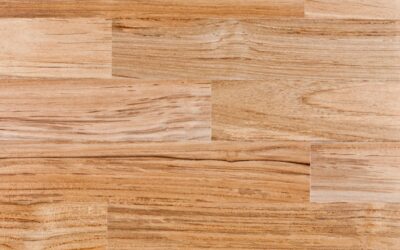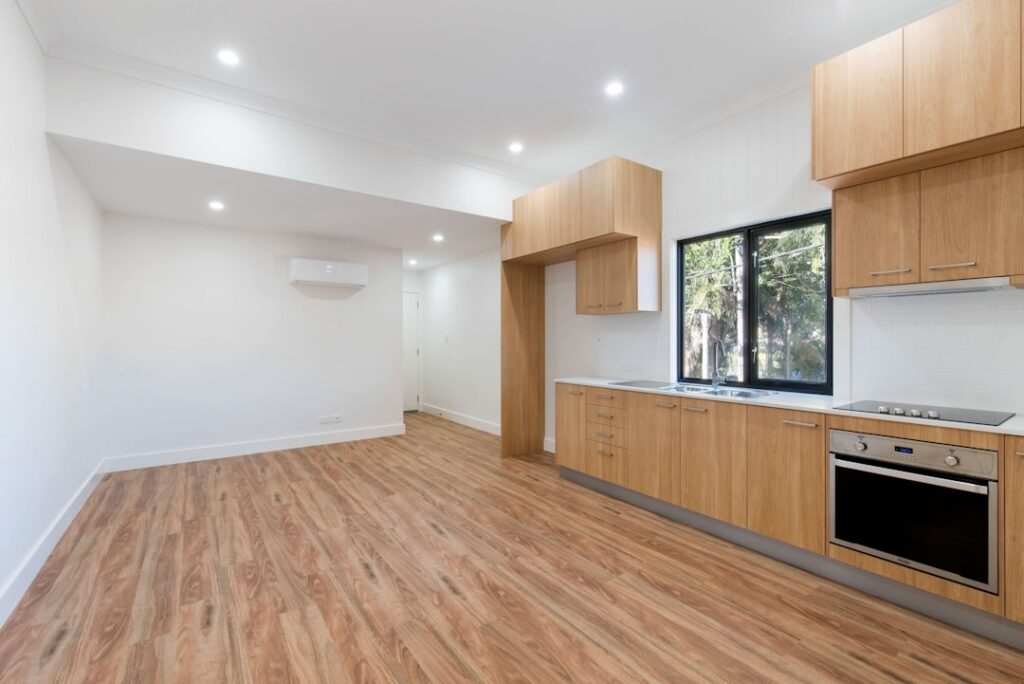
Spotted gum hybrid flooring recreates one of Australia’s most recognizable hardwoods as a waterproof, rigid-core plank that installs with a simple click-lock system. Real spotted gum is a dense eucalyptus timber prized for its dramatic color range, from pale honey through chocolate brown with streaks of red, and its tight, wavy grain. Hybrid flooring captures that look in a printed wear layer over a stone-plastic or wood-plastic core, giving US homeowners a low-maintenance floor that handles spills, kids, and pets without the cost or upkeep of solid eucalyptus boards.
What Hybrid Flooring Is
Hybrid flooring is a category that emerged from Australia and sits between luxury vinyl and laminate. A typical plank has four parts: a backing layer, a rigid core made of either stone-plastic composite (SPC) or wood-plastic composite (WPC), a high-resolution printed decor layer that mimics real timber, and a clear, scratch-resistant wear layer on top, usually finished with an embossed texture that you can feel as well as see. The result is a board that is fully waterproof, dimensionally stable, and rigid enough to span minor subfloor imperfections.
The spotted gum version simply uses a decor print modeled on the genuine timber. Good manufacturers photograph real boards and vary the print across multiple plank designs so the floor does not show an obvious repeating pattern. Because the visual is a printed image protected by a tough wear layer, you get the distinctive spotted gum coloring without the natural timber’s sensitivity to moisture and scratching.
Why Spotted Gum Is Popular
As a real wood, spotted gum is one of the hardest and most durable eucalyptus species, with a Janka hardness well above North American red oak. Its appeal in flooring is the warm, complex color and the subtle wave in the grain that gives rooms a high-end, natural feel. Translating that into a hybrid plank brings the aesthetic to spaces where real hardwood would struggle, such as kitchens, laundries, and below-grade rooms.
The color also happens to be forgiving. The mid-to-dark brown tones with reddish flecks hide dust, pet hair, and light scratches better than uniform pale or very dark floors. That practicality, combined with the waterproof core, is why spotted gum is one of the most requested decors in the hybrid category.
The Main Advantages
- Fully waterproof core, suitable for kitchens, bathrooms, and basements
- Click-lock installation that floats over most existing hard floors
- Tough wear layer that resists scratches, dents, and fading
- Stable across temperature swings, with no acclimation drama of solid wood
- Low maintenance, cleaned with a damp mop and no refinishing required
- The premium spotted gum look at a fraction of solid-timber cost
Many hybrid planks include a pre-attached acoustic underlay, which softens footfall sound and adds a little warmth and cushioning underfoot compared with bare SPC. That built-in pad also simplifies installation, since you skip rolling out a separate underlayment.
The Honest Drawbacks
It is not real wood, and a discerning eye up close can tell. The texture is convincing but uniform, and unlike genuine spotted gum, a hybrid floor can never be sanded back and refinished. When the wear layer eventually wears through or the floor dates, the fix is replacement, not restoration. That makes the wear-layer thickness, measured in mils, an important durability spec to compare.
Quality varies enormously. Cheap hybrid planks with thin wear layers and low-grade cores can scratch, gap at the joints, or show impressions from heavy furniture. Very large windows that bake the floor in direct sun can cause some products to expand or fade if they are not rated for it. And while the core is waterproof, water that seeps through the seams can still sit on the subfloor, so spills should not be ignored indefinitely.
SPC vs WPC Cores
The biggest buying decision is core type. SPC, the stone-plastic composite, is denser, thinner, harder, and more resistant to dents and heat, which makes it the better pick for sunny rooms, heavy furniture, and commercial-grade durability. WPC, the wood-plastic composite, is slightly thicker and softer, so it feels a touch warmer and quieter underfoot but is more prone to indentation.
For most US homes with active families, an SPC spotted gum hybrid with a wear layer of at least 0.5mm, around 20 mil, offers the best blend of toughness and value. If comfort and sound are your priority and the room is shaded, a WPC plank or an SPC plank with a thick attached acoustic pad can be the nicer floor to walk on.
What It Costs
In the US market, spotted gum hybrid flooring typically ranges from about $3 to $7 per square foot for the planks, with premium lines featuring thicker wear layers and longer warranties pushing toward $8 or $9. Because it is a floating click-lock floor, installation is comparatively affordable, often $1.50 to $4 per square foot if you hire a pro, and many confident DIYers install it themselves for the cost of a few tools.
Budget for transition strips, trim, and about 7 to 10 percent overage for cuts. Factor in subfloor prep too, since a floating floor still needs a clean, dry, and reasonably flat base. Compared with installing and finishing genuine spotted gum hardwood, the hybrid route commonly saves well over half the total project cost.
Installation Tips
Hybrid planks float, meaning they are not glued or nailed to the subfloor; they lock to each other and move as one surface. The subfloor should be flat to within about 3/16 inch over 10 feet, clean, and dry. Leave an expansion gap of roughly 8 to 10mm around the room perimeter and around fixed objects, then cover it with baseboard or quarter-round. Large rooms may need an expansion joint, so check the manufacturer’s maximum run length.
Let the planks acclimate in the room for the recommended time, often 24 to 48 hours, so they adjust to the home’s temperature. Stagger the end joints between rows by at least 8 to 12 inches for a strong, natural-looking layout, and use a tapping block rather than hitting the planks directly to avoid damaging the locking edges.
Care and Maintenance
Maintenance is one of the strongest selling points. Sweep or vacuum to remove grit, then damp-mop with a pH-neutral floor cleaner. Skip wax, polish, and steam mops, since the floor never needs refinishing and excessive heat or moisture can harm the wear layer. Felt pads under furniture and walk-off mats at entries protect the surface from the abrasive debris that causes most visible wear.
Wipe spills reasonably promptly, and for sunny rooms use blinds or UV-filtering window film to limit fading and heat expansion. With this basic routine, a quality spotted gum hybrid floor holds its appearance for 15 to 25 years.
Is Spotted Gum Hybrid Right for You?
This floor suits homeowners who love the warm, characterful look of spotted gum timber but want a waterproof, low-maintenance, budget-friendly surface that stands up to real family life. It is ideal for kitchens, basements, busy living areas, and anywhere a solid hardwood would be impractical. If you specifically want a floor you can sand and refinish for generations, or you can tell printed decor from real grain and that bothers you, genuine hardwood remains the better fit. For everyone else, a mid-grade SPC spotted gum hybrid delivers an impressive amount of style and durability for the money, and D and G Flooring can help you compare wear layers and core types to find the right match.
Prefer to explore on your own?
See how new flooring looks in your actual room in seconds — free, no signup.
Try the free Floor Studio →