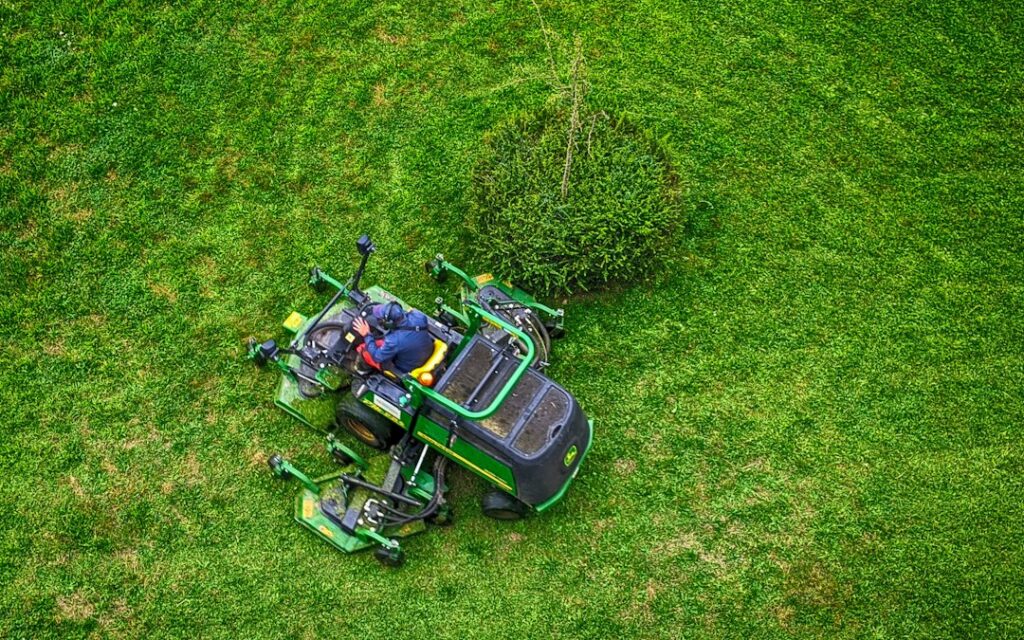
Drive past a landscaping crew mowing a commercial property and you’ll increasingly see the operator standing rather than sitting, riding a compact platform behind a wide deck. That’s a stand up lawn mower, and while it started as a pro tool, larger-property homeowners are catching on. Standing gives you better sightlines, faster on-and-off for gates and trailers, and a shorter machine that fits where a sit-down zero-turn won’t. If you’re mowing an acre or more and want commercial-grade speed, this class deserves a serious look.
What a Stand-On Mower Actually Is
A stand-on mower, sometimes called a stand-up or stander, is a zero-turn mower where the operator stands on a rear platform instead of sitting in a seat. Dual lap bars control the two independent hydrostatic drive wheels, letting the machine pivot in place just like a sit-down zero-turn. The key difference is the footprint: eliminating the seat and legroom shortens the machine by a foot or more, making it far more nimble in tight spaces.
Because you’re standing, your center of gravity shifts and your eyes sit higher, giving you a commanding view of the deck edge and any obstacles. Landscapers love this for trimming close to beds and fences without scalping.
Why Stand On Instead of Sit Down
The advantages go beyond a better view. Several practical factors drive the popularity of standers among crews and demanding homeowners.
- Faster on and off — you step off in a second to move a branch or open a gate, then step back on. On a property with lots of stops, this saves real time.
- Better traction and control on slopes — shifting your weight helps the machine grip, and standing lets you react quickly on uneven ground.
- Smaller footprint — fits more machines on a trailer and squeezes through 36-inch gates that stop a full sit-down rider.
- Less operator fatigue on rough ground — your legs absorb bumps like natural shock absorbers, whereas a seat transmits every jolt to your spine.
Deck Sizes and Cutting Speed
Stand-on mowers come in decks from 32 to 61 inches, with 48 and 52 inches being the most common. Ground speeds reach 8 to 11 mph on commercial models, meaning a stander can clear more grass per hour than most homeowner sit-down zero-turns. A 52-inch deck running at 8 mph covers roughly 3 to 4 acres per hour under real-world conditions with turns and overlap.
For a homeowner, a 36 to 48-inch deck is usually the right call. It fits through gates, stores in a normal garage bay, and still cuts a one-to-three acre property quickly. The 60-inch decks are built for large commercial lots and are overkill for most residential yards.
Gas vs. Battery Standers
Most stand-on mowers still run gas engines from Kawasaki, Kohler, or Briggs & Stratton in the 20 to 37 horsepower range, chosen for their durability under daily commercial abuse. But battery-electric standers are arriving, offering quiet operation and zero emissions with run times that now stretch to a full residential mowing session. If you mow your own property a couple times a week, an electric stander eliminates gas, oil, and maintenance headaches. If you’re running a crew all day, gas still wins on refuel-and-go endurance.
What They Cost
Standers are commercial machines, and the prices reflect that build quality:
- $5,000 to $7,000 — entry-level homeowner-friendly standers with 36 to 48-inch decks.
- $7,000 to $10,000 — mid-range commercial models with larger decks and premium engines.
- $10,000 to $14,000+ — top-tier machines from Wright, Scag, Toro, and Ferris built for eight-hour days.
Wright Manufacturing essentially invented the category with its Stander line, and Scag, Toro (GrandStand), and Ferris all make well-regarded competitors. For a homeowner, the entry-level tier delivers commercial toughness at the lowest price of admission.
Who Should Buy One
A stand-on mower makes the most sense for homeowners with one to five acres who have gates, tight corners, or slopes that a bulky sit-down zero-turn handles awkwardly. It’s also ideal if you value durability and plan to keep the machine for 15-plus years, since commercial builds outlast homeowner-grade riders many times over. If your property is flat, wide open, and obstacle-free, a cheaper sit-down zero-turn may serve you just as well for less money and more seated comfort on long runs.
Learning to Ride One
Standers have a short learning curve if you’ve never used lap-bar controls. The bars are sensitive: pushing both forward drives you ahead, and pulling one back pivots you that direction. New operators tend to jerk and overcorrect for the first hour, then it clicks. A few tips smooth the transition:
- Start in an open area at low speed until the lap bars feel natural.
- Make gradual, sweeping turns at first rather than sharp pivots that can tear turf.
- Keep your knees slightly bent to absorb bumps and maintain balance.
- Slow down before turns to avoid skidding the drive tires and gouging the lawn.
Comparing Stand-On to Sit-Down Zero-Turns
The closest competitor to a stand-on mower is a conventional sit-down zero-turn, and the two share the same lap-bar controls and pivot-in-place capability. The differences come down to ergonomics, footprint, and price. A stand-on is roughly a foot shorter, fits more machines per trailer, and lets you dismount instantly, which is why commercial crews with many stops favor them. A sit-down, by contrast, is more comfortable over long, uninterrupted runs of open grass, since standing for two straight hours does tire your legs.
For a homeowner deciding between the two, the honest guide is this: if your property has lots of gates, obstacles, and reasons to hop off frequently, the stand-on wins. If it’s wide-open acreage where you’ll sit and cover ground for an hour at a stretch, the sit-down’s seat is worth having. Both cut at similar speeds and quality, so the choice is really about how you move around your particular yard.
Durability and Long-Term Value
Standers are built to commercial standards, and that construction is a big part of their appeal even to homeowners. Where a homeowner-grade lawn tractor might use stamped-steel decks and lighter spindles rated for a couple hundred hours a year, a stander typically features:
- A heavy fabricated or reinforced steel deck that resists bending and cracking.
- Commercial hydrostatic drive systems built for thousands of hours of use.
- Durable engines from Kawasaki or Kohler designed for daily commercial abuse.
- Greasable spindles and heavy-duty bearings that outlast sealed homeowner units.
The payoff is longevity. A stander that a landscaper would wear out in five years of daily use might last a homeowner 20 years or more, since residential hours are a fraction of commercial ones. That durability helps justify the higher upfront price for anyone planning to keep the machine for the long haul rather than replacing a cheap rider every several seasons.
Maintenance and Upkeep
Commercial-grade construction means a stand-on mower rewards regular maintenance with a very long service life. The routine is similar to any quality zero-turn but worth staying on top of given how hard these machines can work. Keep the following schedule and the mower will run reliably for years:
- Change the engine oil and filter after the first 8 hours, then every 50 hours or annually on gas models.
- Grease the spindles and pivot points at the intervals in the manual, since greasable fittings are a durability advantage you should actually use.
- Sharpen or replace the blades every 25 hours for a clean cut, and keep a spare set on hand.
- Check and adjust the drive belt tension periodically, as a slipping belt robs power and wears prematurely.
- Rinse the deck underside after each mow and check the hydraulic fluid level on the drive system.
On battery-electric standers the list shrinks considerably, with no oil, filters, or belts driven by an engine to service, leaving mostly blade sharpening, deck cleaning, and battery care. That reduced upkeep is one more reason the electric models are gaining ground among homeowners who’d rather mow than wrench.
The Bottom Line
A stand up lawn mower brings commercial speed, durability, and maneuverability to homeowners who need more than a lawn tractor and want a machine that fits through gates and handles obstacles with ease. Pick a 36 to 48-inch deck for residential use, decide between gas endurance and battery quiet based on how you mow, and expect to spend $5,000 or more for a build that will outlast several homeowner riders. For the right property, standing up is a genuinely better way to mow.