A LEED Platinum office in Portland I helped spec last year saved $61,000 in lifetime energy costs largely because of the floor — not the HVAC. Sustainable commercial flooring is the most under-leveraged decision in green building, because the right choice cuts embodied carbon, indoor VOCs, and replacement cycles all at once. After certifying three commercial projects under LEED v4.1 and one WELL v2 facility, I can tell you the marketing labels and the third-party data tell different stories.
- What "Sustainable" Actually Means in a Spec
- Cork: The Underrated Workhorse
- Linoleum: The 160-Year-Old Sleeper
- Recycled Rubber: Fitness, Industrial, and Behind-the-Counter
- Bamboo and Reclaimed Wood: Aesthetic-Driven Sustainability
- Subfloor Prep and Adhesive Choices Matter
- Maintenance Cycles That Preserve the Sustainability Math
- Choosing the Right Sustainable Commercial Flooring
- Frequently Asked Questions
What “Sustainable” Actually Means in a Spec
The term covers four overlapping criteria: low-VOC content (FloorScore or Greenguard Gold certified), high recycled content (post-consumer percentage matters more than post-industrial), rapidly renewable raw materials (cork, bamboo, linoleum), and Cradle-to-Cradle or Declare Label transparency. A product can hit one box and miss the other three.
Pull the EPD (Environmental Product Declaration) before spec’ing. If the manufacturer doesn’t publish one, the embodied carbon claim is marketing copy, not data. EPDs covering A1-A3 modules are table stakes for any project chasing LEED MR credits.
Cork: The Underrated Workhorse
Portuguese cork is harvested from oak bark on a 9-year cycle without killing the tree, which is why it scores well on the Forest Stewardship Council audits. Commercial-grade cork plank — Wicanders Hydrocork or Amorim ArtComfort — runs $4.50 to $7.80 per sq ft installed.
It’s softer underfoot than vinyl, which matters in retail and healthcare where staff stand 8+ hours. Acoustical performance is the bonus: cork drops impact noise 18-22 dB versus a 6-dB drop for LVT. Service life lands at 25-40 years with proper sealer maintenance every 5-7 years.
- FloorScore and Greenguard Gold certified
- 30-50% recycled cork content in most commercial lines
- R-value: 0.85 — about 4x better than ceramic tile
- Best fit: offices, libraries, boutique retail, healthcare admin
Linoleum: The 160-Year-Old Sleeper
Real linoleum (not vinyl) is made from linseed oil, pine rosin, wood flour, cork dust, and limestone on a jute backing. Forbo Marmoleum and Tarkett Linosom dominate the commercial market at $5.20 to $8.40 per sq ft installed. The biocide content is naturally antibacterial — hospitals have specified linoleum for over a century for that reason.
Embodied carbon hits roughly 1.4 kg CO2e per square meter for Marmoleum versus 8.6 kg for sheet vinyl. The trade-off is sensitivity to alkaline cleaners; janitorial staff need pH-neutral chemicals or the surface ambers and softens within 18 months.
Recycled Rubber: Fitness, Industrial, and Behind-the-Counter
Tire-derived rubber with up to 95% post-consumer content — Ecore Performance, Nora Norament — runs $7.00 to $14.50 per sq ft installed. The wear layer survives 25-40 years under rolling loads, which is why hospitals, transit hubs, and FedEx sort facilities standardize on it.
The smell is the main complaint. New install off-gases for 10-21 days, and even certified low-VOC products carry a faint tire odor in low-airflow rooms. Specify a 90-day flush-out before occupancy in any space chasing WELL air quality credits.
Bamboo and Reclaimed Wood: Aesthetic-Driven Sustainability
Strand-woven bamboo runs $4.80 to $9.50 per sq ft installed and tests harder than red oak on the Janka scale (around 3,000 lbf for top brands like Cali Bamboo Fossilized). The catch: 80% of commercial bamboo comes from China, and shipping eats most of the carbon savings unless you’re west of the Rockies.
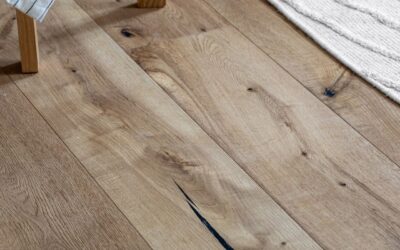
Reclaimed oak, heart pine, and Douglas fir from deconstructed buildings or wine barrels run $11 to $26 per sq ft installed. The carbon math is excellent — you’re sequestering material instead of harvesting it — but supply is unpredictable. Specify a 16-week lead time minimum and a 12% overage allowance because the boards are not dimensionally consistent.
Subfloor Prep and Adhesive Choices Matter
The greenest finished floor turns into a VOC factory if it sits on a solvent-based adhesive or a moisture-cured urethane. Specify a low-VOC pressure-sensitive acrylic adhesive (under 50 g/L VOC) or a wet-set water-based product. Forbo L885 and Mapei Ultrabond ECO 711 are standard on most LEED projects.
Concrete moisture must test below 3 lbs CaCl per 1,000 sq ft or below 75% RH. Failed slabs need a moisture mitigation system, which adds $1.80 to $3.50 per sq ft and brings its own embodied carbon — worth weighing against switching to a dry-laid modular tile system instead.
Maintenance Cycles That Preserve the Sustainability Math
Cork needs a polyurethane top coat refresh every 5-7 years at $0.45-$0.85 per sq ft. Linoleum gets a polish strip and reapplication annually at $0.18-$0.32 per sq ft. Rubber requires only damp mopping with neutral cleaner — no waxing, no buffing.
The lifecycle math is what makes sustainable commercial flooring pencil out: a $7 per sq ft cork floor with 30-year service life costs less per year than a $3.50 LVT replaced at year 12. Add the WELL certification points and the tenant retention bump, and the green spec usually wins on a 10-year hold.
Choosing the Right Sustainable Commercial Flooring
Match the certification stack to the project’s actual goals. Chasing LEED only? Prioritize EPDs, recycled content, and FloorScore. Chasing WELL? Prioritize VOC emissions and acoustics. Chasing a corporate ESG report? Specify Declare Red List Free or Cradle-to-Cradle Silver minimum. Don’t chase every label at once — you’ll triple the budget and confuse the procurement team. Pick the two or three metrics that align with the tenant’s brand, document them with manufacturer data, and the floor will deliver on the promise for the full 25-40 year service life.
Frequently Asked Questions
Is carpet tile a sustainable commercial flooring option?
It can be. Carpet tile with recycled nylon face fiber, recycled-content backing and a published EPD scores well, and many manufacturers run take-back programs that recycle old tiles instead of landfilling them. Because worn or stained tiles are replaced one at a time, the whole floor lasts longer. Look for CRI Green Label Plus for low emissions and use a low-VOC or adhesive-free installation.
Is polished concrete a sustainable flooring choice?
Yes, where the structural slab already exists. Polishing the slab adds almost no new material, needs no adhesive, and is maintained with damp mopping, so embodied carbon and upkeep stay low. Use a water-based densifier and sealer to keep VOCs down. The trade-offs are a hard, cold, noisy surface, so offices often add area rugs or acoustic ceiling treatment.
Is LVT considered sustainable commercial flooring?
LVT generally ranks below cork, linoleum and recycled rubber. It is PVC-based, hard to recycle, and often replaced sooner, which hurts lifecycle carbon. FloorScore certification shows low emissions but says nothing about embodied carbon. If LVT is required, choose phthalate-free products with recycled content, a published EPD and a manufacturer take-back program.
Prefer to explore on your own?
See how new flooring looks in your actual room in seconds — free, no signup.
Try the free Floor Studio →