Ask any plumber who works on apartment buildings, hotels, or dorms which shower valve they would install in their own house, and you will hear one name over and over. The Symmons Temptrol shower valve has been in continuous production since 1939, when Paul Symmons patented the original pressure-balancing mixing valve, and the current S-96 series still accepts rebuild parts that fit valves installed during the Eisenhower administration. That is not marketing folklore — I have personally rebuilt a Temptrol stamped 1961 with parts off the shelf at a supply house.
Part of our Bathroom Remodeling & Flooring guide — explore the full guide →
What makes a symmons temptrol shower valve worth writing about is that it behaves nothing like the cartridge valves most homeowners know. There is no cartridge. There is a brass spindle, a stainless piston, and a handful of washers, and every one of them is replaceable through the front of the wall. This guide covers identifying your model, rebuilding it, adjusting it, and knowing when it makes sense for a residential job.
What a Temptrol Actually Is
Inside the rough brass body sits a free-floating stainless steel piston — Symmons calls it the pressure-balancing spool. Hot water pressure pushes one face, cold pushes the other. If someone flushes a toilet and cold pressure drops, the piston instantly slides to choke the hot side by the same proportion, holding outlet temperature within about 2 to 3 degrees F. This is mechanical, spring-free balancing with a single moving part, which is why the design meets ASSE 1016 and why it survives decades of hard water that would seize a plastic cartridge.
Flow control works differently than a modern single-handle valve too. Turning the handle counterclockwise moves the spindle from off through progressively hotter mix. Volume is either fixed or, on models with the secondary volume knob on the trim, adjusted independently. First-time users often think the valve is broken because there is no “cold only” position with full flow — that is by design, and it takes one shower to get used to.
Identifying Your Model
Nearly every residential unit is some variant of the S-96 series shower valve or the S-96-2 tub/shower version. Useful identifiers when you are staring at 60-year-old trim:
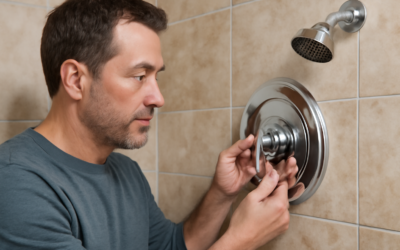
- The dome trim: classic Temptrols wear a distinctive chrome dome escutcheon roughly 7 inches across with SYMMONS stamped on it — instantly recognizable across the room.
- Model stamps: the rough body carries a casting mark; S-96-1 through S-96-5 variants differ mainly in outlet configuration and integral stops.
- Newer Temptrol II: post-2010 versions add a screwdriver-adjustable hot limit stop and updated trim, but the internal service parts remain cross-compatible with legacy bodies.
If your handle pulls straight out to adjust volume and rotates for temperature, you have the current handle style. Older installs use the T-handle with a separate volume knob at 6 o’clock on the dome.
The Rebuild Kit Every Supply House Stocks
Service is the Temptrol’s superpower. The TA-10 rebuild kit, typically $25 to $45, includes the seat washers, O-rings, and gaskets that cure 95 percent of drips. Individual parts worth knowing by number:
- TA-10: washer and gasket rebuild kit — the routine 10-year service.
- TA-4: replacement spindle assembly, about $50-$80, for stripped threads or worn spindle faces.
- TA-9: the pressure-balancing piston/spool, $30-$50, swapped when temperature control gets lazy.
- T-12A: seat removal tool, a stepped socket you genuinely need — improvised tools chew up the brass seats.
Every real plumbing supply house in the Northeast keeps these in a drawer, and the big-box special-order counters and online sellers cover the rest of the country in two days.
Rebuilding One: The 45-Minute Job
A Temptrol rebuild happens entirely from the finished side of the wall. The sequence:
- Close the integral service stops with a flat screwdriver — they hide under the dome on models so equipped — or shut the branch supply.
- Remove the handle screw and handle, then unthread the dome cap. Expect to need strap-wrench persuasion on a 40-year-old chrome dome; padded channel-locks scar it.
- Unscrew the spindle assembly counterclockwise and pull it straight out.
- Reach in with the T-12A tool and extract both hot and cold seats. Replace seats and washers from the TA-10 kit.
- Pull the piston, soak it in white vinegar for 20 minutes if it shows scale, and confirm it slides freely in its bore before reinstalling.
- Reassemble with a light film of silicone grease on every O-ring, open the stops, and cycle the handle through its full travel a few times.
Budget 45 minutes the first time, 20 once you have done a few. Compare that to opening drywall to swap a dead proprietary cartridge body and the appeal is obvious.
Setting the Hot Limit
Scald protection on a Temptrol comes from the adjustable limit stop that restricts how far the spindle can rotate toward hot. On current models, an adjustment screw sits behind the handle: clockwise reduces maximum temperature, counterclockwise raises it. Set it with a thermometer in the stream — code target is a 120 degree F maximum at the outlet, and each quarter turn moves the ceiling roughly 6 to 10 degrees depending on your supply temperatures.
Recheck the limit every time you rebuild the valve or change water heater setpoint. A rebuild restores full flow through fresh washers, and a limit set against worn parts can suddenly deliver noticeably hotter water afterward.
Why Plumbers Specify It
Three reasons come up on every job site conversation about Temptrols. Durability first: an all-brass body with a stainless piston shrugs off hard water, and 30-to-50-year service lives are documented constantly. Parts continuity second: Symmons has never orphaned the platform, so a 1965 valve rebuilds with today’s kit — no other American shower valve can claim that unbroken lineage. Institutional trust third: property managers running hundreds of units standardize on Temptrol because one rebuild kit, one tool, and one training session covers the whole building.
The trade-offs are real but narrow. New S-96 valves with trim run $250 to $400, double a builder-grade Delta. The industrial dome aesthetic is polarizing in a spa-style master bath, though Symmons now offers squared modern trim options. And the volume/temperature behavior confuses guests raised on Moen single-handles for exactly one shower.
Installing a New Temptrol: Rough-In Notes
Setting a fresh S-96 in an open wall follows standard valve practice with a few Symmons-specific wrinkles. The body sweats or threads onto 1/2-inch supplies — order the S-96-2 configuration with integral service stops if your jurisdiction allows, because those stops are what make every future rebuild a no-basement-trip job. Set the valve depth so the finished wall lands within the range marked on the plasterguard; the dome trim forgives roughly 5/8 inch of depth variation, which is more generous than most modern trims but still worth centering. Mount height follows convention: 45 to 48 inches to valve centerline for a shower stall, 28 to 32 inches over a tub.
Pull the spindle and piston before soldering — brass bodies hold torch heat long enough to cook the washers — and flush the lines hard before reassembly. Construction debris is the number-one cause of a brand-new Temptrol running lukewarm, because a single flake of solder lodged against the piston mimics a failing spool. Strap the body solidly to blocking; the valve outweighs a cartridge valve two to one, and a rigid mount keeps the handle feel crisp for decades.
Retrofitting a Temptrol where a builder-grade valve lived is the one job that needs planning: the body is physically larger, so confirm stud-bay clearance, and the dome escutcheon covers a generous 7-inch circle that hides most old tile scars — often saving a tile repair entirely. Plumbers charge $450-$800 for a straightforward swap with access; the valve’s rebuild economics start paying that back around year twelve, when the second or third plastic cartridge would otherwise have been billed.
Buying and Troubleshooting Quick Reference
- New valve with trim: $250-$400 depending on finish; rough valve alone about $150-$220.
- Drip from the head: hot or cold seat washer — TA-10 kit.
- Temperature wanders or runs lukewarm: scaled piston — clean or replace TA-9.
- Handle spins loose: stripped spindle threads — TA-4 spindle.
- Squealing at certain positions: worn washers fluttering against the seat; rebuild cures it.
- No hot at all: check the integral stop was not left half-closed by the last service.
If you inherit a house with that chrome dome in the shower, do not let a remodeler talk you into cutting it out reflexively. Spend $40 on a rebuild kit and an hour of your Saturday, and that valve will likely outlast the next three showerheads you hang on it.