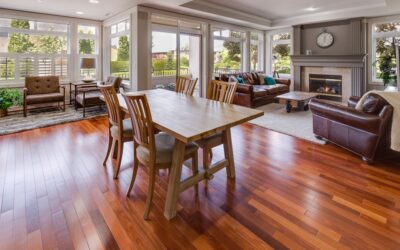
Despite the name, Tassie oak is not actually an oak at all. It is a marketing term used in Australia for three eucalyptus species harvested in Tasmania: messmate, alpine ash, and mountain ash. Tassie oak flooring has carved out a US niche among homeowners who want the long, clean grain pattern of European oak at a slightly different price point, with a pale honey color that turns golden under polyurethane. Boards typically run 130 to 180 mm wide and 14 to 19 mm thick, with a Janka rating around 1,050 to 1,400.
What Makes Tassie Oak Different
Compared to American white oak (Janka 1,360), Tassie oak sits in the same general hardness range but has a noticeably straighter grain with fewer cathedral patterns. The color reads warmer out of the box, closer to a light maple than the slightly gray cast of European oak. Knots are smaller and tighter, and gum veins show up as fine dark streaks that some buyers love and others find distracting.
Density varies by species within the trade name. Mountain ash boards run lighter at roughly 680 kg/m3, while messmate hits closer to 780. If you are buying online, ask the supplier which eucalyptus species the lot was milled from. The differences matter for impact resistance and acoustic feel underfoot.
The Pros That Sell Buyers
The grain consistency is the headline. If you want a calm, modern floor without the busy character of distressed or hand-scraped product, Tassie oak delivers. The pale base color also takes stain beautifully. Whitewash, smoked, and weathered gray finishes pop on this species in a way they often muddle on red oak.
Sustainability credentials are another draw. Most Tasmanian mills carry FSC or PEFC chain-of-custody certification, and the species are not on any threatened list. For homeowners chasing a green building checkmark, that documentation is easier to source than for some Asian and African hardwoods.
The Cons You Should Weigh
It moves with humidity. Eucalyptus species are notorious for tangential shrinkage. In US climates with seasonal humidity swings between 25 percent and 60 percent, you can expect visible gapping in winter and slight cupping in summer unless the subfloor stays inside a tight 35 to 55 percent range. A whole-house humidifier on the HVAC is close to mandatory in northern climates.
Sourcing in the US can be slow. Most stock ships from Australia or Vietnamese mills processing Australian logs, and lead times of 8 to 14 weeks are common. If your renovation has a hard deadline tied to a kitchen install or a closing date, build that calendar into your project plan or pick a domestic species.
Cost Expectations
Tassie oak flooring typically lands between $7 and $12 per sq ft for prefinished engineered planks at retail. Solid 19 mm boards from specialty importers run $9 to $15 per sq ft. Add $4 to $7 per sq ft for installation depending on whether you nail-down, glue-down, or float over an underlayment. A 1,000 sq ft install lands somewhere between $11,000 and $22,000 all in.
- Engineered prefinished, 14 mm: $7 to $9 per sq ft
- Engineered prefinished, 19 mm: $9 to $12 per sq ft
- Solid prefinished: $10 to $15 per sq ft
- Solid unfinished, site sanded: $8 to $11 per sq ft plus $3 to $5 finish labor
Installation Considerations
Acclimate the boards on site for at least 7 days, not the 48 hours that some manufacturer instructions suggest. Eucalyptus needs the time. Stack the bundles cross-hatched with spacers in the actual install room, run the HVAC at the homeowner’s normal temperature setting, and check moisture content with a pin meter. The boards should hit within 2 percent of the subfloor reading before you nail a single plank.
Engineered Tassie oak floats nicely over a quality underlayment with an attached vapor barrier. Solid product should be nailed every 6 to 8 inches into a wood subfloor or glued down on slab using a urethane adhesive rated for engineered hardwood. Skip the cheap latex glues. They release under summer humidity and you will hear hollow spots within 18 months.
Maintenance and Care
Dust mop daily, vacuum weekly with a hard floor attachment, and damp mop monthly with a pH-neutral hardwood cleaner. Bona Pro Series and Loba Cleaner both work well on the polyurethane and oil-modified finishes typically applied to this species. Avoid steam mops and oil soaps. Steam pushes moisture into the seams and oil soaps build up haze on factory finishes.
Plan to recoat the floor every 5 to 8 years in a high-traffic kitchen, every 10 to 12 years in living areas. The pale base color shows wear paths sooner than darker species, so inspect under area rugs annually. A full sand and refinish is possible on solid boards and on engineered planks with at least 4 mm of wear layer.
Where Tassie Oak Works Best
Open-plan living and dining areas are the sweet spot. Wide planks and clean grain make a 400 sq ft great room feel cohesive. Bedrooms work well too. Avoid bathrooms, mudrooms, and basements unless you are using engineered product with a documented water resistance spec, and even then the seasonal movement issue can show up at thresholds.
For coastal homes with year-round humidity above 55 percent, talk to a flooring contractor about whether engineered Tassie oak with a stable plywood core is appropriate. The species can do it, but the install detail and HVAC setup matter more than they would for white oak or hickory.
Final Buying Advice
Order 10 percent overage instead of the typical 7 percent. Tassie oak grading is not as standardized as US species, and you will toss more boards for color or knot defects than expected. Buy from a supplier who will let you cull on delivery and return rejected bundles. The species is beautiful when curated, but unfiltered cartons can include surprise gum streaks that derail an otherwise calm floor design.
Prefer to explore on your own?
See how new flooring looks in your actual room in seconds — free, no signup.
Try the free Floor Studio →