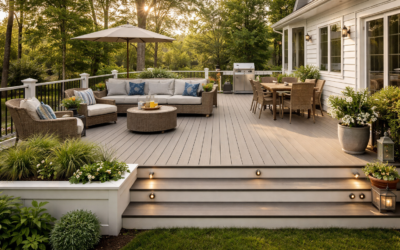
Here is the twist most deck shoppers miss: timbertech vs azek is not a contest between two rival companies. TimberTech and AZEK belong to the same brand family, and the boards once sold simply as AZEK decking are now marketed as TimberTech Advanced PVC. The real decision is between two materials sold under one roof: capped PVC boards with no wood in them, and capped composite boards made with wood fiber.
That matters because the material, not the logo, drives the warranty length, moisture behavior, fire ratings, weight and price. Once you sort the collections by material, comparing them becomes simple. PVC sits at the top of the price ladder with the longest warranty. Composite costs less and covers most backyard decks well.
The specs here come from TimberTech’s own collection, comparison and warranty pages. Collections, colors and warranty terms change, so confirm details on the current spec sheet and warranty document before you order.
TimberTech vs AZEK at a Glance
The fastest way to read timbertech vs azek is to group the collections by material. Price tiers use the maker’s own dollar-sign scale, from one sign (entry) to four (premium).
| Feature | TimberTech Advanced PVC (AZEK) | TimberTech Composite |
|---|---|---|
| Core material | Recycled polymer, zero wood or organic filler | Polymers blended with wood flour |
| Cap | Four-sided protective cap | Three- or four-sided cap, by collection |
| Collections | Vintage, Landmark, Harvest+, Harvest, Solstice | Legacy, Reserve, Terrain+, Terrain, Premier+, Prime+, Prime, Premier |
| Product warranty (residential) | Limited lifetime | 25 or 30 years, by collection |
| Fade and stain warranty | 50 years (35 years on Solstice) | 25 or 30 years, by collection |
| Fire ratings (select collections) | Ignition resistant, Class A flame spread, WUI compliant | Class C flame spread, WUI compliant |
| Board widths | Standard 5.5 in, wide 7.25 in, narrow 3.5 in (by color) | Standard 5.5 in |
| Price tier | $$ (Harvest) to $$$$ (Vintage, Landmark) | $ (Prime+, Prime) to $$$ (Legacy, Reserve) |
Warranty terms differ for commercial use and can vary by region, and every document carries a version date. Read the current warranty for your exact collection before you buy.
How the Brands Are Related
AZEK built its name on cellular PVC trim and later PVC decking. TimberTech built its name on composite decking. Both brands sat under The AZEK Company, which consolidated its decking under the TimberTech name, so you now see labels like “TimberTech AZEK” and “TimberTech Advanced PVC” on the same board. On July 1, 2025, James Hardie completed its acquisition of The AZEK Company, adding the brands to its exterior products business. That is why people search for timbertech and azek together: it is one catalog with two materials.
In practice:
- If a board is called AZEK or Advanced PVC, it is a PVC board with no wood fiber.
- If it is in the Legacy, Reserve, Terrain or Prime/Premier families, it is a composite board. Older literature grouped these as PRO (upper tiers) and EDGE (entry tiers), names you may still see on existing decks and in older store listings.
- Railing, fascia, lighting and hidden fasteners from the same family are designed to work across both materials.
Capped Composite vs Capped PVC
Capped composite
Composite decking blends wood fiber and polymers in the core, then wraps it in a protective cap. The cap handles stains and fading while the core adds stiffness and a solid, heavy feel underfoot. TimberTech says its composite boards contain up to 85% recycled material. Because the core holds wood fiber, a damaged cap or an exposed cut end can take on some moisture, so gapping, end treatment and ventilation guidance matter. The maker rates composite moisture resistance as good to better, behind PVC.
Capped PVC
Advanced PVC boards have no wood or organic filler at all, which is why the maker ranks them best for moisture. They suit docks, pool surrounds, coastal homes and low decks close to the ground. TimberTech also says its PVC stays up to 30 degrees cooler than competitive composites, and select colors carry its heat-reducing technology. PVC is lighter to carry and cut, but it expands and contracts more with temperature, so installation gaps and fastening rules need close attention. Select collections carry ignition-resistant and Class A flame spread ratings for wildfire areas; confirm the rating for your board against local code.
Collections and Colors
Each collection targets a look and a budget. Color lists change frequently, so treat these as examples drawn from the current collection pages.
- Vintage (PVC, $$$$). Exotic hardwood looks such as ipe, mahogany and teak. Colors include Weathered Teak, Cypress, Coastline, Mahogany, English Walnut and Dark Hickory.
- Landmark (PVC, $$$$). A crosscut hardwood look: French White Oak, American Walnut, Castle Gate and Boardwalk.
- Harvest+ and Harvest (PVC, $$$ and $$). Cathedral grain with a stained-wood look. Harvest+ offers Toasted Wheat and Timber Gray; Harvest offers Slate Gray, Kona and Brownstone.
- Legacy and Reserve (composite, $$$). Legacy has a hand-scraped finish in colors like Whitewash Cedar, Pecan, Tigerwood and Espresso. Reserve mimics reclaimed wood with Antique Leather, Dark Roast, Driftwood and Reclaimed Chestnut.
- Terrain+ and Terrain (composite, $$). Subtle or rugged grain, with colors such as Natural White Oak, Weathered Oak, Silver Maple and Brown Oak.
- Premier+, Prime+, Prime and Premier (composite, $ to $$). Entry boards. Prime uses a scalloped, lighter profile; Premier is the full-profile version in the same colors.
Order physical samples. Screen photos rarely capture the variegation and sheen of a capped board, and colors shift in direct sun.
Choosing Between Them
Let the deck’s exposure and your budget decide.
- Constant moisture or water contact. Lean toward Advanced PVC. Docks, pool decks and decks with little clearance benefit most.
- Tight budget with good drainage. An entry or mid composite gives the low-maintenance benefits at a lower price.
- Longest warranty. The PVC collections carry the limited lifetime product warranty; composite runs 25 or 30 years.
- Hot, sunny exposure. All capped boards warm up in direct sun, darker colors more so. Choose lighter shades, or a PVC color with heat-reducing technology, for south and west facing decks.
- Wildfire area. Check which collections carry the fire ratings your jurisdiction requires.
- Wide-board or mixed-width look. Only the PVC side offers wide and narrow boards, in select colors.
- Diagonal layouts or heavy loads. Confirm joist spacing in the installation guide for the specific board, since diagonal runs typically need tighter spacing.
Installation and Care Basics
Both materials install with hidden fasteners or color-matched face screws, and both follow the maker’s gapping rules. PVC needs extra attention to the temperature at install time because it moves more. Both need correct joist spacing, ventilation underneath and a sound substructure, since decking warranties do not cover framing failures.
For cleaning, sweep regularly and wash with mild soap and water. A composite deck cleaner made for capped boards removes pollen, grime and light mildew without harming the cap. Skip metal-bristle brushes and harsh chemicals, and keep pressure washer tips at a safe distance. Wipe up grease and food spills promptly, since stain warranties assume reasonable cleanup.
Troubleshooting Common Complaints
- Boards feel hot underfoot. Use lighter colors, add shade, or keep an outdoor rug in sunny high-traffic spots.
- Gaps opened up or closed. Temperature movement, especially with PVC. Check that installation followed the gapping chart for the install temperature.
- Light scuffs. Many fade over time on capped boards. Use furniture pads and avoid dragging metal legs.
- Mildew spots. Usually surface growth on dirt and pollen. Clean with a capped-board deck cleaner and improve airflow beneath the deck.
- Color difference between bundles. Order enough for the whole job at once and mix boards from several bundles as you lay them.
Cost Ranges and When to Call a Pro
Board prices climb from the entry composite collections through the upper composites to Advanced PVC, with Vintage and Landmark at the top. The maker rates both materials low for ongoing maintenance cost, far less than wood that needs regular staining. Installed cost depends more on deck size, height, railing and framing than on the boards, and labor often matches or exceeds material cost.
DIY is realistic for a simple, low, ground-level platform if you follow the installation guide closely. Hire a licensed deck builder for raised decks, ledgers attached to the house, stairs and railings, or anything that needs a permit. TimberTech also offers a limited replacement labor warranty when registered contractors install its products per the guides, so ask about registration when you interview builders.
Frequently Asked Questions
Is AZEK the same company as TimberTech?
They are brands in the same family. AZEK-branded decking is now sold as TimberTech Advanced PVC, and The AZEK Company was acquired by James Hardie in July 2025.
Which is better in a timbertech vs azek comparison?
Neither wins every case. PVC handles moisture best and carries the longest warranty, while composite costs less and feels more solid underfoot. Match the material to your exposure and budget.
Does AZEK decking have wood in it?
No. Advanced PVC boards are made with zero wood or organic filler. TimberTech composite boards contain wood flour in the core under a polymer cap.
What warranty comes with TimberTech composite decking?
Residential product and fade and stain warranties run 25 or 30 years depending on the collection. Check the current warranty document for your specific boards.
Can I mix composite and PVC boards on one deck?
It is possible, for example PVC around a pool and composite elsewhere, but colors and expansion rates differ. Plan separate zones with a border board between them.