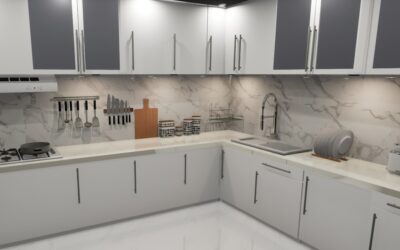
The 12 to 18 inches of empty wall above kitchen cabinets is the single most ignored design surface in American homes. Most homeowners either stuff it with dusty vases or pretend it does not exist. Smart top of cabinet decor can soften ceiling height, hide soffit transitions, and add the warmth that pure cabinetry never delivers — but only if you respect a few proportional rules. Pieces that look right in your living room often shrink visually up there. The trick is scale, color rhythm, and accepting that nobody dusts a cookie jar at 96 inches more than twice a year.
Part of our Kitchen Remodeling guide — explore the full guide →
- Measure the Gap Before You Buy Anything
- Build Around a Color Anchor
- Group in Threes With Height Variation
- Decor Items That Actually Work Up High
- What to Avoid
- Lighting Above the Cabinets
- Soffit and Crown Molding Considerations
- Cleaning Plan You Can Actually Stick To
- Seasonal Refreshes Without a Full Rework
- Common Top of Cabinet Decor Mistakes
- When to Skip the Decor Entirely
Measure the Gap Before You Buy Anything
Most kitchens fall into one of three height categories. Standard 8-foot ceilings with 36-inch wall cabinets leave roughly 12 inches above. Nine-foot ceilings with extended cabinets leave 12 to 18 inches. Ten-foot or vaulted ceilings can leave 24 inches or more.
Items should fill 60 to 75 percent of the available vertical space. In a 12-inch gap, that means decor 7 to 9 inches tall. In an 18-inch gap, 11 to 14 inches. Anything shorter looks lost; anything taller crowds the ceiling and traps grease.
Build Around a Color Anchor
Pick two anchor colors from your existing kitchen — typically the cabinet finish, the countertop, or a recurring accent like a runner rug or pendant. Repeat those two anchors three to five times across the cabinet tops. Random multicolored pieces read as visual noise from a distance, and the cabinet tops are always seen from across the room first.
If your kitchen is mostly white with brass hardware, pull from the brass. Three matte brass canisters of varying heights paired with two olive plants creates a coherent line.
Group in Threes With Height Variation
The reliable formula is the rule of three: one tall, one medium, one short. The tall piece sets the eye line, the medium piece bridges, and the short piece grounds the group. Spread groups every 30 to 36 inches, leaving negative space between clusters.
For a 9-foot run of cabinets, three clusters of three works. For a 6-foot run, two clusters. Anything more crowds the visual rhythm.
Decor Items That Actually Work Up High
- Large stoneware pitchers in 12 to 16 inch heights — Bennington, McCoy, or modern reproductions from Magnolia at $30 to $80
- Trailing artificial vines in eucalyptus, ivy, or olive — real plants struggle without light at that height
- Vintage wooden cutting boards leaned at angles for a layered look
- Framed botanical prints in 14 to 20 inch heights, leaned not hung
- Glass demijohns or wine bottles in amber and green — Pottery Barn and Target sell these for $25 to $60
- Stacked vintage cookbooks with linen-wrapped covers as height risers
- Black metal lanterns in 14 to 18 inch heights for industrial-leaning kitchens
- Woven baskets stored on their sides showing the round opening
- Architectural salvage like corbels, finials, or vintage sign letters
What to Avoid
Skip anything you actually use. Wedding china, holiday platters, and good wine glasses end up coated in airborne kitchen grease within six months. Skip artificial flowers in bright pinks, purples, or reds — they read as plastic from across the room and rarely match anything else in a real kitchen. Skip tiny knick-knacks under 6 inches; they disappear visually and pile up dust.
Lighting Above the Cabinets
If your decor is worth seeing, light it. Battery-operated puck lights with adhesive backs ($25 for a 6-pack) work in older kitchens without wiring. For new installs, low-voltage LED rope lights tucked behind a 1-inch valance create a warm glow that washes the ceiling and highlights silhouettes.
Use 2700K to 3000K bulbs to match warm kitchen lighting. Cooler 4000K bulbs make decor look harsh and clinical from below.
Soffit and Crown Molding Considerations
If your cabinets meet a soffit (a boxed-in section of ceiling), the gap is typically only 1 to 4 inches and there is nothing to decorate. Painting the soffit the same color as the cabinets visually erases it, which is usually the cleanest solution. If the soffit is hopelessly outdated, removing it during a remodel costs $400 to $1,200 and opens up the dead space for proper top-of-cabinet styling.
For cabinets with crown molding that runs to the ceiling, there is no top-of-cabinet space at all. Skip this article and focus on under-cabinet styling instead.
Cleaning Plan You Can Actually Stick To
Every piece up there will collect dust, smoke, and a thin film of cooking grease. Clean twice a year, using a step stool and a microfiber cloth dampened with diluted dish soap. Avoid white pieces unless you commit to wiping them quarterly — gray dust shows immediately on white ceramics. Earth tones, warm woods, and aged metals hide film much longer.
To minimize dust accumulation, choose larger pieces with smooth surfaces over collections of small textured items. A single 14-inch ceramic vase wipes clean in 30 seconds; a flock of porcelain birds takes 20 minutes.
Seasonal Refreshes Without a Full Rework
Swapping one accent piece per cluster is enough to mark a season. In fall, slip in a small pumpkin or a bundle of dried wheat. In winter, a brass star or simple greenery sprig. Keep the anchor pieces year-round so the kitchen never looks like a holiday store. The seasonal swap works because 80 percent of the visual structure stays consistent — only the focal grace note changes.
Common Top of Cabinet Decor Mistakes
- Lining items in a single straight row across the entire cabinet run, like soldiers
- Using too many small items so the area looks like a flea market booth
- Choosing decor in colors that fight the cabinet finish or countertop
- Storing functional dishes up there that you will never realistically retrieve
- Forgetting that pieces look smaller from 8 feet below than they do at eye level
- Letting one cluster bleed into the next without clear negative space
When to Skip the Decor Entirely
If your kitchen has 8-foot ceilings, dark cabinets, and no overhead light, decor up there competes with already low headroom. A clean painted line where cabinet meets ceiling looks more sophisticated than any vase arrangement. Empty space, used confidently, is its own style choice — and one that ages better than any trend-driven top of cabinet decor in 2026.