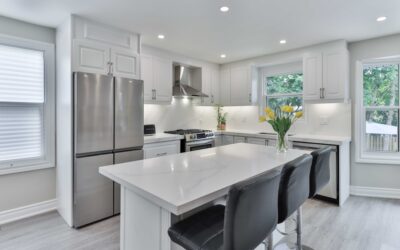
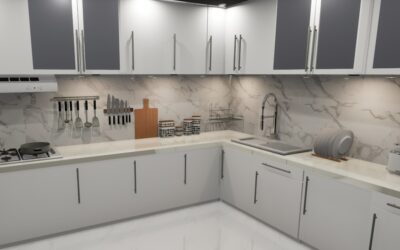
Walk into ten newly remodeled kitchens in any US suburb and at least six will lean transitional. The style has quietly become the default for resale-friendly remodels because it ages slower than trendier looks. A transitional kitchen blends the warmth of traditional cabinetry with the clean lines of contemporary design, giving you a space that feels timeless without looking dated five years down the road. If you are planning a remodel in the $35,000 to $90,000 range, this is the style your designer will probably steer you toward first.
Part of our Kitchen Remodeling guide — explore the full guide →
What Defines a Transitional Kitchen
Think of transitional as the calm middle ground between a colonial farmhouse and a downtown loft. Cabinets typically use Shaker doors with a slim 2.25-inch frame, paired with quartz or honed marble countertops and simple polished nickel hardware. Crown molding may be present, but it is straight and minimal rather than ornate. Color palettes lean neutral: warm whites, soft grays, greige, and the occasional navy or sage island for contrast.
Materials matter more than ornamentation. You will see rift-cut white oak, painted maple, and large-format porcelain tile far more often than glossy thermofoil or heavily distressed wood. The goal is restraint. If a single element shouts for attention, it is usually intentional, like a 36-inch range hood or a waterfall island edge.
Cabinet Styles That Work
Shaker doors dominate, but not all Shakers are equal. A flat-panel Shaker with a 5-piece drawer front reads more contemporary, while a slab door with edge banding pushes the room further toward modern. Most homeowners land on a soft Shaker with a slight inside bevel, which photographs well and hides minor knife dings.
Pay attention to box construction. Plywood boxes with full-extension soft-close drawers run $300 to $700 per linear foot installed for semi-custom lines like KraftMaid or Wood-Mode. Big-box particleboard boxes start around $180 per linear foot but feel cheap within a few years. For a transitional look that holds value, spec inset doors only if your budget tolerates a 25 to 40 percent upcharge over standard overlay.
Countertop and Backsplash Choices
Quartz rules this category, and for good reason. Brands like Cambria Brittanicca, Caesarstone Calacatta Nuvo, and Silestone Eternal Calacatta Gold mimic marble veining without the etching headaches. Expect $65 to $110 per square foot installed for premium quartz, or $45 to $75 for solid neutrals.
For backsplash, three patterns dominate transitional kitchens:
- 3×12-inch handmade ceramic subway in a warm white, stacked or 1/3 offset
- 2×8-inch zellige tile in a soft greige or pale blue
- Slab backsplash in the same quartz as the counter, run to the underside of the upper cabinets
Skip busy mosaic patterns. They date quickly and fight the calm rhythm transitional design depends on.
Color Palettes and Paint Picks
Neutral does not mean boring. The most successful transitional kitchens use a layered palette: a warm white perimeter, a deeper island color, and a third accent on a hood or pantry door. Reliable paint picks include Benjamin Moore White Dove OC-17, Sherwin-Williams Alabaster SW 7008, and Farrow and Ball Cornforth White for perimeters. For islands, Hale Navy HC-154, Urbane Bronze SW 7048, and Card Room Green No. 79 are repeat winners.
Sample any color in your actual space for at least 48 hours before committing. North-facing kitchens in the Midwest pull cool tones gray, while south-facing Florida kitchens warm everything two shades.
Lighting That Sets the Tone
Layered lighting separates a builder-grade kitchen from a designed one. Plan three layers: ambient recessed cans on a dimmer, task lighting under cabinets, and decorative pendants over the island. For 4-inch LED recessed cans, expect $90 to $150 each installed if wiring is accessible.
Pendants should hang 30 to 36 inches above the counter, measured from the bottom of the fixture. Two pendants suit a 6-foot island, three for 8 feet or longer. Schoolhouse, Hudson Valley, and Visual Comfort all make transitional fixtures in the $250 to $600 range that read custom without the custom price tag.
Flooring Options That Hold Up
Wide-plank engineered hardwood in white oak with a matte UV-cured finish is the default flooring for a reason. It runs $7 to $13 per square foot installed, handles refinishing once or twice, and pairs with almost any cabinet color. Plank widths of 7 to 9 inches feel current; anything narrower than 5 inches starts to look traditional.
If you have a slab foundation, busy pets, or a real concern about water, look at luxury vinyl plank with a stone-polymer core. Karndean Korlok and Coretec Pro Plus offer realistic wood visuals with full waterproof construction for $4 to $8 per square foot installed. Porcelain plank tile in a wood look works well in southern climates where you want the cool feel underfoot.
Appliances and Hardware Details
Stainless still reigns, but matte black and panel-ready appliances are gaining ground. A common transitional setup pairs a 36-inch professional gas range (Bertazzoni, Bluestar, or Cafe) with a custom panel-ready 36-inch refrigerator and a hidden dishwasher. Budget $12,000 to $22,000 for the appliance package alone.
Hardware ties everything together. Polished nickel and unlacquered brass have replaced satin nickel as the go-to finishes. Spec 4-inch pulls on drawers under 24 inches, 6-inch pulls on wider drawers, and 1.25-inch knobs on doors. Buy two extra of each in case a finish gets discontinued mid-project, which happens more often than manufacturers admit.
Realistic Budget Ranges
A full transitional kitchen remodel in a 200 sq ft footprint typically falls in these ranges:
- Cosmetic refresh (paint, hardware, counters, backsplash): $15,000 to $28,000
- Mid-range remodel with semi-custom cabinets: $45,000 to $75,000
- High-end remodel with custom cabinetry, paneled appliances, and structural changes: $90,000 to $160,000
Plan a 15 percent contingency for any kitchen older than 25 years. Hidden plumbing, knob-and-tube wiring, and out-of-square framing are not surprises in old houses, they are line items waiting to be discovered.
Common Mistakes to Avoid
Three errors show up in transitional kitchens repeatedly. First, mixing too many finishes. Pick one main metal for hardware, one for plumbing, and one accent metal for lighting. Beyond that, the room reads chaotic. Second, undersizing the island. A 4 by 7-foot island is the practical minimum for seating plus prep; smaller islands always feel like an afterthought. Third, skipping the range hood vent to the exterior. A recirculating hood may pass code, but cooking moisture and grease will dull your finishes within two years.
Get the bones right and the transitional kitchen rewards you with a space that still looks current after a decade. That longevity is the entire point of the style, and it is why builders, flippers, and forever-home owners all keep coming back to it.