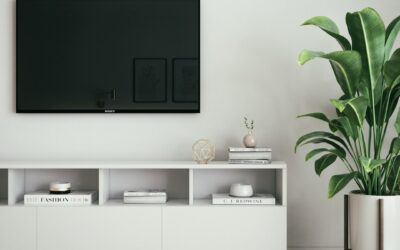
Mount a television too high and you spend every movie tilting your head back until your neck aches. The correct TV height from floor in inches is not a guess; it is driven by seated eye level, and the widely used target is roughly 42 inches from the floor to the center of the screen. That single number solves most living room setups, but the ideal changes with your TV size, your furniture, and whether you are hanging it over a fireplace. Getting it right the first time saves patching a wall full of misplaced anchor holes.
The 42-Inch Rule of Thumb
The guiding principle is that the center of the screen should land at your eye level while you are seated. For most people sitting on a standard sofa, that eye level falls around 42 inches above the floor. Center the TV there and your gaze lands naturally on the middle of the picture with no tilt.
Why 42 inches? A typical couch places a seated adult’s eyes about 40 to 45 inches off the ground. Splitting the difference at 42 inches to the screen’s center gives comfortable, relaxed viewing for the majority of rooms. Start there, then fine-tune to your own furniture and family.
Measure Your Own Eye Level Instead of Guessing
The 42-inch figure is an average, not a law. For a personalized fit, do this quick measurement:
- Sit on your sofa in your normal viewing posture.
- Have someone measure from the floor to the center of your eyes.
- That number is your target height for the center of the screen.
Households with a low-slung sectional or deep lounge seating may land closer to 36 to 40 inches, while a higher-seat sofa or bar stools push the number up. Matching the mount to your actual seating beats any generic rule.
Adjusting for TV Size
Because the target is the center of the screen, larger TVs sit lower to the floor at their base and smaller TVs sit higher. To position any set, subtract half the screen’s height from your center target to find where the bottom edge goes.
As a rough guide for mounting the bottom of the screen with a 42-inch center target:
- 55-inch TV: screen height near 27 inches, so the bottom lands around 28 to 29 inches off the floor.
- 65-inch TV: screen height near 32 inches, so the bottom lands around 26 inches off the floor.
- 75-inch TV: screen height near 37 inches, so the bottom lands around 23 to 24 inches off the floor.
Notice the pattern: the bigger the TV, the lower its base sits, which keeps that all-important center point at eye level.
Room Type Changes the Math
A living room built around a sofa is the standard case, but other rooms shift the ideal height.
- Bedroom: you often watch while lying down or propped on pillows, so mounting higher, sometimes 48 to 60 inches to center, angles the screen toward a reclined view.
- Kitchen: viewing while standing or perched on a stool calls for a higher mount.
- Home gym: standing or moving means the TV goes up, often at or above standing eye level.
- Home office: a desk-height chair sits lower, so the TV can come down accordingly.
Match the height to how you actually use the space, not to a generic living room number.
The Over-Fireplace Question
Mounting above a fireplace is enormously popular and almost always puts the screen too high for comfortable viewing. A mantel typically forces the center of the TV well above the 42-inch mark, leaving you craning upward during a long movie.
If a fireplace mount is your only option, a few strategies help:
- Use a tilting or full-motion mount so you can angle the screen down toward the seating.
- Sit farther back, since greater viewing distance reduces the neck strain of a high screen.
- Consider a pull-down mount that drops the TV to eye level for viewing and returns it up when idle.
- Watch out for heat; keep the TV above the mantel with adequate clearance from fireplace heat.
Whenever you have a wall without a fireplace, that is the better home for the TV.
Viewing Distance and Angle
Height works together with distance. A common guideline places you about 1.5 to 2.5 times the screen’s diagonal away, so a 65-inch TV suits a seating distance of roughly 8 to 11 feet. The screen should also sit flat or tilt no more than about 15 degrees; steeper angles distort the picture and defeat a careful height calculation.
Choosing the Right Mount for Your Height Goal
The mount you pick directly affects how well you can hit and adjust your target height. Each style serves a different situation.
- Fixed (flat) mounts: hold the TV flush and still; best when you can place the center exactly at eye level on a normal wall.
- Tilting mounts: angle the screen down, ideal when the TV must sit a little high, such as above a console or low mantel.
- Full-motion mounts: extend, swivel, and tilt, letting you correct for a high or off-center position and view from multiple seats.
- Pull-down mounts: drop a fireplace-mounted TV to eye level for viewing, the best answer for a high mantel.
Match the mount to the wall and the seating. A fixed mount is cleanest and cheapest when the geometry is ideal, but where you are forced higher, spend the extra money on tilt or full motion to protect your neck.
Finding and Anchoring Into Studs
Height means nothing if the TV falls off the wall. A flat-panel and its mount can weigh 30 to 80 pounds or more, so the hardware must anchor into wall studs, not just drywall. Use a stud finder to locate the studs, which are typically 16 inches apart on center, and mark them.
If your ideal height does not line up with the studs, a mount with a wide horizontal rail lets you shift the bracket while keeping the TV centered where you want it. On masonry, such as a brick or stone fireplace, use appropriate masonry anchors rated for the load. Never trust drywall anchors alone with a television.
Final Checklist Before You Drill
Before committing anchors to the wall, dial in your TV height from floor in inches with this quick routine: measure your seated eye level, subtract half the screen height to place the bottom edge, locate the studs, and hold the TV or a cardboard cutout in place to confirm the view feels right. Ten minutes of measuring beats a lifetime of neck strain, and it keeps your wall free of the extra holes that come from mounting too high on the first try.
Prefer to explore on your own?
See how new flooring looks in your actual room in seconds — free, no signup.
Try the free Floor Studio →