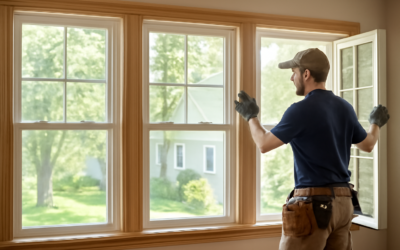
Andersen sells windows under one name but across very different product families, and the difference between them is bigger than most shoppers expect. A composite 100 Series double-hung and a wood-interior A-Series casement share a logo, yet they differ in frame material, finish options, price tier and how they are sold. Sorting the types of Andersen windows by series first, then by style, makes quotes much easier to compare.
Part of our Windows & Doors guide — explore the full guide →
In short: the 100 Series is the value composite line, the 200 Series is a limited-offering wood line, the 400 Series is the long-running wood window with vinyl cladding, the A-Series and E-Series form the premium Architectural Collection, and Renewal by Andersen is a separate full-service replacement business using its own composite windows. A metal line, Andersen Aluminum, and large moving glass walls round out the lineup.
- Types of Andersen Windows by Series
- 100 Series: Composite Value Windows
- 200 Series: Wood at a Lower Price
- 400 Series: The Long-Running Wood Window
- A-Series and E-Series: The Architectural Collection
- Renewal by Andersen: Full-Service Replacement
- Energy Efficiency and ENERGY STAR Options
- Window Styles Explained
- How to Choose a Series
- General Cost Ranges
- Frequently Asked Questions
Types of Andersen Windows by Series
The table summarizes each series using details from the maker’s own product pages. Price tiers are relative within the brand, not fixed prices, and features change, so check the current product guide before ordering.
| Series | Material | Window styles | Relative price tier |
|---|---|---|---|
| 100 Series | Fibrex composite (wood fiber and thermoplastic polymer) inside and out | Double-hung, single-hung, awning, casement, gliding, picture, specialty | Value; priced to compete with vinyl |
| 200 Series | Wood with vinyl to resist water | Double-hung, gliding, picture | Value; affordable alternative to 400 Series |
| 400 Series | Wood interior, Perma-Shield vinyl exterior cladding | Awning, bay and bow, casement, tilt-wash double-hung, Woodwright double-hung, gliding, picture, specialty | Mid |
| A-Series | Wood interior; fiberglass and composite exterior | Awning, casement, double-hung, picture, specialty | Premium (Architectural Collection) |
| E-Series | Wood interior with extruded aluminum cladding outside | Awning, bay and bow, casement, double-hung, gliding, picture, specialty | Premium, custom made to order |
| Renewal by Andersen | Fibrex composite | Awning, bay and bow, casement, double-hung, picture, sliding, specialty | Premium, sold and installed direct |
| Andersen Aluminum | Aluminum | Custom-configured windows and patio doors | Premium, design-focused |
100 Series: Composite Value Windows
The 100 Series is built from Fibrex, Andersen’s composite of wood fiber and thermoplastic polymer. The maker describes it as twice as strong as vinyl and says the material will not flake, blister or peel and never needs painting. It is positioned as a value line comparable in price to vinyl, which makes it the go-to for budget-conscious replacements and new builds.
Styles cover the basics: double-hung, single-hung, awning, casement, gliding, picture and shaped specialty units. Exterior color options are narrower than the 400 Series, though darker exterior colors designed for heat are offered. Interiors are not real wood, so if you want stain-grade wood inside, look higher up the lineup.
200 Series: Wood at a Lower Price
The 200 Series combines wood with vinyl designed to resist water. Andersen calls it an affordable alternative to the 400 Series and notes that its limited offerings may not suit every project. Styles are fewer: double-hung, gliding and picture windows, plus patio doors.
Choose the 200 Series when you want a wood interior on a tighter budget and your openings are standard sizes. If you need casements, awnings or bays, move to the 400 Series. Availability can be more limited by region, so ask your dealer what is stocked.
400 Series: The Long-Running Wood Window
The 400 Series is the line most people picture when they hear the brand name. Frames are primarily wood, with fiberglass and composite in certain components, wrapped on the exterior in Perma-Shield, a rigid vinyl cladding formed around the wood for low maintenance. Inside, you get real wood that can be stained or painted, or factory-finished options.
It offers the widest style range among the standard lines: awning, bay and bow, casement, tilt-wash double-hung, Woodwright double-hung (a more traditional look, popular for historic homes), gliding, picture and specialty shapes. Standard glass is dual-pane, with triple-pane and Low-E upgrades available. The maker lists a limited warranty of 20 years on standard glass and 10 years on non-glass parts.
A-Series and E-Series: The Architectural Collection
A-Series
A-Series pairs a wood interior in several species with a fiberglass and composite exterior that the maker says will not peel, blister, fade or corrode. Andersen describes it as the best-performing, most energy-efficient window line it has offered. Styles include awning, casement, double-hung, picture and specialty units, with an emphasis on authentic architectural details and custom colors.
E-Series
E-Series uses extruded aluminum cladding over a wood core, with the two parts attached so each can expand and contract independently. It is made to order for custom sizes and shapes and offers a broad palette of exterior colors plus custom colors and anodized finishes. Window types include awning, bay and bow, casement, double-hung, gliding and picture. Pick E-Series when design freedom, unusual shapes or a specific exterior color matter more than price.
Renewal by Andersen: Full-Service Replacement
Renewal by Andersen is the company’s replacement division. You do not buy these windows from a lumberyard. Instead, a consultant visits (or meets virtually), measures, orders custom windows and sends company installers. Windows are made from Fibrex composite and come in awning, bay and bow, casement, double-hung, picture, sliding and specialty styles.
The appeal is one point of contact from measuring to service. The tradeoff is price: full-service replacement generally costs more than buying a comparable 100 or 400 Series window and hiring an independent installer. Get at least one competing quote before you sign.
Energy Efficiency and ENERGY STAR Options
Andersen has been recognized as an ENERGY STAR Partner of the Year, but certification applies to specific window configurations, not to a whole series. Whether a given unit qualifies depends on its glass package, gas fill and your climate zone. Look at the National Fenestration Rating Council label on each window for U-factor and Solar Heat Gain Coefficient, and ask your dealer which glass options meet ENERGY STAR criteria for your region.
In cold climates, prioritize a low U-factor (triple-pane is offered on several lines). In hot climates, prioritize a low Solar Heat Gain Coefficient. Low-E coatings tuned for your climate matter more than the series name.
Window Styles Explained
Most types of Andersen windows share the same basic operating styles, so once you know the styles you can compare series side by side.
- Double-hung: Two sashes that both slide up and down; tilt-wash versions tilt in for cleaning.
- Single-hung: Only the bottom sash moves; simpler and usually less costly.
- Casement: Hinged on the side and cranked outward; seals tightly and catches breezes.
- Awning: Hinged at the top and opens outward; can stay open in light rain.
- Gliding: Sashes slide horizontally; good for wide, short openings.
- Picture: Fixed glass for views and light; does not open.
- Bay and bow: Projecting assemblies of several units that add space and light.
- Specialty: Arches, circles, trapezoids and other custom shapes.
How to Choose a Series
Narrowing the types of Andersen windows to one or two series is easier with a short decision path.
- Set your interior finish. Want real wood inside? Look at 200, 400, A-Series or E-Series. Painted-look composite is fine? Consider 100 Series or Renewal.
- Match the house style. Historic homes suit 400 Series Woodwright or A-Series. Modern homes may suit E-Series or aluminum.
- Check climate needs. Pick glass packages by U-factor and SHGC for your zone.
- Decide how you want to buy. Dealer plus independent installer, or full-service replacement.
- Compare installed prices. Installation quality affects performance as much as the window.
General Cost Ranges
Installed prices vary widely with size, style, glass and labor. As a rough guide, value-tier composite windows often run in the mid-hundreds to around $1,000 installed per opening, mid-tier wood windows commonly land around $800 to $1,800, and premium architectural or full-service replacement windows can reach $1,500 to $3,000 or more per opening. Bays, bows and large specialty shapes cost more. Get written quotes that list series, style, glass package and installation details.
Replacing windows usually needs no permit for same-size swaps, but enlarging openings or changing structure requires a permit and sometimes an engineer. Homes built before 1978 may have lead paint on old sashes and trim, so ask installers about lead-safe work practices.
Frequently Asked Questions
What are the main types of Andersen windows?
The main series are 100 Series, 200 Series, 400 Series, A-Series and E-Series, plus Renewal by Andersen for full-service replacement and a separate aluminum line.
Which Andersen window series is the most affordable?
The 100 Series and 200 Series are the value lines. The 100 Series is composite and priced to compete with vinyl; the 200 Series offers wood at a lower price with fewer styles.
What is the difference between Andersen and Renewal by Andersen?
Andersen series windows are sold through dealers and installed by your contractor. Renewal by Andersen sells custom composite windows directly and installs them with its own crews.
Are Andersen windows ENERGY STAR certified?
Many configurations qualify, but certification depends on the glass package and your climate zone. Check each window’s rating label and ask the dealer.
Is the 400 Series wood or vinyl?
Both. The frame is primarily wood with a wood interior, and the exterior is covered with a rigid vinyl cladding for low maintenance.