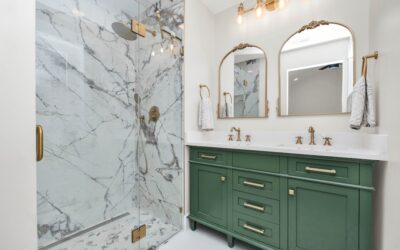
A new shower installation in a midrange US bathroom remodel runs $3,500 to $15,000, and the layout and style chosen determine whether the final result feels like a cramped afterthought or the bathroom’s anchor feature. Understanding the different types of showers available — from simple prefab alcove units to custom wet rooms — helps homeowners budget realistically and pick a design that fits the actual space, plumbing constraints, and household needs. After specifying showers for dozens of renovations and a few new builds, the options sort into a small number of proven categories.
Part of our Bathroom Remodeling & Flooring guide — explore the full guide →
- Alcove Showers: The Budget Standard
- Walk-In Showers: The Modern Favorite
- Frameless Glass Enclosures
- Wet Rooms: The Luxury Option
- Steam Showers: The Spa Upgrade
- Tub-Shower Combinations
- Corner Showers: Fitting Tight Spaces
- Curbless (Zero-Threshold) Showers
- Prefab vs. Custom-Tiled
- Fixture Styles and Shower Heads
- Budgeting and Realistic Timelines
Alcove Showers: The Budget Standard
Alcove showers occupy a three-walled recess, typically 30 by 60 inches, with a shower curtain or glass door on the fourth side. This is the most common shower configuration in US homes because it uses the same footprint as a standard bathtub and shares two plumbing walls with the tub arrangement.
Prefab fiberglass or acrylic alcove units cost $400 to $1,500 in materials and install in one to two days by a pro. Custom-tiled alcove showers run $4,000 to $8,000 installed and offer unlimited style flexibility. The alcove is the right choice for secondary bathrooms, guest baths, and any remodel on a tight budget.
Walk-In Showers: The Modern Favorite
Walk-in showers eliminate the threshold or reduce it to a single low curb, with glass enclosures or open designs that feel larger than their actual square footage. They have dominated new-construction primary bathrooms since 2015 and continue to gain share in renovations.
Advantages include easier aging-in-place access, easier cleaning without a track or door rails, and a more spacious visual feel. Disadvantages include splash-zone planning (water travels further than with enclosed units) and a higher installation cost — typically $5,000 to $12,000 for a quality walk-in.
Frameless Glass Enclosures
Frameless glass enclosures use 3/8-inch or 1/2-inch tempered glass attached with minimal hardware. The look is clean, modern, and showcases tile work behind. Expect $1,500 to $4,000 for the glass alone, plus custom fabrication time of 2 to 4 weeks after measurement.
Framed enclosures using aluminum channels cost half as much — $600 to $1,500 — but look dated in contemporary bathrooms. Semi-frameless splits the difference at $1,000 to $2,500.
Wet Rooms: The Luxury Option
Wet rooms waterproof the entire bathroom floor and slope the whole space toward a central or linear drain. The shower area is defined by a partial glass panel or simply by the tile pattern. The look is continental European and appears frequently in high-end new builds.
Wet rooms require full bathroom renovation — the floor, walls, and sometimes ceiling all need waterproofing membrane. Expect $15,000 to $40,000 for a full wet room conversion. The reward is a bathroom that feels like a spa and accommodates mobility needs without looking institutional.
Steam Showers: The Spa Upgrade
Steam showers add a steam generator, sealed door, and bench to a standard enclosed shower. The steam generator costs $1,200 to $3,500 for units sized to 3 to 5 kW. Total installed cost including plumbing, electrical, tile, and sealed enclosure runs $5,000 to $15,000 above a standard shower.
The upgrade pays back in daily relaxation value but requires careful planning. Ventilation must be separate from the main bathroom fan, ceiling height should be 8 feet or less for efficient steam, and all materials in the steam zone must be waterproof.
Tub-Shower Combinations
Tub-shower combos remain essential in homes with only one bathroom or with young children. The 60-by-30-inch footprint handles both functions, although neither as well as dedicated fixtures.
For resale, retaining at least one tub in the home matters — real estate data consistently shows homes with zero bathtubs sell slower in family-oriented markets. The primary bathroom can be a walk-in shower if the secondary bathroom has a tub-shower combo.
Corner Showers: Fitting Tight Spaces
Corner shower units range from compact 32-by-32-inch neo-angle designs to larger 42-inch square and rectangular configurations. They work well in small bathrooms where an alcove layout is not possible.
Neo-angle prefab units cost $600 to $1,500 and install in an afternoon with two people. Custom-tiled corner showers run $3,500 to $7,000. The main drawback is limited elbow room during showering — if the household has anyone over 6 feet tall, step up to at least 40-by-40 inches.
Curbless (Zero-Threshold) Showers
Curbless showers eliminate the traditional 2 to 4-inch curb, creating a flush transition from bathroom floor to shower floor. They are essential for wheelchair accessibility and increasingly popular for their clean modern look.
Technical execution requires the subfloor to slope toward a linear drain at 1/4 inch per foot, plus waterproof membrane that extends beyond the shower splash zone. The Schluter Kerdi system has made this easier for contractors, but the labor still runs 30 to 50 percent more than a curbed shower.
Prefab vs. Custom-Tiled
The big decision for most showers is prefab fiberglass or acrylic versus custom-tiled. The honest comparison:
Prefab advantages — lower cost ($400 to $2,500 vs. $4,000 to $15,000), faster installation (1 to 2 days vs. 5 to 10 days), fewer grout joints to clean, no tile to replace.
Custom-tiled advantages — unlimited style options, better resale value, more durable, can be designed for any shape, uses premium materials.
For primary bathrooms in homes planned to be owned 5+ years, custom tile almost always wins. For secondary bathrooms, rental properties, and quick renovations, prefab saves time and money without sacrificing functionality.
Fixture Styles and Shower Heads
Fixtures layer onto whatever enclosure style you choose. Popular configurations:
- Single showerhead — wall-mounted standard, $50 to $400
- Rainfall ceiling-mount — 8 to 12-inch head overhead, $150 to $800
- Dual-head — wall and handheld on slide bar, $200 to $600
- Body sprays — multiple wall jets, $400 to $1,500 plus plumbing
- Thermostatic valve — precise temperature control, $400 to $1,200
Make sure your home’s water supply can handle the selected fixtures. Multi-head showers with body sprays can demand 8 to 12 gallons per minute, which exceeds what a 1/2-inch supply line can deliver. Plan the valve and plumbing for the final fixture arrangement, not the base showerhead.
Budgeting and Realistic Timelines
Overall project budgets by shower type in 2026:
- Prefab alcove in existing footprint — $1,500 to $3,500 total
- Custom-tiled alcove — $5,000 to $9,000
- Prefab walk-in or corner — $2,500 to $5,000
- Custom walk-in with frameless glass — $8,000 to $18,000
- Wet room conversion — $15,000 to $40,000
- Steam shower upgrade — add $5,000 to $15,000 to base
Timeline runs 3 to 5 days for prefab installs, 10 to 20 days for custom tile work. Delay factors include custom glass lead times (2 to 4 weeks), tile delivery, and inspections between rough-in and finish plumbing. Plan accordingly and have a backup bathroom ready if the shower is in the primary bath.