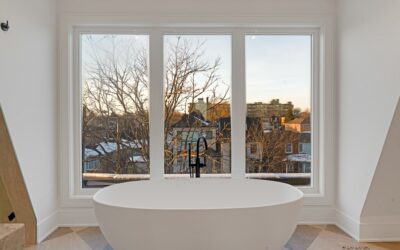
The farmhouse bathroom is now a permanent fixture in American remodels, but the shower is usually where it goes sideways. Too much white tile and the room turns hospital-cold. Too much shiplap and you’ve built a sauna that grows mildew by month three. The best farmhouse shower ideas balance hardworking materials (subway tile, marble thresholds, brushed brass) with warm accents (live-edge shelves, black grout, vintage glass) and just enough texture to keep the space feeling lived-in rather than staged.
Part of our Bathroom Remodeling & Flooring guide — explore the full guide →
The Tile Choices That Anchor the Style
White subway tile is the default, and for good reason — it’s durable, cheap, and unmistakably farmhouse. The variation comes in size, layout, and grout color. Standard 3×6 inch tiles in offset bond pattern with a charcoal grout from Mapei Ultracolor Plus FA ($28 per 25-lb bag) reads classic without trying too hard. For more drama, jump to 4×12 inch handmade ceramic from Fireclay Tile or Heath at around $25 per square foot.
The shower floor wants contrast: 2-inch hex marble in honed Carrara ($14 per square foot) or smaller penny round ceramic in matte white. Avoid glossy floor tiles — they’re slippery when wet and feel modern, not farmhouse.
Shower Enclosures and Doors
The barn door shower enclosure is a polarizing choice. Done well, it captures the style perfectly. Done poorly, it looks like a kit assembled by someone who’s never used a level. Three enclosure approaches that consistently work:
- Barn-style sliding glass: 3/8-inch tempered glass with matte black hardware. DreamLine and Vigo offer kits from $700 to $1,200.
- Black-framed fixed panel: Steel-look powder-coated frames on a single 36-inch panel — modern farmhouse, less expensive at $400 to $700.
- Curtain-only walk-in: A heavy linen curtain on a black iron rod over a curbless walk-in shower. Strongest farmhouse vibe, but only works with proper sloping and a 4-inch dam.
Skip frosted glass entirely. It fights the clean lines of the rest of the room.
Fixtures: Brass, Bronze, or Matte Black?
This is where farmhouse showers earn their soul. The fixture choice telegraphs whether the room is country farmhouse, modern farmhouse, or something in between.
- Unlacquered brass (Newport Brass, Waterworks, Rejuvenation): patinas with use. Country and English farmhouse looks.
- Oil-rubbed bronze (Moen Wetherly, Delta Cassidy): rustic without going precious.
- Matte black (Kohler Purist, Brizo Litze): modern farmhouse, currently the most installed finish.
Use a thermostatic mixing valve like the Delta R10000 ($240) so temperature stays constant when someone flushes a toilet. A separate volume control plus a 7-inch rain head and handheld on a slide bar adds maximum flexibility for $700 to $1,200 in fixtures.
Niche, Bench, and Storage Details
A 14×28 inch recessed niche tiled out in the same field tile but on a small marble shelf is a near-universal upgrade. Install it on the wall opposite the showerhead so it doesn’t catch direct spray. Stagger two niches at 36 and 60 inches above the floor if you have two regular users — couples fight less when each has their own shelf.
Built-in benches need 18-inch depth and a slight slope toward the drain (1/4 inch per foot is enough). Cap with a marble or quartz top, sealed annually. A 16×36 inch bench top in honed Carrara runs about $180 fabricated.
Shiplap Adjacent Walls (Done Safely)
Shiplap inside the wet zone of a shower is a maintenance nightmare. Inside the bathroom proper, on the wall directly outside the shower glass, shiplap brings the farmhouse mood without the moisture risk. Use primed MDF shiplap at $1.20 per linear foot, painted with two coats of bathroom-rated Sherwin-Williams Emerald Urethane Trim Enamel ($95 per gallon) in a satin finish.
For a true shiplap look inside the shower, switch to large-format porcelain tile that mimics shiplap. Daltile Linden Point and Florim Stockholm both make 12×24 inch tiles with embossed plank texture for around $9 per square foot.
Lighting Inside the Wet Zone
Most builders install a single recessed shower light and call it done. A better farmhouse setup uses one wet-rated recessed can centered over the shower head plus a sealed wall sconce or pendant for soft side lighting. Look at Hudson Valley Heirloom or Visual Comfort Bryant in unlacquered brass with seedy glass globes, both wet-rated.
Wire everything to a dedicated dimmer. A 4 a.m. morning shower under 100 percent LED is exactly what farmhouse calm isn’t. Dropping to 20 percent brightness keeps the room feeling soft and intentional.
Grout, Sealing, and Maintenance
White subway tile lives or dies by its grout. Bright white grout looks crisp for about 3 months in a daily-use shower, then turns dingy gray as soap film and minerals build up. Two ways to win the long game:
- Use charcoal or warm gray grout from day one (Mapei Ultracolor Plus FA in Pewter or Chocolate at $28 per bag)
- Spec an epoxy or urethane grout (Mapei Flexcolor CQ at $55 per gallon) that doesn’t absorb stains or soap film
Either approach lasts 15-plus years with minimal maintenance. Cement grout in pure white requires resealing every 6 to 12 months and still telegraphs every coffee splash and shampoo drip. Skip it unless you genuinely enjoy resealing tile work.
Curbless Walk-In: Worth the Upgrade?
Curbless showers add roughly $1,200 to $2,500 over a standard installation because they require a recessed pan, a linear drain (Schluter Kerdi-Line at $400), and a more demanding waterproofing detail. They pay back in two ways: aging-in-place value (no curb to trip over) and visual openness in small bathrooms. For under 65 square foot baths, a curbless walk-in farmhouse shower with a linen curtain reads larger and more intentional than any curbed glass enclosure could.
Whatever combination of farmhouse shower ideas you choose, plan around two principles: warm materials in the dry zones, hardworking materials in the wet zones, and brass or matte black to bridge between them. Done well, a 5×7 farmhouse shower lasts 20 years and adds genuine resale weight to a mid-range home.