Ten years ago this look belonged to barns and warehouses; today it anchors some of the most photographed modern homes in the country. Vertical metal siding — panels run top to bottom instead of horizontally — sheds water brilliantly, installs fast over large walls, and delivers a crisp, linear aesthetic that pairs equally well with a farmhouse or a flat-roofed modern build. It is also one of the longest-lived claddings you can buy, with 40-to-60-year service lives common. Before you order panels, though, you need to choose among several very different profiles, two metals, and a price range that stretches from $4 to $16 per square foot installed.
- The Main Vertical Profiles
- Steel vs. Aluminum, Gauges, and Finishes
- What Vertical Metal Siding Costs Installed
- Why Vertical Orientation Performs So Well
- Installation Notes That Separate Good Jobs From Bad
- Insulation and Sound: What Metal Walls Feel Like to Live In
- Maintenance and Longevity
- Mixing Metal With Other Claddings
- Is It Right for Your House?
The Main Vertical Profiles
Profile choice drives the whole look and much of the cost:
- Board and batten metal: Wide flat pans (10 to 16 inches) with raised battens mimicking traditional wood board-and-batten. The go-to modern-farmhouse profile. Panels: $2.50 to $5 per sq ft material
- Standing seam: Flat panels with concealed fasteners and raised interlocking seams every 12 to 18 inches. The sleekest, most architectural option and the most expensive: $4 to $8 per sq ft material
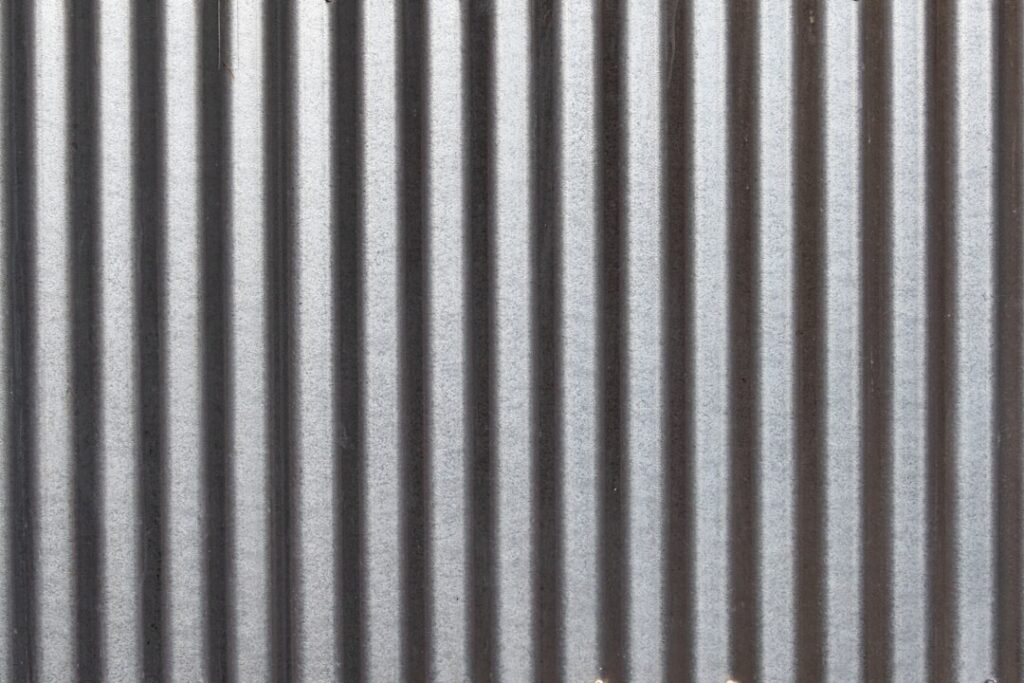
- Corrugated (7/8-inch wavy): The classic round-wave profile, industrial and honest. Cheapest to buy at $1.50 to $3.50 per sq ft, exposed fasteners
- Ribbed/classic rib (R-panel, PBR): Trapezoidal ribs on 9- or 12-inch centers, agricultural roots, exposed fasteners. $1.50 to $3 per sq ft, the budget workhorse
- Flush/interlocking flat panel: Smooth face with hairline joints for a monolithic modern wall. $4 to $7 per sq ft
Concealed-fastener systems (standing seam, most board-and-batten, flush panels) cost more but eliminate the hundreds of gasketed screw heads that exposed-fastener panels rely on — screws whose neoprene washers become a maintenance item in year 15 to 20.
Steel vs. Aluminum, Gauges, and Finishes
Steel dominates residential vertical siding. Specify 26 gauge or heavier (24 gauge for standing seam) — 29-gauge agricultural panel oil-cans and dents noticeably on walls that catch raking light. All quality steel siding is galvanized or, better, Galvalume-coated beneath its paint. Aluminum costs 20 to 40 percent more, dents more easily, but cannot red-rust, making it the right call within a mile or two of salt water.
Finish matters as much as metal. Insist on PVDF paint (Kynar 500/Hylar 5000) for dark or vivid colors — it holds color and resists chalking for 30-plus years, versus 10 to 15 for cheaper SMP (silicone-modified polyester) finishes that fade unevenly. Matte black, charcoal, and dark bronze — the colors this style is famous for — are exactly the shades where SMP fade shows worst, so the roughly $0.50-per-square-foot PVDF upcharge is the best money in the whole project. Most manufacturers back PVDF with 30- to 40-year finish warranties.
What Vertical Metal Siding Costs Installed
Full installed pricing, including trim, underlayment, and labor:
- Corrugated or rib panel, exposed fastener: $4 to $8 per sq ft
- Board and batten metal: $6 to $11 per sq ft
- Standing seam or flush panel: $9 to $16 per sq ft
A 2,000-square-foot-wall home therefore runs anywhere from $9,000 for rib panel to $28,000-plus for standing seam. Trim is the hidden line item people miss: outside corners, J-channel, window and door heads, and base flashing can add 20 to 30 percent to material cost, and complex homes with many openings push labor up fast. For comparison, vinyl siding installs at $3 to $7 per square foot and fiber cement at $6 to $12 — metal’s premium buys lifespan and fire resistance vinyl cannot match.
Why Vertical Orientation Performs So Well
Gravity is the argument. Water on a vertical panel runs straight down the flutes and off the wall with no horizontal laps to seep through, which is why barns have used vertical metal for a century. There are no ledges to hold dirt streaks, snow slides off wall bases cleanly, and long panels mean a two-story wall can be clad floor to eave with zero horizontal seams — panels come cut to length up to 20-plus feet. The full assembly matters, though: quality installs use a drainable housewrap or rain-screen furring strips behind the panels so any incidental moisture dries, and vented base and top trims so the cavity breathes. Metal over bare studs is a shed detail, not a house detail.
Installation Notes That Separate Good Jobs From Bad
Vertical panels need horizontal fastening substrate: installers either strap the wall with furring at 24 inches on center or fasten through sheathing into blocking. Thermal movement is the other discipline — a 16-foot dark steel panel grows roughly 1/8 inch or more across a 100°F swing, so concealed-fastener clips or slotted holes must be used as designed, and exposed-fastener screws driven snug, never crushed. Oil-canning (visible waviness in flat pans) is the top cosmetic complaint on wide flat profiles; combat it with heavier gauge, striated or ribbed pan options, and a dead-flat substrate. Finally, order panels, trim, and touch-up paint from one manufacturer in one batch — color lots vary, and a mismatched corner trim reads instantly on a charcoal wall. Cut panels with shears or a nibbler, never an abrasive blade, which burns the coating and seeds rust at every cut edge.
Insulation and Sound: What Metal Walls Feel Like to Live In
Two livability questions come up in every consultation. On insulation: the panel itself adds essentially no R-value, so comfort comes entirely from the wall assembly behind it — standard cavity insulation plus, ideally, an inch of continuous exterior foam under the furring, which also flattens the substrate and fights oil-canning. Homes detailed that way perform identically to any other cladding. On sound: rain on metal walls is a non-issue, unlike uninsulated metal roofs, because the wall cavity, sheathing, and insulation damp the panel; what you may notice is faint ticking during rapid temperature swings as long panels expand — normal, and quieter on clip-mounted systems than on hard-screwed ones. Hail is the honest caveat: dents on walls are rarer than on roofs since walls take glancing hits, but in serious hail country, textured or striated profiles hide the occasional dimple far better than dead-flat pans, and insurance adjusters treat wall dents as cosmetic, which most policies exclude. Choose profile and gauge with that in mind and the metal wall disappears into daily life.
Maintenance and Longevity
Upkeep is minimal but not zero. Rinse walls annually where sprinklers or road salt hit them, touch up scratches through to bare metal with manufacturer paint, and on exposed-fastener systems plan a screw check around year 15 — backing out or degraded washers get replaced with oversized stitch screws in an afternoon. Avoid letting treated lumber, concrete, or dissimilar metals (copper especially) sit in contact with the panels; galvanic corrosion at those contact points is the one failure mode that shows up early. Do that little, and 26-gauge Galvalume with a PVDF finish is realistically a 40-to-60-year wall.
Mixing Metal With Other Claddings
Few homes wear vertical metal head to toe, and the mixed-material approach is often the strongest design move. The current playbook pairs black or charcoal board-and-batten metal on gables and upper stories with brick, stone veneer, or horizontal wood-look siding below — the metal reads as the roofline’s vocabulary extended downward, and the masonry grounds the composition. Corrugated wainscots under lap siding give farmhouses and shops a durable kick zone where mowers and weather do their worst. On budgets, a smart hybrid puts standing seam on the one street-facing gable where its crisp seams show and rib panel everywhere else; from the curb the house reads premium, and the material bill drops by a third. Whatever the mix, resolve the transitions with proper metal flashings — a Z-flashing where metal meets a band board, sealed counterflashing at masonry — and keep the panel colors within the same manufacturer’s palette so warm blacks and cool blacks do not argue on the same wall. Bring home large samples: metal color shifts more with sun angle than any brochure suggests.
Is It Right for Your House?
Vertical metal siding makes the strongest case on modern and farmhouse designs, tall gable walls that showcase long panel runs, wildfire-prone regions (it is noncombustible), and anywhere the owner wants to install a cladding once and forget it. It is a weaker fit on ornate traditional facades and on tight budgets where vinyl’s $3-per-foot pricing rules. Priced honestly — mid-pack rib panel at $6 to $8 installed, standing seam when the budget allows — it is one of the few sidings where the expected lifespan genuinely justifies the upcharge, and the curb appeal arrives the day the trim goes on.