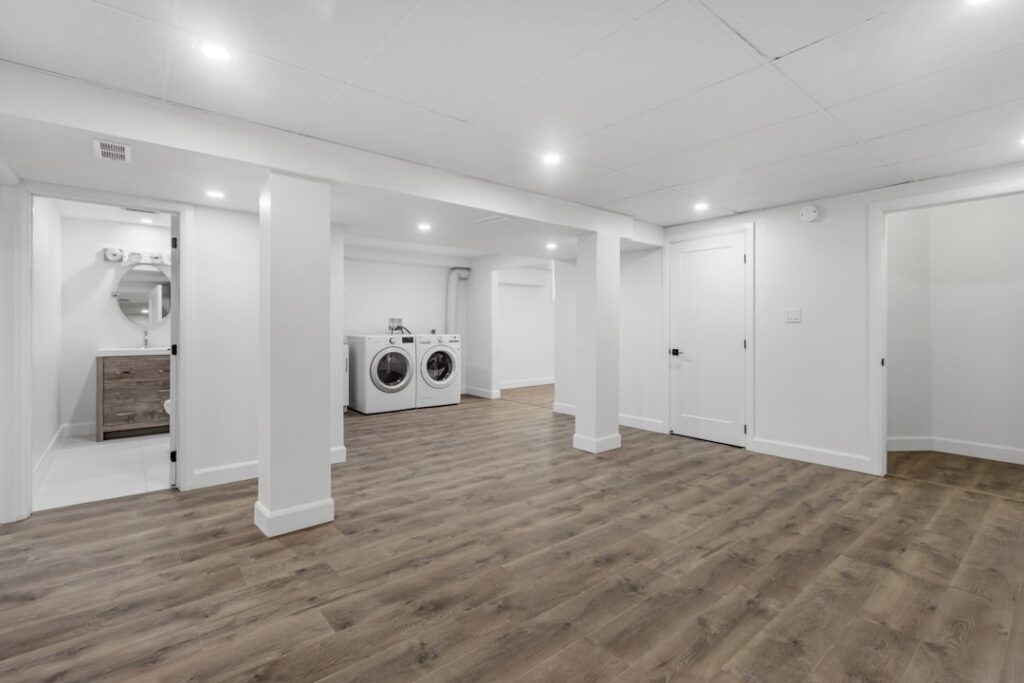
A basement is the hardest room in the house to floor, and it is exactly where the wrong product fails fastest. Vinyl plank flooring for a basement has become the default recommendation for good reason: it shrugs off the damp, cool conditions that destroy hardwood and laminate below grade. But not every vinyl plank is built for a slab, and the difference between a floor that lasts and one that cups and gaps comes down to the core you choose and how you handle the concrete underneath. A basement slab is never as dry as it looks.
This guide explains why rigid-core vinyl suits below-grade rooms, how to deal with moisture and acclimation, and where vinyl plank still has honest limits you should know before buying.
Why Vinyl Plank Suits Basements
Basements combine two problems that wreck most flooring: persistent moisture and temperature swings. Concrete slabs wick water vapor up from the ground year-round, even when the surface feels dry, and basements stay cooler and more humid than the rest of the house. Solid hardwood swells and cups in that environment. Traditional laminate, with its fiberboard core, swells at the edges and never recovers once it gets wet.
Vinyl plank is 100 percent waterproof at the plank level. Water will not swell it, and spilled or condensed moisture on top does no damage. It is comfortable underfoot, warmer than tile, and installs as a floating floor over concrete without nails or a wood subfloor. For a below-grade room, that combination is hard to beat, which is why vinyl plank flooring dominates basement remodels.
Choose Rigid-Core SPC, Not Flexible Vinyl
This is the single most important buying decision. Not all vinyl plank is the same, and for a basement the core construction matters more than the color.
- SPC (stone plastic composite): A dense, rigid core made with limestone. It barely expands or contracts with temperature, which is exactly what you want over a slab that swings from cold in winter to warmer in summer. SPC is the top choice for basements.
- WPC (wood plastic composite): A softer, warmer rigid core. Comfortable but more prone to expansion than SPC, so it is a second choice below grade.
- Flexible glue-down or peel-and-stick LVP: Thin and dependent on a flawless, dry slab and adhesive that survives moisture. In a basement, any vapor coming through the slab can break the glue bond. Generally not the first pick unless the slab is proven dry.
For most basements, a rigid SPC plank at least 4 mm to 6 mm thick with an attached pad and a wear layer of 12 mil or more is the sweet spot. The rigid core also bridges minor slab imperfections better than flexible vinyl.
The Slab Moisture Reality
Here is the part people skip and regret. Vinyl plank is waterproof, but that does not mean you can ignore the concrete. Vapor still moves up through the slab, and trapped moisture can promote mold and mildew under the floor even when the vinyl itself is fine. Before you install, test the slab.
- Plastic sheet test: Tape a 2-foot square of plastic to the slab and leave it 24 to 72 hours. Condensation underneath means the slab is passing significant vapor.
- Calcium chloride or in-slab RH testing: A more precise reading if you want numbers before committing.
If the slab shows moisture, you have options: a stand-alone 6-mil polyethylene vapor barrier under the floor, a rigid plank with a built-in moisture backing, or an underlayment rated as a vapor retarder. Check the manufacturer’s instructions, because some SPC products want a vapor barrier over concrete and some already include one. Never stack two separate pads and a vapor barrier randomly; follow the spec.
Acclimation and Prep
Even rigid SPC benefits from acclimating to the room. Leave the boxes flat in the basement for 24 to 48 hours so the planks reach the room’s temperature before you click them together. Skipping this can cause slight gapping at seams later as the material settles.
Prep the slab carefully. Grind down high spots and fill low spots so the floor is flat within about 3/16 inch over 10 feet. Vacuum thoroughly, and leave the required expansion gap, usually around 1/4 inch, around the entire perimeter and any fixed obstacle. That gap gives the floating floor room to move with seasonal changes and is covered by baseboard or quarter round.
Pros of Vinyl Plank in a Basement
- Fully waterproof planks that survive spills, condensation, and minor leaks.
- Rigid SPC resists temperature-driven expansion over a cold slab.
- Floats over concrete with no subfloor, saving height and cost.
- Warmer and quieter underfoot than tile or bare concrete.
- DIY-friendly click installation and easy plank replacement.
Honest Cons and Limits
Vinyl plank is not magic. It protects itself, not the room. In a basement that actually floods, water will get under the floating floor through the perimeter gap and sit there, and you may need to lift planks to dry the slab even though the vinyl survives. If you have a history of standing water, address drainage, grading, or a sump before you floor anything.
It also will not fix a fundamentally wet basement. Vinyl over a slab that is passing heavy vapor without a barrier can trap moisture and grow mildew underneath. And while SPC is rigid, a badly out-of-level slab will still telegraph through and can cause clicking joints to separate. Fix the slab first.
What It Costs
Expect quality rigid-core SPC basement planks to run roughly $2.50 to $5 per square foot for the material, with premium lines higher. Add underlayment or a vapor barrier if the product needs one, plus trim and transition strips. Professional installation typically adds $1.50 to $4 per square foot. For a 600-square-foot basement, a solid DIY job in mid-grade SPC often lands in the $2,500 to $3,500 range including materials and trim.
A couple of installation habits pay off in a basement specifically. Run your first row along the longest straight wall and check it with a chalk line, because basement walls are often out of square and a crooked start compounds across the room. If your basement has support columns or a bulkhead, plan your plank layout so cuts land cleanly around those obstacles rather than leaving thin, fragile slivers. And keep a few extra boxes of the same batch on hand after the job; dye lots change over time, and having matching planks in storage means a future spill cleanup or a scratched board is a five-minute fix instead of a hunt for discontinued flooring.
Vinyl plank flooring turns a cold, damp basement into usable, comfortable space, but only when you respect the slab beneath it. Choose rigid SPC, test for moisture and add a vapor barrier if needed, acclimate the planks, and flatten the concrete. Handle those four things and your basement floor will look and feel like the rest of the house for years, instead of becoming the room nobody wants to walk into barefoot.
Prefer to explore on your own?
See how new flooring looks in your actual room in seconds — free, no signup.
Try the free Floor Studio →