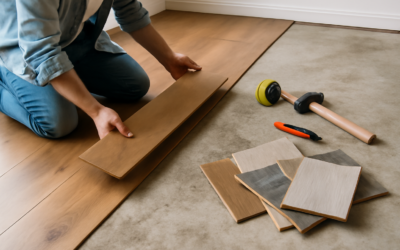
A basement slab is the single most demanding surface in a house to floor over, because concrete wicks moisture from the ground beneath it year-round. Choosing the right basement flooring options over concrete waterproof enough to survive that constant vapor is what separates a finished space you enjoy from a mold problem you rip out in three years. I have torn out ruined laminate and swollen engineered wood from more basements than I can count, and every failure traced back to ignoring the slab’s moisture.
Part of our Epoxy, Concrete & Garage Floors guide — explore the full guide →
This guide covers the flooring materials that genuinely handle below-grade concrete, what each costs installed, and the moisture prep that makes any of them last.
- Test the Slab Before You Choose Anything
- SPC Rigid-Core Vinyl: The All-Around Winner
- Porcelain and Ceramic Tile: Maximum Durability
- Epoxy and Concrete Coatings
- Options to Approach With Caution
- Subfloor Systems for Comfort and Insulation
- Choosing the Right Basement Floor
- Handling Transitions, Stairs, and Perimeter Trim
- Insulation, R-Value, and Comfort Underfoot
- Maintenance and Long-Term Moisture Watch
Test the Slab Before You Choose Anything
No flooring decision matters until you know how much moisture the slab pushes. Tape a 2-by-2 foot square of clear plastic sheeting to the bare concrete for 48 to 72 hours; condensation underneath means significant vapor drive. For a real number, a calcium chloride test measures pounds of moisture per 1,000 square feet over 24 hours, and most manufacturers cap installation at 3 to 5 pounds without a vapor barrier.
Also check for a working vapor retarder under the slab and address any active water intrusion first. No waterproof floor survives standing water from a cracked foundation or a failed sump pump, so fix drainage, grading, and cracks before spending a dollar on flooring.
SPC Rigid-Core Vinyl: The All-Around Winner
For most basements, SPC (stone plastic composite) rigid vinyl plank is the option I recommend first. Its dense mineral-and-PVC core is 100 percent waterproof, will not swell like laminate, and its rigidity floats over minor slab imperfections with a simple click-lock system. A 5mm to 6mm plank with a 20 mil wear layer runs $2.50 to $5 per square foot in material, plus $1.50 to $3 for installation.
SPC tolerates the temperature swings and humidity a basement throws at it, holding shape between 50 and 90 degrees Fahrenheit. Pair it with an attached IXPE pad or a dedicated vapor-barrier underlayment for warmth and quiet, and leave a 1/4 inch expansion gap around the perimeter. If a plank ever gets damaged by a leak, you swap a single board rather than reflooring the room.
Porcelain and Ceramic Tile: Maximum Durability
When you want a floor that shrugs off flooding entirely, porcelain tile is the gold standard. Set in a proper thinset over a crack-isolation membrane, tile is impervious to water, so a burst pipe means mopping up rather than tearing out. Material runs $2 to $8 per square foot, with professional installation adding $7 to $14, making it the most expensive route but also the longest-lived.
The downsides are comfort and cold. Tile is hard and chilly underfoot, which is why it pairs so well with electric radiant heat mats that add roughly $8 to $12 per square foot but transform a basement’s feel. If the slab has active cracks, insist on an uncoupling membrane like a dimpled underlayment so slab movement does not telegraph up and crack the grout.
Epoxy and Concrete Coatings
Sometimes the best basement floor is the slab itself, sealed and coated. A professionally applied epoxy or polyaspartic coating bonds directly to the concrete, creating a seamless waterproof surface with no seams for water to penetrate. Full flake-broadcast epoxy systems run $3 to $7 per square foot, and they resist moisture from above completely while breathing enough to handle modest vapor from below.
Coatings shine in workshops, gyms, and utility basements where you want durability over softness. The critical variables are surface prep and slab moisture, since epoxy will bubble and peel if applied over a slab pushing more than about 3 pounds of vapor without a moisture-mitigation primer. A polyaspartic topcoat cures fast, often walkable in 24 hours, and resists the yellowing that plagues bargain epoxy under any UV exposure.
Options to Approach With Caution
Some floors sold for basements simply do not belong on a moist slab. Traditional glue-down engineered hardwood and standard laminate both use wood-based cores that swell and delaminate once vapor reaches them, and I have replaced countless swollen laminate seams to prove it. Solid hardwood should never go below grade at all.
Carpet directly on concrete is another trap, because the slab’s coolness invites condensation that feeds mold and mildew in the padding. If you want carpet’s warmth, use a raised subfloor panel system with a built-in vapor barrier and dimpled underside, or choose carpet tiles with a waterproof backing that can be lifted and dried individually.
Subfloor Systems for Comfort and Insulation
A raised subfloor is the secret weapon for a basement you actually want to spend time in. Interlocking panels, typically 2-by-2 feet with an OSB top and a dimpled plastic underside, lift the finished floor about 3/4 to 1 inch off the slab, creating an air gap and vapor break that keeps the surface warmer and drier. Expect $2 to $4 per square foot for the panels.
You then install SPC, laminate rated for the system, or carpet on top of the subfloor, gaining insulation value and a noticeable comfort boost underfoot. In a cold-climate basement that stays near 60 degrees Fahrenheit, this air gap can raise the finished floor temperature enough to make the difference between a usable room and one nobody visits.
Choosing the Right Basement Floor
Match the material to how you will use the space and how wet the slab runs. For a finished living area over a reasonably dry slab, SPC vinyl over a vapor-barrier underlayment gives the best balance of waterproofing, comfort, and cost. For a gym or workshop, epoxy or tile wins on toughness, and for maximum flood protection, tile over an uncoupling membrane is unbeatable.
Whatever you pick among basement flooring options over concrete waterproof performance should never be assumed, so test the slab, fix any water intrusion, and use the correct vapor barrier for your product. Get the moisture management right first, and any of these floors will give you 15 to 25 years of dry, durable service below grade.
Handling Transitions, Stairs, and Perimeter Trim
The field of the floor is only part of the job, and the edges are where basements leak comfort and look unfinished. Where a floating SPC or subfloor system meets a stairway, a concrete slab step-down, or a doorway to an unfinished utility area, you need proper transition strips that accommodate the height difference and the floor’s expansion. A rigid vinyl floor floats, so it must never be pinched under a nailed threshold; use a T-molding or reducer that lets the planks move seasonally.
Perimeter details protect against moisture too. Leave the required 1/4-inch expansion gap around every wall and column, then cover it with baseboard or quarter-round that sits slightly off the floor rather than clamping it. In a basement I keep the bottom of the drywall and trim about a half inch above the finished floor, so a minor water event wets the flooring surface without wicking up into the walls and creating a mold problem behind the baseboard.
Insulation, R-Value, and Comfort Underfoot
A waterproof floor that stays icy cold still goes unused, which is why insulation belongs in the plan for any below-grade room. A raised subfloor panel with a dimpled underside adds a small air-gap R-value and breaks the thermal bridge to the cold slab, noticeably warming the surface in a basement that hovers near 60 degrees Fahrenheit. For more warmth, rigid foam board rated for ground contact can go under a floating subfloor to push the assembly toward R-5 or higher.
Under tile, electric radiant heat mats are the comfort upgrade that transforms a basement, adding roughly $8 to $12 per square foot but eliminating the cold-underfoot complaint entirely. Even a thicker attached IXPE pad on SPC plank makes a measurable difference in how the floor feels on bare feet, so weigh comfort against budget rather than assuming waterproof alone is enough.
Maintenance and Long-Term Moisture Watch
Installing the right waterproof floor is not the finish line; below-grade slabs demand ongoing vigilance. Keep an eye on the humidity in the space and run a dehumidifier to hold relative humidity around 50 percent, because even a fully waterproof floor sits in a room where high humidity can still condense on cold surfaces and feed mildew at the margins. A cheap hygrometer on the wall tells you when the dehumidifier needs to work harder.
Watch the perimeter and any floor drains after heavy rain or snowmelt, since the earliest sign of trouble is usually dampness at a wall seam, not a flood in the middle of the room. If you chose SPC or carpet tiles, the payoff of a modular floor is that a single soaked plank or tile lifts out to dry rather than condemning the whole room, so keep a few spare boards from your original dye lot stored flat for exactly that day.