Choosing the best flooring to put over concrete comes down to one thing above all: managing moisture. Concrete slabs, especially on grade or below grade, can wick moisture from the ground, and that vapor is the number one enemy of any floor laid on top. The good news is that several materials handle slabs beautifully when installed correctly. The top performers are rigid-core luxury vinyl, engineered hardwood, tile, and floated laminate with the right underlayment. Here is how to choose and install confidently.
- Test the Slab for Moisture First
- Rigid-Core Luxury Vinyl Plank (Top Pick)
- Engineered Hardwood
- Tile (Ceramic and Porcelain)
- Floated Laminate
- What to Avoid Over Concrete
- Installation Essentials
- Why Subfloor Flatness Matters So Much
- Comfort and Insulation Considerations
- Matching the Floor to the Room
- The Bottom Line
Test the Slab for Moisture First
Before you buy anything, test the concrete for moisture. Skipping this step is the most common reason floors fail over slabs, leading to cupping, mold, or adhesive failure.
- Plastic sheet test: tape a 2×2-foot plastic square to the slab for 24 to 72 hours; condensation underneath signals moisture.
- Calcium chloride test: measures moisture vapor emission rate (MVER) in pounds per 1,000 sq ft over 24 hours.
- Relative humidity probe test: the most accurate method, reading moisture inside the slab.
Whatever you find, plan to include a vapor barrier or moisture-mitigating underlayment. New slabs should also cure for a minimum of 30 to 60 days before flooring goes down.
Rigid-Core Luxury Vinyl Plank (Top Pick)
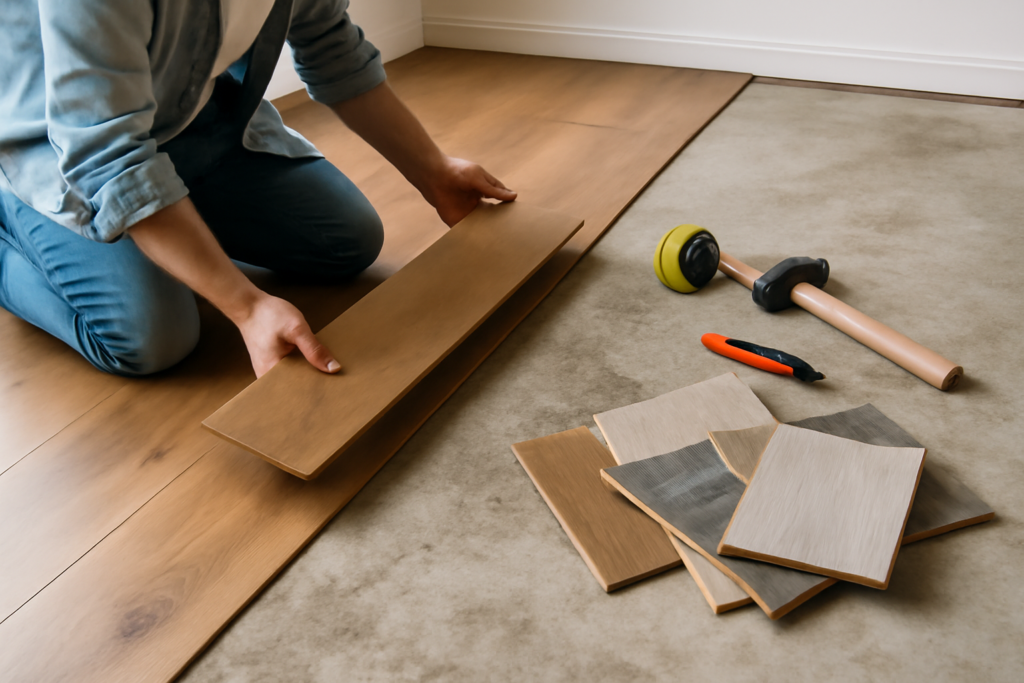
For most homeowners, rigid-core LVP (SPC or WPC) is the best all-around choice over concrete. It is waterproof, dimensionally stable, and forgiving of minor slab imperfections, and it floats over the slab with a click-lock system.
SPC (stone-plastic composite) cores are especially tough and resist denting. Many products include an attached pad, and most still benefit from a vapor barrier over the slab. LVP handles basements, kitchens, and living areas with ease, runs roughly $2.50 to $5 per square foot for material, and installs quickly for DIYers.
Engineered Hardwood
If you want genuine wood over concrete, engineered hardwood is the answer. Unlike solid wood, its plywood or HDF core is dimensionally stable, so it tolerates the slight movement and humidity swings a slab can produce.
Engineered wood can be glued down with a moisture-control adhesive or floated over an underlayment with a vapor barrier. Choose a product with a wear layer of 2 mm or more if you want refinishing potential. Expect material costs of about $3 to $10 per square foot. It is the choice when authentic wood look and resale value matter most.
Tile (Ceramic and Porcelain)
Concrete and tile are natural partners. Tile is hard, waterproof, and ideal over slabs in kitchens, bathrooms, mudrooms, and basements, and it can be set directly on a properly prepared slab with thin-set mortar.
For slabs prone to minor cracking or movement, install a crack-isolation membrane first to keep slab cracks from telegraphing into the tile. Porcelain is denser and more durable than ceramic. Tile is cold and hard underfoot, which pairs well with radiant heat, and material costs span a wide range from about $2 to $15+ per square foot.
Floated Laminate
Laminate is a budget-friendly option over concrete, provided you use a quality underlayment with an integrated or separate vapor barrier. The floating click-lock planks are not fastened to the slab, so they accommodate normal movement.
Standard laminate is vulnerable to moisture, so a slab with elevated readings is not a good candidate unless you address it. For drier slabs in bedrooms and living rooms, AC4-rated laminate over a vapor-barrier underlayment delivers a convincing wood look at a low price, often $1.50 to $4 per square foot for material.
What to Avoid Over Concrete
Some choices simply do not belong on a slab. Knowing them prevents an expensive mistake.
- Solid 3/4-inch hardwood is not recommended directly over concrete because it moves too much with moisture.
- Standard laminate without a vapor barrier will swell if slab moisture is present.
- Glue-down products on an untested or damp slab risk adhesive failure.
Installation Essentials
- Test slab moisture and let new slabs cure fully before installing.
- Grind high spots and fill low spots so the slab is flat within manufacturer tolerances.
- Use a vapor barrier or moisture-mitigation underlayment appropriate to your readings.
- Leave the required expansion gap around the perimeter for floating floors.
- Acclimate the flooring in the room before installation per the manufacturer’s instructions.
Why Subfloor Flatness Matters So Much
Beyond moisture, flatness is the other make-or-break factor over concrete. Slabs are rarely perfectly level; they have high spots, low spots, and sometimes a slight slope. Floating floors laid over an uneven slab flex underfoot, develop hollow spots, and can fail at the joints, while glued or mortared floors bond unevenly.
Most flooring manufacturers specify flatness within roughly 3/16 inch over a 10-foot span. Achieving that means grinding down high spots and filling low areas with a self-leveling compound before installation. It is tempting to skip this step to save time, but it is the single most common reason floors over concrete fail prematurely. Budget for slab prep up front rather than paying for a redo later.
Comfort and Insulation Considerations
Concrete is hard, cold, and unforgiving underfoot, so comfort deserves a thought alongside durability. Floors with an attached or added underlayment pad, like many rigid-core vinyl products, feel warmer and quieter than tile set directly in mortar. If you want the coziness of carpet over a slab, choose carpet with a quality pad rated for concrete use, and confirm the slab is dry first.
For genuinely warm floors, radiant heat changes the equation entirely. Tile is the best partner for in-slab or under-tile radiant systems because it conducts heat efficiently and tolerates the temperature cycling. Some engineered wood and rigid-core vinyl products are also rated for radiant heat, but always verify the manufacturer’s maximum surface temperature before pairing them with a heated slab.
Matching the Floor to the Room
The right choice often varies room by room within the same slab. In a finished basement family room, rigid-core vinyl or engineered wood gives warmth and comfort. In a basement bathroom or laundry, tile or rigid-core vinyl handles the moisture. In a garage conversion or workshop, tile or even a coated concrete surface stands up to heavy use. Map each space to its moisture level, traffic, and comfort needs rather than flooring the whole level with one material out of convenience.
The Bottom Line
The best flooring to put over concrete is the one that respects the slab’s moisture and movement. Rigid-core luxury vinyl is the most versatile and forgiving pick, engineered hardwood offers real wood with stability, tile is unbeatable in wet areas, and floated laminate is the budget option for drier slabs. Test for moisture first, prep the slab flat, use the right vapor barrier, and any of these will give you a durable, good-looking floor that lasts.