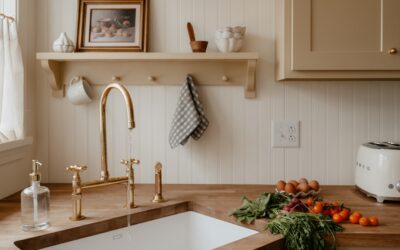
Look closely at a designer farmhouse kitchen and you will often spot the faucet rising straight out of the tile backsplash rather than the counter behind the sink. A wall faucet kitchen setup mounts the tap on the wall, freeing the deck around the sink and delivering a clean, architectural look that has become a hallmark of high-end and vintage-inspired kitchens. This guide explains how wall-mounted faucets work, the rough-in requirements you must plan for, the real advantages and headaches, and what installation costs.
Part of our Kitchen Remodeling guide — explore the full guide →
- What a Wall-Mounted Kitchen Faucet Is
- The Rough-In: The Part You Cannot Skip
- Matching Spout Reach to Your Sink
- Advantages of Going Wall-Mounted
- The Drawbacks to Weigh
- Cost of a Wall Faucet Kitchen Setup
- Installation and Freeze Protection Tips
- Bridge Faucets vs Single-Hole Wall Mounts
- Coordinating the Faucet With Your Sink Choice
- Long-Term Maintenance and Repair Access
What a Wall-Mounted Kitchen Faucet Is
Instead of the supply lines coming up through holes in the countertop or sink deck, a wall-mounted faucet runs its plumbing inside the wall and exits through the backsplash. The faucet body bolts to a bracket fastened to blocking between the studs, and the spout arcs out over the sink from above. Both single-handle and widespread two-handle configurations exist, with the classic look being a bridge-style faucet with cross handles.
Because the plumbing lives in the wall, the counter and sink deck stay completely clear, which is both the defining aesthetic and the biggest planning challenge of the whole approach.
The Rough-In: The Part You Cannot Skip
Everything about a successful wall faucet kitchen install hinges on the rough-in, the in-wall plumbing set during framing or a wall opening. Get this wrong and the faucet lands off-center or too low, so measure carefully against your specific faucet’s spec sheet.
- Center height: the faucet outlets typically sit 6 to 12 inches above the sink rim, high enough to clear tall pots but not so high that water splashes.
- On-center spread: two-handle wall faucets require a precise distance between the hot and cold outlets, commonly 8 inches, matched exactly to the faucet.
- Blocking: solid wood blocking between studs must back the mounting point so the faucet does not wobble.
- Alignment: the outlets must center over the sink drain, planned before the sink location is finalized.
Follow the manufacturer’s rough-in template to the fraction of an inch, because once the tile goes up, moving the plumbing means opening the wall again.
Matching Spout Reach to Your Sink
Spout reach matters even more on a wall faucet than a deck faucet, because the tap starts behind the sink at the wall. Measure from the backsplash to the center of your sink drain and choose a faucet whose spout reach delivers water over that point. A spout that falls short dumps water on the back edge of the basin instead of the center, and one that overreaches splashes toward the front.
For a standard 22-inch-deep sink set close to the wall, look for a spout reach in the 8 to 10 inch range. Farmhouse apron sinks that sit forward of the backsplash need a longer reach, so always verify the geometry before buying.
Advantages of Going Wall-Mounted
Homeowners choose wall faucets for real, tangible benefits beyond looks.
- Easy cleaning: with nothing mounted on the deck, wiping the counter and sink surround is effortless, and no grime collects around the base of the faucet.
- Clean sightlines: the uncluttered counter reads as intentional and upscale, especially with a stone slab backsplash.
- Works with apron sinks: wall mounting solves the awkward geometry of some farmhouse sinks that leave little deck room.
- Space savings: useful behind sinks where the counter is shallow.
For anyone who has scrubbed hard-water crust from around a deck faucet’s base, the clean counter alone sells the idea.
The Drawbacks to Weigh
Wall-mounted faucets are not for every kitchen, and the tradeoffs are worth an honest look. The plumbing lives in an exterior or interior wall, which raises freezing risk if the pipes run in an uninsulated exterior wall in cold climates. Repairs are harder because reaching the valve means opening the wall rather than diving under the sink. Installation is more demanding and less forgiving than a drop-in deck faucet.
There is also the retrofit hurdle. Adding a wall faucet to an existing kitchen means rerouting supply lines up into the wall and patching tile, which is far more involved than a straight faucet swap. This is why wall faucets are easiest to specify during a full remodel or new construction.
Cost of a Wall Faucet Kitchen Setup
Budget for both the faucet and the added labor of in-wall plumbing. Quality wall-mounted kitchen faucets range from about $200 for a basic model to $600 or more for premium bridge-style units in designer finishes. The faucet itself is only part of the picture.
Labor is where wall mounting costs more than a deck faucet. Roughing in the supply lines, installing blocking, and coordinating with the tile work typically adds $300 to $800 in plumbing labor during a remodel, and considerably more if you are opening finished walls. Plan the faucet selection before the plumber roughs in, since the rough-in must match the exact model you intend to buy.
Installation and Freeze Protection Tips
If your wall faucet plumbing runs in an exterior wall in a cold climate, insulate generously behind the pipes and keep the wall cavity as warm as possible, because a burst supply line inside a finished wall is a costly repair. Where feasible, route the supplies through an interior wall instead.
During installation, pressure-test the connections before closing and tiling the wall, and confirm the faucet body sits perfectly plumb so the handles and spout line up straight against the finished tile. Once the tile is set, seal the escutcheon-to-tile joint with a bead of clear silicone to keep splashes from wicking behind the wall. Done thoughtfully, a wall faucet kitchen delivers a striking, easy-to-clean look that keeps paying off every time you wipe down a spotless counter.
Bridge Faucets vs Single-Hole Wall Mounts
Wall-mounted kitchen faucets come in two main configurations, and the choice shapes both the look and the plumbing. Bridge faucets connect the hot and cold inlets with a visible horizontal tube, or bridge, that spans between two mounting points, giving a classic, farmhouse-vintage appearance beloved in traditional kitchens. They require two supply points spaced at the specified on-center distance, most often 8 inches.
Single-hole and single-post wall faucets, by contrast, feed from one point and often use a single lever for both temperature and volume, delivering a cleaner, more modern line. Bridge faucets tend to cost more and demand more precise rough-in because of the two mounting points, while single-post units are simpler to align. Decide which look suits your kitchen before the rough-in, since the plumbing behind the wall must be set for the specific style and spread you choose. A gorgeous bridge faucet on a sleek modern kitchen can look out of place, so match the faucet character to the room.
Coordinating the Faucet With Your Sink Choice
Because a wall faucet arcs out over the basin from behind, the relationship between faucet and sink is more critical than with a deck-mounted tap. A deep single-bowl sink pairs beautifully with a tall wall faucet that gives clearance for filling large pots, while a shallow or divided sink needs the spout height and reach dialed in so water lands in the bowl rather than splashing the divider or the counter.
Farmhouse apron-front sinks are a natural companion to wall faucets, since the apron sits forward and the wall mount keeps the faucet clear of the exposed front. Measure the distance from the backsplash to the center of the drain and to the front of the basin, then choose a spout reach and height that centers water in the bowl. Coordinating the finish between the faucet and any sink accessories, along with the cabinet hardware, ties the whole prep zone together into a considered, cohesive design.
Long-Term Maintenance and Repair Access
Living with a wall faucet means planning for the day it needs service, since the working valve sits inside the wall rather than under the sink. Most wall faucets are designed so the cartridge and internal parts can be serviced from the front by removing the handle and trim, which spares you from opening the wall for routine repairs like a worn cartridge or a drip. Confirm this front-serviceable design when you buy, and favor a brand with readily available replacement cartridges.
Keep the model and finish information filed away so you can order the correct parts years later, and choose an established manufacturer whose components stay in production. For the rare repair that does require in-wall access, an access panel installed in an adjacent closet or cabinet back can save you from cutting tile. With a quality front-serviceable faucet and easy parts availability, a wall-mounted kitchen faucet delivers its clean, distinctive look for decades while remaining as maintainable as any standard tap.