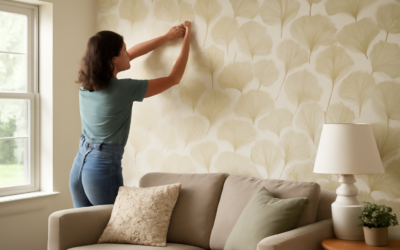
Papering an entire room can feel overwhelming and expensive, which is exactly why a single feature wall has become the go-to design move. A well-chosen wallpaper accent wall living room project delivers maximum visual impact with minimal cost, commitment, and labor, transforming a flat, forgettable space into one with a clear focal point and real personality. The key is picking the right wall, the right pattern, and the right product for your skill level. This guide covers how to choose each, and how to install your accent wall so it looks professional rather than DIY.
Part of our Paint & Walls guide — explore the full guide →
Why Just One Wall?
An accent wall concentrates bold pattern and color in one place, giving a room drama without overwhelming it. Papering all four walls with a busy print can feel closed-in and costs four times as much, while a single papered wall creates a focal point that draws the eye and anchors your furniture arrangement. It is also far less work and far cheaper to change your mind about down the road.
For a living room specifically, an accent wall lets you introduce a print or texture you love — a moody floral, a geometric pattern, a grasscloth texture — while keeping the remaining walls calm and neutral. The contrast is what makes the feature wall read as intentional design rather than decorating overload.
Choosing the Right Wall
Not every wall makes a good accent, and picking the wrong one wastes the effect. The best candidate is the wall your eye naturally lands on when you enter the room, or the one behind your primary furniture grouping. In most living rooms that means:
- The wall behind the sofa — the classic choice, framing the main seating area
- The fireplace wall — reinforcing an existing architectural focal point
- The wall behind a media console or TV — grounding the entertainment zone
- The first wall you see from the entryway or main sightline
Choose a wall without too many windows, doors, or interruptions, since a mostly solid surface shows off the pattern and makes installation far simpler. A wall broken up by openings means more cutting, more waste, and a less cohesive result.
Selecting a Pattern and Color
The pattern sets the entire mood, so let the room guide you. In a small living room, a large-scale pattern can actually open the space up and feel intentional, while tiny busy prints may read as clutter. In a big room, a bold, large-scale design fills the wall with confidence.
Coordinate the wallpaper’s colors with what you already own. Pull an accent hue from your rug, artwork, or throw pillows so the papered wall feels connected to the room rather than random. If your furnishings are neutral, the accent wall is your chance to introduce color and pattern; if your room already has bold pieces, a subtle textured paper like grasscloth adds richness without competing.
Peel-and-Stick vs Traditional Wallpaper
Your product choice depends on your skill, your timeline, and whether you rent or own. The two main categories each have clear strengths.
Peel-and-Stick Wallpaper
Peel-and-stick, or removable wallpaper, has an adhesive backing you simply peel and press onto the wall — no paste, no water tray, no mess. It is the beginner’s best friend and ideal for renters because it removes cleanly without damaging paint. It repositions easily during install, forgiving the inevitable first-timer mistakes. The trade-offs are a slightly higher cost per roll and a shorter lifespan than traditional paper.
Traditional Wallpaper
Traditional paper, whether pre-pasted or requiring separate paste, is more durable and often offers a wider selection of high-end patterns and textures like grasscloth. It costs less per roll but demands more skill, more tools, and more patience to hang, and it is harder to remove later. For a permanent feature wall in a home you own, traditional paper delivers a longer-lasting, higher-end result.
Measuring and Estimating Rolls
Buy enough paper the first time, because dye lots vary between print runs and a mid-project reorder may not match. Measure the wall’s width and height, multiply for square footage, and check each roll’s coverage. Crucially, account for the pattern repeat — the vertical distance before the design repeats — because matching the pattern across strips wastes some material at each seam.
Add at least 10 to 15% extra for pattern matching, trimming, and mistakes, and buy all rolls from the same batch or dye lot. Running short and having to blend a mismatched lot is the fastest way to ruin an otherwise beautiful wall.
Step-by-Step Installation
A patient DIYer can hang an accent wall in an afternoon. The basic process:
- Clean the wall and fill any holes or dents so the surface is smooth and dust-free
- Snap or draw a plumb vertical line as your starting guide — walls and corners are rarely truly straight
- Hang the first strip against that plumb line, not the corner, smoothing from the center outward to push out bubbles
- Match the pattern carefully on each following strip before pressing it down
- Use a smoothing tool or plastic squeegee to eliminate air bubbles and wrinkles
- Trim excess at the ceiling and baseboard with a sharp blade against a broad knife
Working from a plumb line rather than a corner is the single trick that keeps the pattern straight, since corners in most homes lean slightly off vertical. Smooth from the middle out on every strip, and take your time matching the pattern at the seams.
Popular Pattern Styles for Living Rooms
The pattern you choose sets the entire personality of the room, so it helps to know what each style communicates. Botanical and floral prints bring warmth and organic softness, working beautifully in traditional and transitional living rooms. Geometric patterns — think trellis, hexagon, or Art Deco motifs — read modern and add crisp structure, ideal for contemporary spaces.
Textured papers such as grasscloth, which is woven from natural fibers, add depth and a subtle, sophisticated richness without a loud print, making them a favorite for a refined feel. Moody dark florals and dramatic murals turn an accent wall into a genuine statement piece for those who want maximum impact. Metallic and mica-flecked papers catch the light and lend a touch of glamour. Consider the mood you want — cozy, energetic, serene, dramatic — and let that guide you toward the pattern family that fits, rather than choosing purely on the swatch alone.
Common Mistakes to Avoid
A few predictable errors trip up first-time accent-wall installers, and knowing them saves grief. The biggest is starting from a corner instead of a plumb line — since corners are rarely truly vertical, aligning your first strip to the corner sends the whole pattern crooked. Always snap a level vertical line and start there. The second is under-ordering, then discovering the reorder is a different dye lot that does not match.
Other frequent slip-ups include skipping wall prep so bumps and holes telegraph through the paper, rushing and trapping air bubbles instead of smoothing each strip from the center outward, and failing to account for the pattern repeat when estimating rolls. In humid rooms or over glossy paint, peel-and-stick may not adhere well, so test a small piece first. Finally, resist choosing a pattern so busy it overwhelms the room — an accent wall should draw the eye pleasantly, not exhaust it. Avoiding these mistakes is largely about patience and preparation, the same two virtues that separate a professional-looking wall from an obvious DIY job.
Finishing Touches and Styling
Once the wall is up, let the rest of the room support it rather than compete. Keep the adjacent walls in a coordinating solid color pulled from the wallpaper. Style the space in front of the feature wall to draw attention to it — the sofa, a piece of art, or a console with lamps frames the wall and completes the vignette.
A wallpaper accent wall living room update is one of the most rewarding weekend projects in home decorating: a modest budget and a few hours of careful work reward you with a striking, personality-filled focal point that makes the whole room feel designed. Choose the right wall, coordinate the pattern with what you own, match your product to your skill level, and hang it from a true plumb line — and your accent wall will look every bit as polished as a professional’s.