
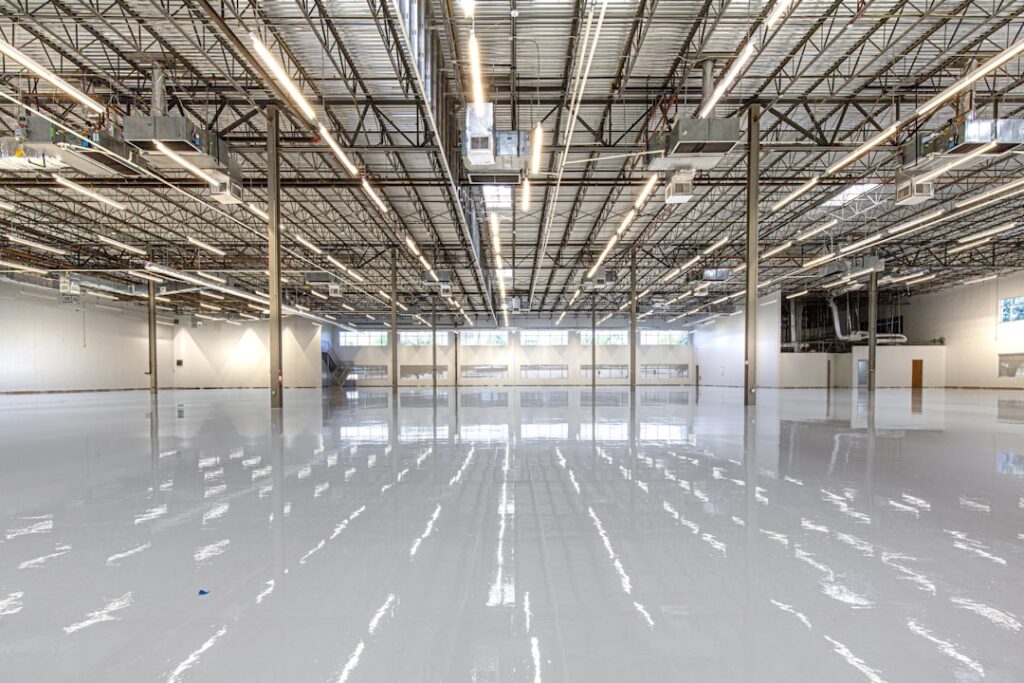
Warehouse floors take a beating. Forklifts running 10 hours a day, heavy pallets being dropped, chemical spills from inventory, and constant abrasion from foot traffic and equipment wheels all conspire to destroy unprotected concrete within a few years. Epoxy flooring is the most popular solution for protecting warehouse concrete — and for good reason. A properly installed epoxy system transforms a dusty, cracking concrete slab into a seamless, chemical-resistant, high-performance surface that can last 10–20 years.
Part of our Epoxy, Concrete & Garage Floors guide — explore the full guide →
This guide covers everything you need to know about warehouse epoxy flooring, from choosing the right system type to understanding load requirements, chemical resistance ratings, installation procedures, and realistic cost expectations.
- Why Warehouses Need Epoxy Flooring
- Types of Warehouse Epoxy Flooring Systems
- Load Requirements and Structural Considerations
- Chemical Resistance Ratings
- Installation Process for Warehouse Epoxy
- Warehouse Epoxy Flooring Costs in 2026
- Maintenance and Longevity
- Frequently Asked Questions
- Final Thoughts on Warehouse Epoxy Flooring
Why Warehouses Need Epoxy Flooring
Raw concrete is porous, relatively soft, and prone to dusting — a process where the surface slowly breaks down into fine powder under traffic. In a warehouse environment, this creates several problems that epoxy flooring directly solves.
Dust and Contamination Control
Concrete dust contaminates inventory, clogs HVAC systems, and creates respiratory hazards for workers. An epoxy coating seals the concrete surface completely, eliminating dust generation. This is particularly critical in food storage, pharmaceutical, and electronics warehouses where contamination can mean regulatory violations and product loss.
Chemical and Spill Resistance
Warehouses handling chemicals, fuels, hydraulic fluids, or even food products need floors that resist staining and chemical attack. Untreated concrete absorbs liquids quickly, creating permanent stains and structural degradation. Epoxy systems create an impervious barrier that allows spills to be cleaned up easily without damaging the substrate.
Abrasion and Impact Resistance
Forklift traffic, pallet drops, and dragging heavy equipment across the floor creates extreme abrasion and point-load stress. Quality warehouse epoxy systems are formulated to withstand these forces far better than bare concrete or simple concrete sealers.
Safety Markings and Traffic Management
Epoxy allows warehouses to integrate permanent traffic lanes, pedestrian walkways, hazard zones, and storage area markings directly into the floor. Color-coded zones improve safety and operational efficiency. Unlike painted lines on concrete, epoxy markings resist wear from forklift tires and do not peel or fade quickly.
Light Reflectivity
High-gloss epoxy floors reflect overhead lighting, improving visibility throughout the warehouse. Some facility managers report a 20–30% improvement in floor-level brightness after epoxy installation, which can reduce the number of light fixtures needed or allow lower-wattage bulbs.
Types of Warehouse Epoxy Flooring Systems
Not all epoxy systems are created equal. The right choice depends on your warehouse’s specific demands, including traffic type, chemical exposure, temperature conditions, and budget.
Self-Leveling Epoxy
Self-leveling epoxy is applied as a thick, pourable coating (typically 1/8 to 1/4 inch) that flows across the concrete and cures into a smooth, seamless surface. This is the most common warehouse epoxy system for general distribution and storage facilities.
- Thickness: 1/8″–1/4″ (3mm–6mm)
- Best for: General warehousing, distribution centers, light manufacturing
- Pros: Smooth finish, easy to clean, good chemical resistance, attractive appearance
- Cons: Can be slippery when wet unless anti-slip aggregate is added
- Cost: $3.00–$7.00 per square foot installed
Epoxy Mortar Systems
Epoxy mortar is the heaviest-duty option available. It combines epoxy resin with graded sand or quartz aggregate to create an extremely thick, hard surface. Epoxy mortar systems are typically 1/4 inch to 3/8 inch thick and can handle the most extreme warehouse conditions.
- Thickness: 1/4″–3/8″ (6mm–10mm)
- Best for: Heavy manufacturing, forklift-intensive operations, chemical processing
- Pros: Maximum impact and compressive strength, can repair severely damaged concrete, excellent chemical resistance
- Cons: Highest cost, longer installation time, rougher texture
- Cost: $7.00–$12.00 per square foot installed
Epoxy Flake Systems
Flake systems involve broadcasting decorative vinyl or acrylic chips into wet epoxy, then sealing with a clear topcoat. While often associated with garage floors, commercial-grade flake systems with urethane topcoats perform well in moderate warehouse environments.
- Thickness: 1/16″–1/8″ (1.5mm–3mm)
- Best for: Showrooms, break rooms, receiving areas, light-duty warehouses
- Pros: Attractive multi-color appearance, built-in texture for slip resistance, hides minor concrete imperfections
- Cons: Not ideal for extremely heavy forklift traffic, topcoat may need recoating every 5–7 years
- Cost: $4.00–$8.00 per square foot installed
Novolac Epoxy Systems
Novolac epoxies are specialty formulations designed for extreme chemical resistance. They withstand concentrated acids, solvents, and caustic chemicals that would destroy standard epoxy. Novolac systems are essential for chemical storage warehouses, battery charging areas, and facilities handling aggressive substances.
- Thickness: 1/8″–1/4″ (3mm–6mm)
- Best for: Chemical storage, battery rooms, pharmaceutical facilities
- Pros: Superior chemical resistance, high heat tolerance (up to 300°F), solvent resistant
- Cons: More expensive, limited pot life during installation, fewer color options
- Cost: $8.00–$15.00 per square foot installed
Epoxy with Polyurethane or Polyaspartic Topcoat
Many modern warehouse systems use a hybrid approach: an epoxy base coat for adhesion and chemical resistance, topped with a polyurethane or polyaspartic clear coat for UV stability, abrasion resistance, and ease of cleaning. This combination outperforms straight epoxy in environments with UV exposure (skylights, open dock doors) and heavy abrasion.
- Thickness: 1/8″–1/4″ total system (3mm–6mm)
- Best for: Warehouses with skylights or open doors, high-traffic distribution centers
- Pros: UV stable (no yellowing), superior abrasion resistance, faster return to service with polyaspartic
- Cons: Higher material cost, requires precise timing between coats
- Cost: $5.00–$10.00 per square foot installed
Load Requirements and Structural Considerations
Warehouse epoxy must withstand forces that go far beyond foot traffic. Understanding the load types your floor will face is critical for specifying the right system.
Compressive Strength
Warehouse epoxy systems should have a compressive strength of at least 10,000 PSI for general warehousing. For heavy forklift operations and racking systems, 12,000–14,000 PSI is recommended. Epoxy mortar systems can achieve compressive strengths exceeding 16,000 PSI. By comparison, standard concrete typically has a compressive strength of 3,000–5,000 PSI.
Forklift and Vehicle Traffic
Forklifts create both rolling loads and point loads that stress the epoxy surface differently than foot traffic. Polyurethane wheels on electric forklifts are less damaging than hard rubber or solid tires. Cushion-tire forklifts operating on smooth epoxy perform well, but pneumatic-tire forklifts designed for rough terrain can be harder on coated surfaces. Specify your forklift types and weights when consulting with an epoxy contractor.
Point Loads from Racking
Pallet racking base plates create concentrated point loads that can exceed 10,000 pounds per post. The epoxy system must handle these loads without cracking or delaminating. In heavy racking areas, some contractors recommend additional epoxy thickness or steel base plates to distribute the load.
Thermal Cycling
Warehouses with loading docks experience temperature swings when doors open in winter or summer. Epoxy systems must be flexible enough to handle the thermal expansion and contraction of the concrete substrate without cracking. Standard epoxy becomes brittle below 40°F, so cold-storage warehouses may require specialized flexible epoxy or polyurethane systems.
Chemical Resistance Ratings
Chemical resistance varies dramatically between epoxy formulations. The following table provides general guidance, but always verify specific chemical resistance with the manufacturer’s technical data sheet.
| Chemical Type | Standard Epoxy | Novolac Epoxy | Polyurethane Topcoat |
|---|---|---|---|
| Water / Mild Detergents | Excellent | Excellent | Excellent |
| Hydraulic Fluid | Good | Excellent | Good |
| Gasoline / Diesel | Good | Excellent | Fair |
| Dilute Acids (5–10%) | Good | Excellent | Good |
| Concentrated Acids | Poor | Good–Excellent | Poor |
| Caustic Soda (NaOH) | Fair | Good | Fair |
| Solvents (MEK, Acetone) | Poor–Fair | Good | Poor |
| Battery Acid (H2SO4) | Poor | Good | Poor |
Installation Process for Warehouse Epoxy
Proper installation is arguably more important than the epoxy product itself. A premium epoxy system installed poorly will fail faster than a mid-grade system installed correctly.
Step 1: Concrete Assessment and Repair
Before any coating work begins, the concrete must be assessed for moisture content, structural cracks, control joint condition, and existing coatings or sealers. Moisture testing per ASTM F2170 (relative humidity) or ASTM F1869 (calcium chloride) is essential. Most epoxies require concrete moisture levels below 75% RH or 3 lbs/1,000 sq ft/24 hours.
Cracks, spalls, and expansion joint damage must be repaired with compatible epoxy filler before the coating system is applied.
Step 2: Surface Preparation
This is the single most critical step. The concrete surface must be profiled to create a mechanical bond with the epoxy. For warehouse applications, the industry standard is a Concrete Surface Profile (CSP) of 3–5, achieved through diamond grinding or shot blasting. Acid etching is insufficient for commercial epoxy systems and should never be used in warehouse applications.
Shot blasting is the preferred method for large warehouse floors because it is fast, dustless (when connected to a vacuum), and produces a consistent profile across the entire surface.
Step 3: Primer Coat
A penetrating epoxy primer is applied to the prepared concrete to seal the surface, penetrate the pore structure, and provide a bonding layer for the body coat. The primer is typically applied at 200–300 square feet per gallon and must cure for 12–24 hours before the next coat.
Step 4: Body Coat Application
The main epoxy body coat (or coats) is applied according to the system specification. Self-leveling systems are poured and spread with notched squeegees and back-rolled. Mortar systems are troweled to thickness. Multiple coats may be applied with 12–24 hour cure times between each coat.
Step 5: Topcoat
A clear or pigmented topcoat is applied to provide UV resistance, enhanced abrasion resistance, and the desired finish (matte, satin, or gloss). Anti-slip aggregate can be broadcast into the topcoat while wet.
Step 6: Line Striping and Markings
After the topcoat cures, traffic lanes, pedestrian walkways, and safety markings are applied using epoxy or urethane paint. OSHA-compliant colors are used for hazard zones, fire lanes, and emergency equipment locations.
Step 7: Cure Time
Full cure for most warehouse epoxy systems takes 5–7 days at 70°F. Light foot traffic is typically allowed after 24–48 hours, and forklift traffic after 72 hours. Full chemical resistance develops at 7 days. Cold temperatures significantly extend cure times.
Warehouse Epoxy Flooring Costs in 2026
Pricing for warehouse epoxy flooring varies based on the system type, concrete condition, warehouse size, and geographic location.
Cost per Square Foot by System Type
| System Type | Material Cost | Labor Cost | Total Installed |
|---|---|---|---|
| Basic Epoxy Coating (2 coats) | $0.75–$1.50/sq ft | $1.50–$2.50/sq ft | $2.25–$4.00/sq ft |
| Self-Leveling Epoxy | $1.50–$3.00/sq ft | $2.00–$4.00/sq ft | $3.50–$7.00/sq ft |
| Epoxy Mortar | $3.00–$5.00/sq ft | $4.00–$7.00/sq ft | $7.00–$12.00/sq ft |
| Novolac Epoxy | $4.00–$6.00/sq ft | $4.00–$8.00/sq ft | $8.00–$15.00/sq ft |
| Epoxy + Urethane Topcoat | $2.00–$4.00/sq ft | $3.00–$6.00/sq ft | $5.00–$10.00/sq ft |
Total Project Cost Examples
- 10,000 sq ft warehouse, basic epoxy coating: $22,500–$40,000
- 25,000 sq ft distribution center, self-leveling epoxy: $87,500–$175,000
- 50,000 sq ft manufacturing facility, epoxy mortar: $350,000–$600,000
- 5,000 sq ft chemical storage, novolac system: $40,000–$75,000
Factors That Increase Cost
- Extensive concrete repair before coating
- Moisture mitigation systems for wet slabs
- Complex line striping and marking layouts
- Expedited cure systems for fast return to service
- Working around existing operations (phased installation)
- Cove base installation at walls for seamless containment
Maintenance and Longevity
A well-maintained warehouse epoxy floor can last 10–20 years before requiring a full recoat. Regular maintenance is straightforward and far less expensive than maintaining bare concrete.
- Daily: Sweep or auto-scrub to remove grit and debris
- Weekly: Damp mop or machine scrub with neutral pH cleaner
- Monthly: Inspect for chips, cracks, or delamination — address immediately to prevent spreading
- Annually: Assess overall condition and plan touch-up repairs as needed
- Every 3–5 years: Apply a maintenance topcoat to refresh the surface and restore slip resistance
Frequently Asked Questions
How long does warehouse epoxy installation take?
A typical 10,000–20,000 square foot warehouse takes 3–5 days for surface preparation and coating application, plus 5–7 days for full cure. Phased installations (doing half the floor at a time) take longer but allow partial operations to continue.
Can epoxy be applied over old coatings?
Sometimes. If the existing coating is well-bonded and compatible, new epoxy can be applied after proper surface preparation. If the old coating is peeling or incompatible, it must be completely removed first. A pull-off adhesion test determines whether overcoating is viable.
Is warehouse epoxy slippery?
Smooth epoxy can be slippery when wet. For warehouse safety, anti-slip aggregate (aluminum oxide, quartz sand, or polymer grit) should be broadcast into the topcoat. Specify the slip resistance coefficient you need based on OSHA requirements for your facility type.
What temperature does it need to be for installation?
Most epoxy systems require concrete and ambient temperatures between 50°F and 90°F, with relative humidity below 85%. The concrete temperature must be at least 5°F above the dew point to prevent condensation that causes adhesion failure.
Final Thoughts on Warehouse Epoxy Flooring
Warehouse epoxy flooring is a proven, cost-effective solution for protecting concrete and creating a safer, more productive work environment. The key to success is selecting the right system for your specific traffic, chemical exposure, and budget requirements — and investing in proper surface preparation. A reputable commercial flooring contractor with warehouse experience is essential. Request references, review their preparation methods, and verify that they use commercial-grade materials rather than consumer products marketed for professional use.
For warehouses exploring alternatives, polished concrete and polyurethane systems are worth considering, but epoxy remains the most versatile and widely proven choice for industrial environments.


