Finding a paper wasp on your kitchen counter with every window sealed is the kind of thing that makes you question your sanity. The bad news is that wasps in house no windows open almost always means there is an active nest somewhere inside the building envelope, usually in an attic, soffit, or wall cavity. The good news is that the entry path is repeatable and findable once you know where to look.
Part of our Windows & Doors guide — explore the full guide →
How Wasps Get Inside a Sealed House
Wasps do not pick locks. They exploit gaps you forgot existed. Modern construction leaves dozens of small openings around the exterior, and even a quarter-inch hole is plenty of room for a yellowjacket queen to start building. Once a colony establishes inside a wall or attic, foragers come and go through that same entry hundreds of times a day. A handful inevitably take a wrong turn and end up in your living space.
The most common entry points are:
- Bathroom exhaust fan vents with damaged or missing flap dampers
- Soffit vents with torn screening
- Gaps around plumbing penetrations and dryer vents
- Cracked or missing chimney caps
- Ridge vents on the roof with worn end caps
- Weep holes in brick siding that lack insect guards
- Gaps where utility lines enter the house
Locating the Nest From Inside
Before you can solve the problem, you need to know which wall or ceiling cavity hides the colony. Listen carefully near walls and ceilings on warm afternoons. An active nest with 200 to 500 workers makes a low, constant rustle that sounds a bit like crinkling paper. The sound is faint but unmistakable once you know what to listen for.
Press your palm flat against suspicious areas of drywall. Active nests warm the surface by 2 to 5 degrees F above the surrounding wall. Or use a $30 infrared thermometer like the Etekcity 1080 to scan ceilings and walls for warm spots. The temperature differential is small but visible on the readout.
Tracking Wasps to the Outside Entry
The next step is finding the outdoor entry. Stand outside your house mid-afternoon on a warm, sunny day. Worker wasps fly in steady, predictable lines to and from the colony, almost always landing or launching from the same square inch of exterior surface. Watch the soffits, roof edges, vents, and any siding gaps for repeated landings.
If you see traffic concentrated at one spot, that is your entry. Mark it with a piece of painter’s tape on the siding nearby so you can find it again at night. Trying to seal it in daylight while the colony is active is how people get stung 20 times in 30 seconds. Wait for full dark when traffic drops to zero.
What Kind of Wasp You Are Dealing With
Different species build in different locations and respond to different treatments. Identification helps you skip wasted effort.
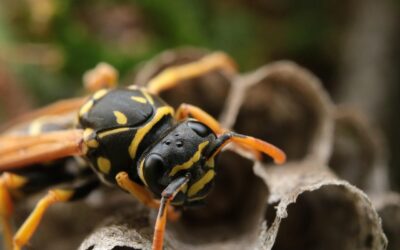
- Paper wasps: Long, narrow body with dangling legs in flight. Build umbrella-shaped open nests, usually in soffits or roof eaves.
- Yellowjackets: Shorter, stockier, faster fliers. Build large enclosed nests in wall cavities, attics, or underground.
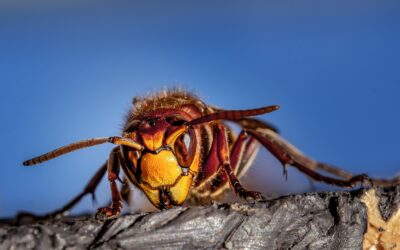
- Bald-faced hornets: Black and white, larger. Build distinctive gray football-shaped nests usually on the outside but occasionally in attic eaves.
- Mud daubers: Solitary, not aggressive, build small mud tubes on siding. Rarely a real infestation.
Yellowjackets are the most common culprit in the no-windows-open scenario because their nests are often invisible inside walls. They also become more aggressive in late summer when the colony peaks.
Removing the Wasps Inside Your House
For the few wasps already inside, do not use a flyswatter. Crushed wasps release alarm pheromones that draw more workers from the nest. Instead, use a vacuum with a long hose attachment, preferably a shop vac. Pour about a cup of soapy water into the canister first. The soap breaks the surface tension and drowns them within seconds.
For one or two visible wasps, a wet kitchen towel thrown over them works fine. Wad it up with the wasp inside and flush it. Avoid sprays indoors. Most aerosol wasp killers contain propellants that smell terrible for days and leave a slick residue on countertops.
Treating the Nest Itself
You have two choices for the nest: DIY treatment or calling a pro. For a soffit or accessible eave nest, a can of Spectracide PRO Wasp and Hornet Killer at $4 fires a stream 27 feet, letting you treat from a safe distance after dark. Wear long sleeves, pants, and eye protection regardless.
Wall-cavity yellowjacket nests are different. Spraying into the entry hole drives wasps deeper into the wall and they often find their way into your living space looking for a new exit. The right move is a dust pesticide like Delta Dust applied with a duster wand, which the workers carry deeper into the nest and kill the colony from inside. Cost is about $20 for the duster and another $25 for a 1-pound bottle of Delta Dust. Treat at dusk, leave the entry open for 48 hours so returning foragers also contact the dust, then seal it.
If the nest is in an attic and larger than a softball, hire a pest control company. National Pest Pros, Aptive, and Orkin charge $150 to $400 for a wasp nest removal with a 30-day callback guarantee. The math favors a pro on a major infestation.
Sealing the Entry After Treatment
Wait 48 to 72 hours after treatment before sealing. Foragers that were out hunting need to return and die inside the nest. Then seal the entry permanently with copper mesh stuffed into the gap and exterior-grade silicone caulk over the top. Caulk alone gets chewed through. The copper mesh stops new colonies from reopening the same path.
Walk the rest of the exterior afterward and seal every other potential entry. One sealed gap means the next queen finds a different one next spring. A morning of thorough caulking and screen repair is the only real long-term fix.