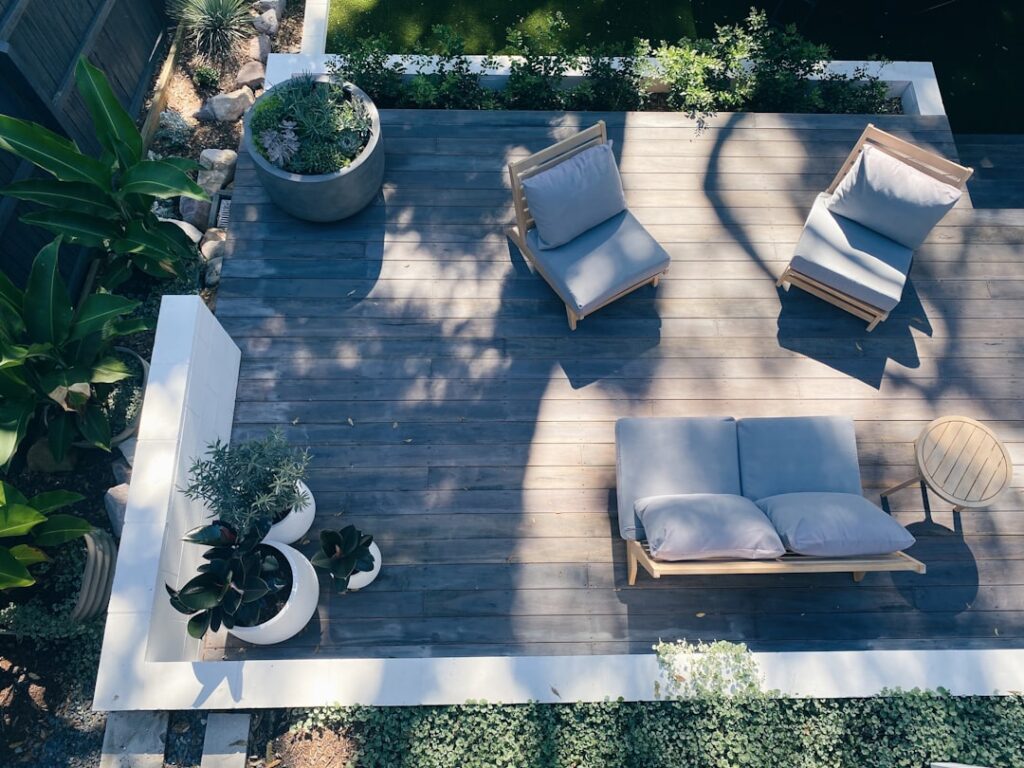
Every spring, homeowners haul leftover luxury vinyl planks onto their decks and discover by August that interior flooring and sunshine do not mix. Real waterproof outdoor vinyl flooring for decks is a different product entirely: heavy sheet-vinyl membranes — the same family of material used on boat decks and rooftop patios — that are heat-welded into a continuous, walkable waterproof skin over the deck surface. Done right, a vinyl deck membrane waterproofs the space below it, survives UV and freeze-thaw for 15 to 25 years, and never needs staining. Done with the wrong product, it peels, fades, and traps water against your framing. Here is how the real category works, what it costs, and why the LVP shortcut fails.
Part of our Roofing guide — explore the full guide →
First, the Hard Truth: Interior LVP Is Not Rated for Decks
Standard luxury vinyl plank and tile — even the “100 percent waterproof” kind — is engineered for climate-controlled interiors, and manufacturers say so plainly in their warranty documents. Outdoors, three things kill it fast. Direct sun pushes surface temperatures past 140°F, beyond most products’ rated range, causing expansion, buckling, and warped click joints; UV exposure fades and embrittles wear layers that carry no outdoor UV package; and freeze-thaw cycling cracks rigid cores and pops seams. Water gets under floating planks and sits against the deck structure, accelerating rot instead of preventing it. A few manufacturers sell covered-porch-rated vinyl for fully roofed, screened spaces — always verify the specific product’s exterior language — but an open deck voids essentially every interior vinyl warranty on the market. If a contractor proposes laying interior LVP on your open deck, that is your cue to find another contractor.
Once your patio flooring is in place, think about how you’ll use the space. A gazebo adds shade and structure, while a good outdoor furniture set turns it into a spot you’ll actually want to hang out in. A deck box is also worth considering if you need somewhere to stash cushions and outdoor gear.
We may earn a commission when you purchase through our links.
What Vinyl Deck Membrane Actually Is
The legitimate product is heavy-gauge PVC sheet, typically 60 to 80 mil (about 1/16 inch) thick, manufactured with UV stabilizers, embossed slip-resistant texture, and often a fiberglass or polyester reinforcement layer. Established names in the category include Duradek, Tufdek, Econodek, and Dec-Tec — brands sold through trained installers or as DIY kits. The sheet is fully adhered to a smooth substrate with adhesive, and seams are hot-air welded (or chemically fused) so the finished surface is one continuous waterproof membrane, sloped to drain and terminated with metal drip edges and wall flashing.
This is the same functional idea as a boat’s nautical-grade decking: a wear surface and a waterproofing layer in one product. Many of these membranes are code-recognized as walking-deck waterproofing, which matters enormously for one use case in particular — decks with living space, storage, or another deck underneath, where “waterproof” has to mean it, not merely shrug off rain.
The Substrate Requirement Nobody Warns You About
Vinyl membrane does not install over standard gapped deck boards. It needs a smooth, continuous substrate — typically 5/8-inch or 3/4-inch tongue-and-groove plywood, sloped roughly 1/4 inch per foot away from the house, with joints sanded or filled. On an existing joist-framed deck, that means sheeting over (or replacing) the current boards, which adds $2 to $4 per square foot in material and labor to the project. Concrete balconies work too, once cracks are patched and the surface is ground smooth. Skipping substrate prep is the number one cause of membrane failure: every board gap and popped nail head eventually telegraphs through or punctures the sheet. Budget for the plywood; it is not optional.
Honest Costs in 2026
- Membrane material: roughly $2 to $5 per square foot for the vinyl sheet itself, depending on thickness and pattern.
- Professionally installed: $8 to $15 per square foot including adhesive, welding, flashing, and drip edge — more where substrate rebuilds are extensive.
- DIY kits (Econodek-style): $4 to $7 per square foot delivered with adhesive and edge trim; realistic for a patient DIYer on a simple rectangular deck.
Compare that with the alternatives: pressure-treated wood decking runs $2 to $5 per square foot in material but demands refinishing every 2 to 3 years; composite boards run $4 to $9 in material and are not waterproof (water passes between boards); and a full waterproofing system under tile can pass $20 per square foot. For a 200-square-foot balcony over a garage, a professionally welded vinyl membrane at $2,000 to $3,000 is frequently the cheapest genuinely waterproof answer.
Living With a Vinyl Deck: The Pros
Owners tend to become evangelists, and the reasons are practical. Maintenance drops to soap-and-water washing a couple of times a year — no staining, sealing, or sanding, ever. The welded surface keeps rain out of the joists and whatever sits below, and quality membranes carry 10-to-15-year waterproofing warranties with real 20-to-25-year service lives. Textured finishes provide good wet traction, a genuine consideration around hot tubs and pool decks. Patterns have improved dramatically too; modern printed membranes come in wood-plank, slate, and aggregate looks that read far better than the beige sheet of the 1990s. And when the membrane finally ages out, the substrate beneath is typically dry and sound, so re-covering is straightforward.
And the Cons, Stated Plainly
Vinyl membrane gets hot in full sun — lighter colors help, but barefoot comfort on a 95°F afternoon trails wood. Dark membranes in southern exposures can fade unevenly over a decade despite UV packages; this is a slow soft failure, not a structural one, but it is real. The look remains sheet vinyl: convincing at a glance, but nobody will mistake it for ipe at close range. Seam and flashing quality is everything — a poorly welded seam or sloppy wall termination leaks in exactly the way the product exists to prevent, so installer selection matters more than brand selection. Punctures from dragged furniture legs or dropped grill tools are patchable, but patches show. Finally, gapped-board deck purists simply may not want a continuous surface at all; a membrane changes how the deck sheds water, and gutters or scuppers at the low edge become part of the design.
Who Should Choose Vinyl Deck Membrane?
Waterproof outdoor vinyl flooring for decks earns its keep in specific situations: any deck or balcony with usable space beneath it, rooftop patios, decks over living areas where a leak means drywall damage, hot-tub surrounds, and owners who are permanently done with the stain-and-seal cycle. Choose a 60-mil-plus reinforced membrane from an established brand, insist on heat-welded seams and manufacturer-trained installation, and get the slope and flashing details in the written scope. Skip the category if you love the look of real wood boards, your deck is a simple ground-level platform where waterproofing buys nothing, or your budget cannot cover proper substrate prep — because on this product, the prep is the project.
Prefer to explore on your own?
See how new flooring looks in your actual room in seconds — free, no signup.
Try the free Floor Studio →