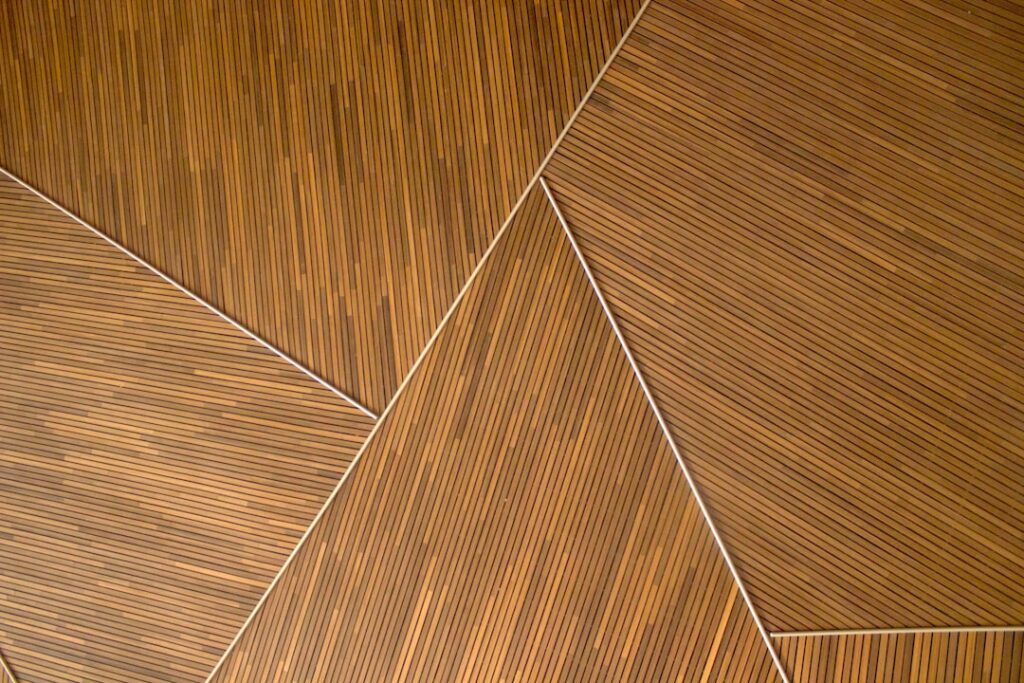
If you have ever admired a wood floor laid in intricate geometric patterns rather than straight planks, you have seen parquet. So what is parquet, exactly? It is a style of wood flooring made from small pieces of wood arranged into repeating geometric designs, most famously the herringbone and the classic square basket-weave. Rather than running long boards in one direction, parquet treats the floor as a canvas, creating patterns that add depth, movement, and a sense of craftsmanship to a room.
- A Brief History of Parquet
- Common Parquet Patterns
- Types of Parquet Flooring
- Parquet vs. Standard Plank Hardwood
- What It Costs
- Where Parquet Works Best
- Installation Considerations
- Choosing a Wood Species for Parquet
- Finishes and Their Effect on the Look
- Parquet Pieces, Tiles, and Panels
- Wear Layers, Refinishing, and Where Each Type Belongs
- Subfloor and Moisture Prep for Parquet
- Site-Finished vs. Prefinished Parquet
- Pros and Cons of Parquet
- Caring for a Parquet Floor
A Brief History of Parquet
Parquet has serious pedigree. The style rose to fame in 17th-century France, where elaborate parquet floors replaced marble in grand homes and palaces because marble required constant scrubbing that rotted the joists beneath. The famous parquet de Versailles pattern, with its large interlocking squares, dates from that era and still inspires high-end installations today.
From those royal beginnings, parquet trickled down to ordinary homes. It saw a major boom in mid-20th-century houses, when factory-made parquet tiles made the look affordable. After falling out of fashion for a while, parquet has surged back as homeowners rediscover its character.
Common Parquet Patterns
The pattern is the whole point of parquet, and several show up again and again:
- Herringbone: rectangular blocks set at right angles in a broken zigzag; the most popular pattern today.
- Chevron: similar to herringbone but the blocks are cut at an angle to form continuous V-shaped rows.
- Basket weave: blocks grouped to look like an over-and-under woven basket.
- Versailles panels: large square panels with an intricate interwoven design.
- Brick: a simpler offset pattern resembling laid brick.
Herringbone and chevron are the go-to choices for modern remodels because they read as both classic and current.
Types of Parquet Flooring
Parquet comes in a few constructions that affect cost and installation:
- Solid wood parquet: individual solid hardwood pieces, traditionally glued down, that can be sanded and refinished multiple times.
- Engineered parquet: a real wood veneer over a stable plywood core, more resistant to moisture and easier to install.
- Parquet tiles: pre-assembled squares of small wood pieces, often with a mesh backing, for faster installation.
Solid parquet offers the longest life and the ability to refinish, while engineered versions handle humidity swings and basements better and tend to install more easily.
Parquet vs. Standard Plank Hardwood
The biggest difference is visual. Plank hardwood emphasizes long, linear boards, while parquet emphasizes pattern and geometry. Parquet draws the eye into the design and can make a room feel more formal or more dynamic, depending on the pattern and finish.
Installation differs too. Laying parquet, especially herringbone or chevron, requires precise cutting and careful layout, so labor costs more than for straight plank. Refinishing parquet can also be trickier, since the grain runs in multiple directions and sanding must account for that to avoid scratching across the grain.
What It Costs
Because of the pattern work, parquet usually costs more to install than plain plank flooring. As a general guide, material runs anywhere from roughly $5 to $20 or more per square foot depending on wood species and construction, and installation labor for an intricate pattern adds a premium over standard plank labor. High-end Versailles panels and exotic woods push the top of the range much higher.
For homeowners on a budget who want the look, engineered parquet and parquet tiles bring the cost down while still delivering the geometric effect.
Where Parquet Works Best
Parquet suits rooms where you want a sense of craftsmanship and visual interest. It looks especially striking in entryways, dining rooms, living rooms, and studies, where the pattern greets you and sets a tone. A herringbone floor running down a hallway draws the eye forward and makes the space feel longer and more intentional.
Because it is wood, parquet belongs in the same rooms as any hardwood. Avoid solid parquet in full bathrooms and other consistently wet areas, where moisture can lift the small pieces. In those spots, an engineered parquet or a wood-look tile in a herringbone pattern gives the look with better moisture tolerance.
Installation Considerations
Parquet installation is more demanding than straight plank, which is the main reason it costs more. The pattern has to be laid out from a precise centerline so the design stays balanced and the cuts fall evenly at the edges of the room. A single misaligned block throws off the whole geometry, so the work rewards a patient, experienced installer.
Solid parquet is typically glued down to a stable, flat subfloor, while engineered parquet and parquet tiles may be glued, nailed, or floated depending on the product. Whatever the method, the subfloor must be flat and dry, since any unevenness shows quickly in a tight geometric pattern. For most homeowners, parquet is a job to hire out rather than tackle as a first DIY flooring project.
Choosing a Wood Species for Parquet
The wood you choose shapes both the look and the durability of a parquet floor. Oak is the workhorse, prized for its hardness and pronounced grain that reads beautifully in herringbone and chevron. Walnut brings a deep, rich brown for a more dramatic, formal effect, while maple offers a pale, clean look with subtle grain that suits modern rooms.
Hardness matters in busy households. Domestic species like oak and hard maple resist dents from daily traffic better than softer woods, which is worth weighing if you have kids, pets, or rolling chairs. Exotic species can deliver striking color but often cost considerably more and may darken or shift tone with sun exposure, so factor in how a given wood will age in your light.
Finishes and Their Effect on the Look
How a parquet floor is finished changes its character as much as the wood itself. A matte or satin oil finish soaks into the grain and leaves a natural, low-sheen surface that is easy to spot-repair but needs periodic re-oiling. A polyurethane finish builds a harder protective film with more sheen and stronger resistance to spills, though refinishing it means sanding the whole floor.
Stain color is another lever. A light, natural stain keeps the geometry feeling fresh and contemporary, while a darker stain emphasizes the pattern’s contrast and lends a traditional, formal mood. Whatever you choose, test the stain and finish on a sample of the actual wood, since the same color reads very differently across oak, walnut, and maple.
Parquet Pieces, Tiles, and Panels
The word parquet comes from French and refers to a small enclosed area, a nod to the way the floor is built from many compact pieces. Traditional parquet uses short slats, often called fingers or blocks, that typically run about 4 to 9 inches long and under an inch to roughly 2 inches wide. Herringbone and chevron blocks are usually longer rectangles, while Versailles-style panels are large squares, commonly 2 to 3 feet across, assembled from many small strips.
Most modern parquet tiles arrive as roughly 12-inch squares with the pattern already fixed to a mesh or paper backing. Laying them is closer to setting large tiles than fitting individual blocks, which cuts installation time sharply and is a big reason parquet has become affordable again.
Wear Layers, Refinishing, and Where Each Type Belongs
Solid parquet can usually be sanded and refinished several times over a life measured in many decades, but it swells and shrinks with humidity, so it is a poor match for concrete slabs and basements. Engineered parquet has a hardwood wear layer, typically about 2 to 6 millimeters thick, over a cross-layered plywood or fiberboard core. That core keeps it stable enough for basements and floors with radiant heat. The tradeoff is fewer refinishes: a thicker wear layer may allow one or two sandings, while a very thin veneer is effectively a one-life floor, so check the wear-layer thickness before you buy.
Subfloor and Moisture Prep for Parquet
Small pieces telegraph every dip, so parquet needs a flatter subfloor than most plank floors. A common target is flat within 3/16 inch over 10 feet, checked with a long straightedge, with low spots filled using a self-leveling compound. Over concrete, test for moisture before any wood goes down and use a moisture-mitigation primer or barrier if the readings are high.
Most parquet is glued down with a urethane or similar flooring adhesive, spread in sections small enough that it does not skin over before the pieces are set. Floating installation generally does not suit true small-block parquet, since the pieces will not stay flat without full adhesion. Leave an expansion gap of about 1/2 inch at the walls, hidden under baseboard or shoe molding.
Safety note for older floors: vintage parquet was often set in black bitumen-type mastic, and some older adhesives contain asbestos. Have old adhesive tested before you scrape, sand, or grind it, and do not dry-sand it yourself.
Site-Finished vs. Prefinished Parquet
Site-finished parquet is sanded flat and coated after installation, which produces the smoothest surface with tight, filled seams. It also creates dust and usually means staying off the floor for a couple of days while coats dry. Prefinished parquet arrives with the finish already applied, so the floor is usable the same day, but the small beveled edges between blocks can collect grit over time.
Pros and Cons of Parquet
Pros: strong visual character, appeal to buyers, and, in solid form, a floor that can last generations with refinishing. Pattern choice can also change how a room feels: a tight herringbone leads the eye along diagonals and can make a small room seem larger, while a repeating Versailles panel gives a big open floor a sense of structure.
Cons: a higher installed cost, sensitivity to moisture and humidity swings, and more seams to keep clean. Repairs are fiddlier than with planks, because a patch has to match both the wood and the angle of the pattern. Keeping indoor humidity around 35 to 55 percent year round helps limit seasonal gaps and cupping.
Caring for a Parquet Floor
Parquet is wood, so it asks for the same basic care as any hardwood. Sweep or vacuum regularly to remove grit that scratches the finish, and wipe up spills quickly since standing water can swell the small pieces and lift them at the seams. Use a cleaner made for hardwood and avoid soaking the floor with water or steam.
Protect the finish by placing felt pads under furniture legs and rugs in high-traffic zones. Solid parquet can be sanded and refinished when it gets worn, refreshing decades-old floors, though the multi-directional grain calls for an experienced refinisher. Treated with care, a parquet floor can last generations while adding a level of craftsmanship and character that straight planks simply cannot match.
Prefer to explore on your own?
See how new flooring looks in your actual room in seconds — free, no signup.
Try the free Floor Studio →