Ask three stone yards what this material is and you may get three different answers — granite, quartzite, or marble. White Fantasy granite countertops deliver the soft white-and-gray veined look of Carrara marble at a fraction of marble’s fragility, which explains why the stone flies out of slab yards. But the trade name hides a geological identity crisis that directly affects how the counter behaves around lemon juice, wine, and hot pans. Buy it with clear eyes and it is one of the best marble-look values in natural stone; buy it believing it is a true granite and you may be disappointed within a year.
Part of our Countertops guide — explore the full guide →
- What White Fantasy Really Is
- The Look: Why People Fall for It
- Installed Cost in 2026
- Durability: The Honest Report Card
- Living With It: A Realistic Care Routine
- Design Pairings That Earn the Stone Its Name
- White Fantasy vs. Super White vs. Quartz
- Fabrication Notes Before You Sign
- Is It White Fantasy Quartzite or Marble? Tests You Can Do at the Yard
- Buying White Fantasy Quartzite Slabs: Sizes, Thickness and How Many You Need
- The Bottom Line
What White Fantasy Really Is
White Fantasy is quarried in Brazil and belongs to the same family as Super White and Fantasy White — commercial names that overlap and get swapped freely between importers. Laboratory testing on stones from this family consistently identifies them as dolomitic marble or a dolomite-quartzite hybrid rather than granite. Dolomite is a carbonate mineral, harder and less reactive than the calcite in classic marble, but still a carbonate — which means acids can etch it and it scratches more easily than a true granite or quartzite.
Why does the industry call it granite? Partly habit, partly sales strategy: “granite” signals durability to buyers. In practice, think of White Fantasy as sitting on a durability ladder — meaningfully tougher than Carrara or Calacatta marble, noticeably softer than Taj Mahal quartzite or any real granite. Priced and cared for on those terms, it earns its popularity honestly.
The Look: Why People Fall for It
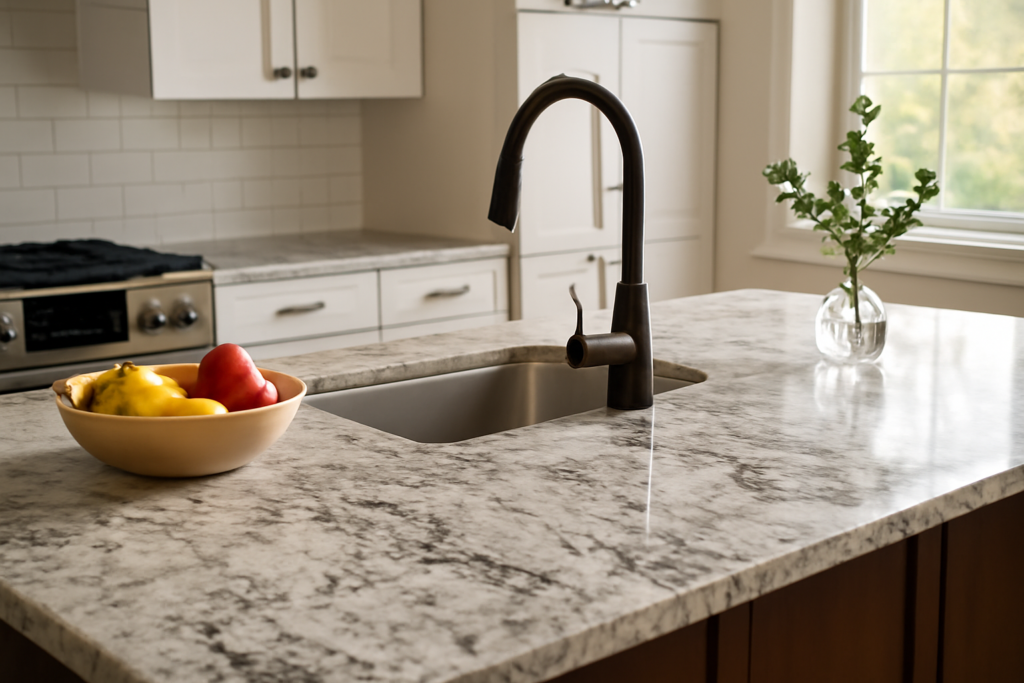
The visual formula is a cool white-to-pale-gray background crossed by soft charcoal veining that moves in loose, cloudy diagonals rather than the tight linear strikes of a quartzite. Some slabs carry a faint icy blue cast; others warm toward greige. The veining has genuine depth — under polish, you can see gray layers floating beneath the surface, an effect engineered quartz still struggles to counterfeit even in its best marble-look patterns.
Slab variation is significant within this stone family, so shop bundles in person. Slabs cut from the same block are sold in sequence, and adjacent slabs book-match beautifully for waterfall islands or full-height backsplashes. A leathered finish has become popular on White Fantasy because it adds grip and hides minor etching; expect to pay $10 to $18 per square foot extra if the yard has to send a polished slab out for refinishing. Honed is the middle path — matte, soft, and very Carrara-like, though it shows fingerprints and oil marks more readily until sealed well.
Installed Cost in 2026
White Fantasy occupies the mid-premium band — above commodity granites, below exotic quartzites:
- Slab material: $55 to $85 per square foot for 3cm slabs, with premium lots to $100
- Fabrication and install: $35 to $55 per square foot on top
- Typical 40 sq ft kitchen: $3,800 to $5,600 complete
Compare that with honed Carrara marble at a similar or slightly lower price but far higher maintenance, and with true white quartzites like Mont Blanc that start closer to $90 per square foot in material alone. Vanity-size remnants run $300 to $600 finished and make this stone an easy yes for bathrooms, where acid exposure is limited to toothpaste and the occasional cosmetic spill.
Durability: The Honest Report Card
Scratch resistance lands around 3.5 to 4 on the Mohs scale for the dolomite content, with harder quartz zones scattered through many slabs. Daily utensil contact will not carve it up, but dragging a cast-iron skillet or cutting directly on the surface will leave marks a granite would shrug off. Use boards, and felt-pad the small appliances you slide around.
Etching is the bigger conversation. Lemon juice, vinegar, tomato sauce, and wine left on the surface can leave dull ghost marks in the polish — slower and fainter than on calcite marble, sometimes taking hours rather than minutes, but real. On polished slabs, etches show as flat spots at an angle to the light; on honed and leathered finishes they often disappear entirely into the texture, which is exactly why experienced fabricators steer kitchen clients toward those finishes. Heat tolerance, by contrast, is genuinely good: brief contact with hot cookware will not scorch the stone, though trivets protect the sealer and polish. Staining is the easiest risk to manage — a quality impregnating sealer applied at install and renewed yearly keeps coffee and oil sitting on the surface where a paper towel handles them.
Living With It: A Realistic Care Routine
Households that love their White Fantasy counters follow a simple pattern. Spills get wiped promptly — not frantically, just within the hour, and acidic spills first. Cleaning happens with pH-neutral stone spray or plain dish soap; vinegar-based and citrus cleaners stay under someone else’s sink. The sealer gets the water-drop test every six months: drops that darken the stone within 10 to 15 minutes mean it is time for a $30 quart of penetrating sealer and a half hour of wipe-on, wipe-off work.
When damage does happen, repairs are more forgiving than most owners expect. Light etching on a honed surface can often be blended with a marble polishing powder in ten minutes of DIY effort. Deeper etches, scratches, or a dulled zone near the sink can be professionally re-honed on site for $250 to $500, restoring the surface to factory condition — a repair path engineered quartz simply does not offer, since its damage is permanent.
Design Pairings That Earn the Stone Its Name
White Fantasy is the rare surface that flatters both warm and cool palettes. With white or greige shaker cabinets and polished nickel, it produces the classic bright marble kitchen without marble anxiety. Against deep blue or charcoal cabinetry, the gray veining ties the palette together while the white field keeps the room from going dark. Natural white oak — flat-panel for modern, shaker for transitional — may be the single best partner, its warmth balancing the stone’s cool base.
For backsplashes, a full-height slab of the same material behind the range is the showpiece move, typically adding $1,200 to $2,500. On a budget, simple white ceramic in a matte finish defers to the counter. Brass and champagne bronze hardware warm the stone; matte black sharpens it. Because the veining is soft and cloudy, White Fantasy also tolerates patterned tile floors better than dramatic quartzites, which fight for attention.
White Fantasy vs. Super White vs. Quartz
Cross-shopping is inevitable, so here is the short version. Super White is essentially the same stone family — evaluate the individual slab, not the label, and if a yard claims one is quartzite and the other marble, ask for the absorption and hardness test data. True quartzites like Mont Blanc or White Macaubas cost 30 to 60 percent more but etch-proof the kitchen entirely. Marble-look quartz matches White Fantasy’s price, kills the maintenance question, and loses on depth, heat tolerance, and repairability. There is no wrong answer — only a wrong match between surface and household. Messy cooks who batch-cook tomato sauce every Sunday belong with quartzite or quartz; careful households get the real-stone look for thousands less with this material.
Fabrication Notes Before You Sign
Dolomitic stones cut cleanly but chip more readily at the blade than granite, so shop selection matters. Ask the fabricator directly whether they have cut Super White or Fantasy White before and what edge profiles they recommend for it — an experienced shop will steer you toward eased, pencil-round, or small bevel edges and away from delicate ogee details that can flake at the arris. Insist on steel rodding at the sink rails, and confirm the quote includes sealing before the crew leaves. If your layout needs a seam, ask to see it placed away from the sink and dishwasher zone, where water and heat cycling stress the epoxy hardest. None of these requests add meaningful cost; all of them add years to the counter.
Is It White Fantasy Quartzite or Marble? Tests You Can Do at the Yard
Many yards now label this stone white fantasy quartzite, while others call it granite or dolomite. Because the label changes how the counter handles acids and scratches, it pays to test the actual slab or an offcut from the same bundle rather than relying on a name. These simple checks take a few minutes and most reputable suppliers will allow them on a remnant.
The Glass Scratch Test
Bring a plain glass tile or the bottom of a glass jar. Press a sharp edge of a stone offcut firmly across the glass. True quartzite is harder than glass and will leave a clear scratch with little effort. A dolomitic stone usually skates over the glass or leaves only a faint mark, and may show a powdery line on its own edge. Test in a few spots, since some slabs mix harder quartz bands with softer areas. Wipe the glass afterward to confirm the line is a real scratch and not a smear of stone powder.
The Acid Etch Test
Place a few drops of lemon juice or plain white vinegar on an unsealed spot of an offcut, leave it 10 to 15 minutes, then rinse and dry. Look across the surface at a low angle toward a light. A dull ring means the stone contains carbonate minerals and will etch in the kitchen. No change suggests a quartz-rich stone. A sample sold as white fantasy quartzite that etches quickly is behaving like dolomite, and you should plan finish and care choices accordingly.
The Water Absorption Check
Drip water on an unsealed polished area and time how long it takes to darken the stone. Darkening in under a few minutes points to higher porosity and a need for a quality impregnating sealer before use. Slow or no darkening suggests a dense stone. Repeat the test after sealing at installation to confirm the sealer took evenly, especially near the sink cutout and along cut edges.
Reading the Results and Staying Safe
If the stone scratches glass and resists acid, you likely have a quartz-rich slab that tolerates a polished finish in a busy kitchen. If it etches but scratches glass in places, treat it as a hybrid and lean toward honed or leathered surfaces. If it fails both, price and care for it as a durable marble. Write the results on your order so the fabricator knows what they are cutting. Never cut or grind stone samples yourself without water and protection: natural stone releases crystalline silica dust that harms the lungs, so wet cutting, a fitted N95 or P100 respirator, and HEPA vacuum cleanup are the minimum for any trimming at home. Leave countertop fabrication to the shop.
Buying White Fantasy Quartzite Slabs: Sizes, Thickness and How Many You Need
White fantasy quartzite, sold under the same name as the granite-labeled stone, usually arrives in full slabs roughly 9 to 10.5 feet long and 5 to 6.5 feet tall, and most kitchens need two to three of them. The exact count depends on the island size, whether you want a full-height backsplash, and how carefully the fabricator can nest the cuts around the veining. Plan the layout before you tag slabs at the yard, because sequential slabs from one bundle are the only way to keep the pattern consistent.
2cm or 3cm Thickness
Most kitchen counters in this stone are cut from 3cm slabs, which span sink cutouts and short overhangs without a plywood subtop. A 2cm slab is lighter and suits backsplashes, shower walls and vanity tops, but on a kitchen counter it needs a laminated or mitered edge to look substantial. For a waterfall island, a mitered 3cm edge gives the cleanest vein wrap.
Rough Slab Count by Layout
| Kitchen layout | Approximate counter area | Typical slab count |
|---|---|---|
| Galley or single wall, no island | 25 to 35 sq ft | 1 to 2 slabs |
| L-shape with small island | 40 to 55 sq ft | 2 slabs |
| U-shape or large island | 55 to 75 sq ft | 2 to 3 slabs |
| Any layout plus full-height slab backsplash | Add 15 to 30 sq ft | Add 1 slab |
Choosing Slabs at the Yard
- Ask for the bundle number and confirm the slabs you tag are sequential.
- Look at each slab both wet and dry; the gray veining deepens when wet, close to how it looks once sealed.
- Check for pits, natural fissures and resin fill, especially near where the sink will go.
- Take photos with a tape measure in frame so the fabricator can plan seams and vein direction.
Because slab sizes and yields vary by quarry block, ask the fabricator for a layout drawing showing where each piece comes from. That drawing confirms the slab count, shows seam placement, and prevents a short order that forces you to match a later slab from a different block.
The Bottom Line
White Fantasy granite countertops are marble in a work jacket — the elegance of Carrara with meaningfully better toughness, at a mid-tier price. Go in knowing it is a dolomitic stone, choose a honed or leathered finish for a hard-working kitchen, keep up the annual sealing, and it will deliver the white-veined look beautifully for decades. Just never let a salesperson convince you it is bulletproof granite, because the stone’s charm depends on treating it as what it actually is.