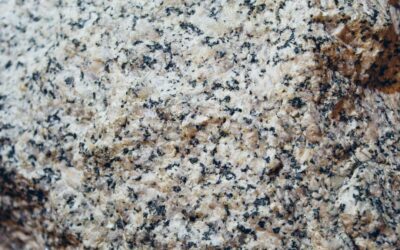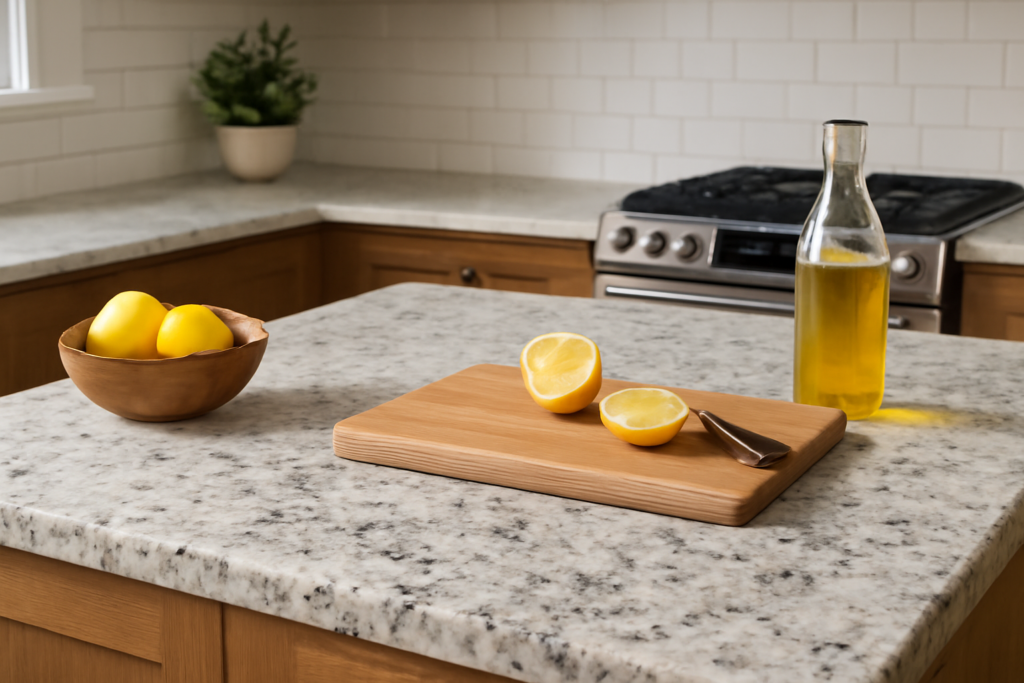
Some countertops demand attention. This one earns it quietly. Colonial white granite countertops bring a creamy off-white ground densely speckled with soft gray and pale lavender feldspar, plus the occasional pin-dot of black or dark red, and almost none of the dramatic veining that dominates stone showrooms today. That restraint is exactly the point. If you are designing a kitchen you intend to keep for two decades, a calm, evenly textured granite from southern India that flatters cream cabinetry and never fights the rest of the room is a genuinely smart bet, and it costs less than most people expect.
Part of our Countertops guide — explore the full guide →
The Salt-and-Pepper Personality
Stand back ten feet and Colonial White reads as a warm, gentle white. Step closer and the surface resolves into thousands of small mineral grains: translucent quartz, milky feldspar, soft gray flecks, and scattered crystals with a distinct lavender or gray-violet cast that catches you off guard the first time you notice it. Those lavender feldspar crystals are the stone’s signature, subtle enough that guests will never name the color but present enough to give the counter depth that plain white surfaces lack. A sparse sprinkling of tiny black biotite dots and the odd dark garnet fleck completes the mix.
What you will not find is movement. There are no rivers of gray, no bold diagonal veins, no dramatic patches. The pattern is granular and evenly distributed edge to edge, which fabricators love because seams nearly vanish and there is no vein flow to match. In a large kitchen with multiple slabs, that uniformity is worth real money; you are not paying a premium slab count just to keep a pattern running in the same direction.
Where This Stone Belongs
Colonial White is happiest in traditional and transitional kitchens. Its cream-leaning base pairs beautifully with antique white, ivory, and glazed cream cabinetry, the very cabinets that make cool, stark whites look gray and sickly. Raised-panel doors, furniture-style islands, warm brass or antique bronze hardware, and hardwood floors in oak or hickory all sit comfortably alongside it. It also works in softer modern schemes: pale sage or mushroom-gray shaker cabinets with brushed nickel pulls, for instance, where the stone’s speckle adds texture without competing.
Because the counter is visually quiet, the backsplash can go either direction. A tumbled travertine or cream subway tile keeps everything serene and classic. Alternatively, use the counter’s calm as a foundation for a statement backsplash, a handmade zellige in soft green or a patterned cement tile, something you could never pull off above a heavily veined stone. Colonial White will not argue with it.
Reading the Undertones Before You Commit
The single most common mistake with this granite is pairing it against a bright, blue-white surface and expecting them to match. Colonial White is warm. Hold a sheet of printer paper against a sample and the stone will look faintly beige-gray by comparison. That warmth is a feature next to cream cabinets and warm wood floors, but next to icy white cabinets, arctic quartz islands, or cool gray-blue paint it can read slightly dingy. Bring home an actual sample, set it against your cabinet door and flooring in both daylight and evening lamp light, and check whether the lavender flecks pick up any wall color in the room. In north-facing kitchens the gray speckle steps forward; under warm 2700K bulbs the cream base does. Know which version you are buying.
Cost: What a Colonial White Kitchen Runs
Plan on $45 to $65 per square foot installed. That is a notch above bargain-tier Indian granites, mostly because Colonial White’s clean, consistent bundles command a small premium, but still comfortably mid-market. Raw 3 cm slabs wholesale around $10 to $16 per square foot. For a typical 50 sq ft kitchen, budget roughly $2,300 to $3,300 including fabrication and installation with a standard edge.
Line items to watch on quotes:
- Sink cutouts: $150 to $300 for an undermount with polished interior edges
- Cooktop cutout: $100 to $200
- Upgraded edge profiles: $10 to $30 per linear foot for ogee or dupont
- Tear-out of existing tops: $150 to $400 depending on material
Slabs typically measure about 110 to 125 inches by 65 to 75 inches. Since pattern matching is a non-issue, ask your fabricator to nest cutouts aggressively; on this stone there is no design penalty for economical layout, and a good shop can sometimes squeeze a small kitchen out of a single slab that would take two slabs of a veined material. Remnant pieces are also worth asking about. Because Colonial White moves steadily through most fabrication shops, offcuts large enough for a 60-inch bathroom vanity or a laundry counter turn up regularly at $25 to $40 per square foot fabricated, a meaningful discount for secondary rooms where you want the kitchen stone to repeat.
Finish and Edge Choices
Polished is the default and shows the crystal structure at its best, each feldspar grain reflecting light at a slightly different angle so the surface shimmers gently as you move through the kitchen. A honed finish suits this granite unusually well, too. Because the pattern is fine and even, honing turns it into something resembling a warm soapstone-adjacent surface, very current in farmhouse designs, though you trade away the sparkle and take on more frequent sealing. Leathered Colonial White is rare but attractive where offered, adding a soft tactile ripple that hides crumbs and water spots around prep zones.
For edges, this is one of the few white granites where a traditional profile genuinely fits. An ogee or half bullnose complements raised-panel cream cabinetry and reinforces the classic character. In transitional rooms, a simple eased edge keeps things versatile. Full bullnose remains popular on bathroom vanities in this stone, where its softness suits the material.
Sealing, Stains, and Long-Term Care
Colonial White is a medium-porosity granite, and its light color means anything it absorbs will show. Sealing is not optional. Your installer applies the first coat; after that, reseal every 12 months with an impregnating sealer, or sooner if a 15-minute water puddle darkens the surface. The whole kitchen takes half an hour and a $25 bottle. Choose an impregnating penetrating sealer rather than a topical coating; topical products build a film that scratches and clouds, while a penetrating sealer soaks into the pores and leaves the natural surface exposed. Two thin coats applied 20 minutes apart outperform one heavy flood coat, and any residue left to dry on the polish will haze, so buff thoroughly with a dry microfiber before the sealer cures.
Oil is the enemy to respect. Olive oil, bacon grease, and butter left overnight near the range can leave a dark halo in the stone that takes a poultice of baking soda and acetone several days to draw out. Wine, coffee, and juice are far less threatening on a properly sealed surface; wipe them within the hour and they leave nothing. Skip acidic and abrasive cleaners, which strip sealer, and use a pH-neutral stone cleaner or plain soapy water. Heat tolerance is excellent, as with any granite, but keep using trivets near seams. With that modest routine, this stone shrugs off decades of daily cooking, and its busy fine grain hides crumbs, water spots, and small chips better than any plain or heavily veined surface will.
Colonial White vs. Its Common Rivals
Shoppers usually cross-shop this stone against two others. River White, also Indian, carries flowing gray veins and burgundy garnet flecks on a cooler base; choose it if you want visible movement, choose Colonial White if you want calm and a warmer cast. Alaska White from Brazil is the opposite personality entirely, high-contrast and dramatic with big silvery crystal patches and dark mineral deposits, and its slabs vary enormously. Colonial White is also frequently compared with cream-toned quartz. Quartz wins on zero maintenance, but at $70 to $110 per square foot installed it costs substantially more, and it cannot replicate the depth of real feldspar crystal under light.
The Bottom Line
Colonial white granite countertops are the steady, gracious choice: warm, evenly textured, seam-friendly, forgiving of daily mess, and priced at $45 to $65 per square foot installed. They will not photograph like a dramatic marble-look slab, and they are not trying to. Verify the warm undertone against your actual cabinets, commit to an annual reseal, and pick the finish that matches your kitchen’s character, and this quiet Indian granite will outlast every trend cycle that passes through your house.