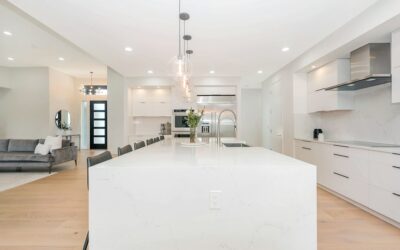
Marble lovers often fall for a slab at the stone yard, then hear the word “etching” and walk away. White pearl quartzite is one of the stones people turn to next: a soft gray-white background with a pearly shimmer and gentle, flowing veins in silver, taupe and charcoal. It delivers much of the elegance of a light marble while standing up far better to knives, heat and daily kitchen life.
Part of our Countertops guide — explore the full guide →
The quick take: genuine quartzite is a very hard natural stone, generally harder than granite, and resists scratching and heat well. It still has some porosity, so it needs a penetrating sealer, usually once a year or so in a kitchen. Before you buy, do a simple etch and scratch test on a sample, because some stones sold as quartzite behave more like marble. Price typically sits in the mid to upper range for natural stone, and since every slab differs, always see the actual slab in person.
What White Pearl Quartzite Looks Like
The name comes from the stone’s luminous, slightly reflective surface. Tiny crystals catch light so the slab seems to glow, especially when polished. The base ranges from bright white to light dove gray. Veining is usually soft and linear or wavy, running in long sweeps rather than tight spiderwebs, in shades of light gray, smoky taupe and occasional deeper charcoal lines.
As with any quarried stone, slabs vary. Some lots are almost white with faint veins; others carry stronger gray movement and even a hint of warm beige. Book-matched slabs, where two consecutive slabs are opened like a book to mirror the pattern, look spectacular on islands and full-height backsplashes.
Finish options
- Polished: maximizes the pearly shimmer and offers the best stain resistance.
- Honed: a velvety matte look that softens the shimmer and shows water marks a bit more.
- Leathered: textured, hides fingerprints and smudges, and highlights the crystal structure.
Hardness and Durability
True quartzite forms when sandstone is subjected to intense heat and pressure, fusing quartz grains into a dense, glassy rock. On the Mohs hardness scale, quartz rates about 7, which is harder than a steel knife blade and harder than the feldspar in most granites. In practical terms, that means everyday slicing will not scratch it, and it holds up to heat from pots far better than engineered quartz.
Durability is not unlimited. Quartzite can chip at edges and corners if struck by a heavy pan, and natural fissures are part of the stone. A good fabricator will stabilize fissures with resin. Eased or slightly rounded edges reduce chip risk compared with sharp square profiles.
Etch Testing: Make Sure It Is True Quartzite
Some stones marketed as quartzite contain a significant amount of calcite or dolomite, the minerals in marble. These “soft quartzites” etch from acids like lemon juice and vinegar and scratch more easily. Testing a sample protects you from an expensive surprise.
- Glass test: drag a sharp corner of the stone sample firmly across a glass tile or bottle. True quartzite scratches glass easily. Marble and dolomite will not.
- Knife test: try to scratch an inconspicuous area with a steel knife. Quartzite will resist and may leave metal marks that wipe off.
- Acid test: place a few drops of lemon juice or vinegar on the polished surface, wait 10 to 15 minutes, rinse and dry. Look at it at an angle in good light. A dull spot means the stone contains calcite and will etch.
Ask the supplier whether you may test a remnant or sample from the same lot. Reputable yards expect this question.
Sealing White Pearl Quartzite
Quartzite is denser than many granites but still has microscopic pores, and light-colored stones show oil and wine stains clearly. A penetrating granite and quartzite sealer fills those pores so spills bead up instead of soaking in.
How often
Run a water test every few months. Drip water on the counter and wait about 15 minutes. If the stone darkens, reseal. Most kitchens need it roughly once a year; low-use areas can go longer.
Sealing steps
- Clean with a pH-neutral stone cleaner and let the surface dry completely, ideally 24 hours.
- Ventilate the room by opening windows and running the exhaust fan.
- Put on nitrile gloves and eye protection; wear a respirator if the label recommends it.
- Apply sealer in small sections with a lint-free cloth.
- Let it penetrate for the label’s dwell time.
- Buff off every bit of excess before it dries to prevent haze.
- Wait the recommended cure time before setting items down.
Never mix sealers or cleaning chemicals, and keep solvent-based products away from gas burners and pilot lights while vapors are present. Dense polished quartzite may absorb very little sealer; if product sits on top without soaking in, the stone may not need another coat yet.
Kitchen Pairings
The cool gray and white palette makes this stone easy to design around.
- White cabinets: a bright, airy look; add warm wood shelves to keep it from feeling sterile.
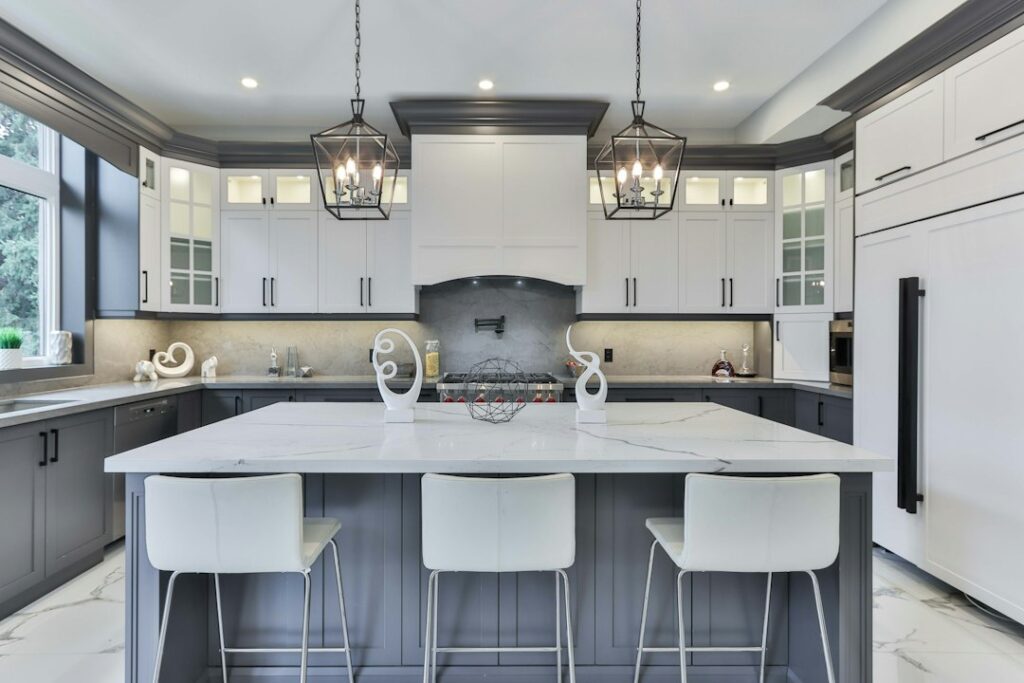
- Light or mid gray cabinets: tonal and serene, picking up the veining.
- Navy, black or charcoal: dramatic contrast that lets the shimmer stand out.
- Natural white oak or walnut: warmth that balances the cool stone.
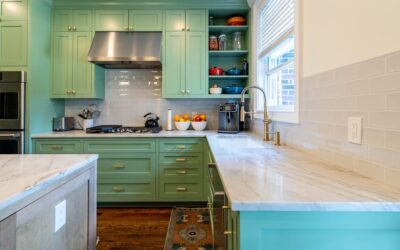
- Sage or muted green: soft and current, especially with brass hardware.
For backsplashes, a simple white or soft gray tile works, or carry the slab up the wall for a showpiece. Polished nickel, chrome and matte black hardware suit the cool tones; warm brass adds contrast. Flooring in light oak, gray-washed wood or large-format porcelain keeps the palette cohesive.
Layout, Edges and Slab Selection
Flowing veins look best when they move in one direction across a run. Ask your fabricator for a layout that shows where each piece will be cut from the slab, especially on the island. Keep seams away from the sink and cooktop, and try to place them where the veining is calm so the joint is less noticeable. Book-matched slabs give a mirrored effect across a seam, which can turn a necessary joint into a design feature.
When choosing a slab, look at the whole lot. Some pieces are brighter and more uniform, others carry stronger gray or beige movement. Tag the slab you want. For edges, eased and slightly rounded profiles resist chipping on this hard but brittle stone. A mitered edge adds visual thickness and lets the veins wrap over the front. Most kitchens use 3 centimeter slabs; 2 centimeter works for vanities and backsplashes.
Price Range and Value
Quartzite generally costs more than entry-level granite and similar to or above premium quartz. Installed prices commonly fall roughly between $70 and $150 per square foot, with book-matched slabs, thicker 3 centimeter material, mitered edges and full backsplashes pushing toward the top of that range. Fabrication costs more than granite because quartzite is so hard, wearing saw blades and polishing pads faster.
Compared with marble, you gain scratch and etch resistance. Compared with engineered quartz, you gain heat resistance and natural depth. Many homeowners consider that combination worth the premium for a kitchen they plan to keep for many years.
Troubleshooting
Dark spot after a spill
Oil stains can often be drawn out with a poultice of baking soda and water left under plastic wrap for 24 to 48 hours. Then reseal.
Dull patch near the sink
Could be mineral buildup from hard water or, on a soft quartzite, etching. Clean with a stone-safe cleaner first. If the dullness remains, a stone restoration pro can repolish it.
Hairline lines in the slab
Natural fissures are common and usually structurally sound. Cracks that catch a fingernail and widen over time should be checked by your fabricator.
When to Call a Licensed Professional
Quartzite slabs are heavy, rigid and can snap if mishandled, and cutting them creates crystalline silica dust that calls for wet cutting, dust control and fitted respirators. Hire an experienced stone fabricator for templating, cutting and installation. Use a licensed plumber for sink and faucet hookups and a licensed electrician for any new or moved outlets, which need GFCI protection near counters. Ask your local building department whether permits apply.
Frequently Asked Questions
Is white pearl quartzite real quartzite?
Most slabs sold under this name are genuine quartzite, but quality varies by quarry and lot. Do a glass scratch test and a lemon juice etch test on a sample to confirm.
Does white pearl quartzite need to be sealed?
Yes. Like most natural stones it has some porosity, so a penetrating sealer about once a year helps prevent oil and wine stains.
Can you put hot pans on quartzite?
Quartzite handles heat well, but trivets are still recommended to protect the sealer and avoid thermal shock from very hot cookware.
Is white pearl quartzite more expensive than quartz?
It is often similar to or more expensive than premium quartz, typically around $70 to $150 per square foot installed, because quartzite is harder to fabricate.
What color cabinets go with white pearl quartzite?
White, gray, navy, black and natural wood cabinets all work. The cool gray veining pairs especially well with painted cabinets and brass or nickel hardware.