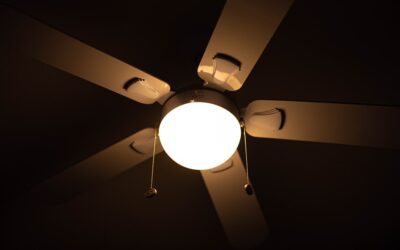
Nothing says relaxed coastal living quite like the gentle sweep of woven blades overhead. A wicker ceiling fan brings texture and warmth that a flat metal fan simply cannot, turning a plain ceiling into a design feature. If you are furnishing a sunroom, a screened porch, or a bedroom with a tropical or farmhouse vibe, a wicker ceiling fan ties the whole look together while still moving air efficiently. This guide covers blade materials, sizing, indoor and outdoor ratings, and what to check before you buy.
What a Wicker Fan Actually Is
The term covers fans with blades made from or wrapped in woven natural fibers, or a synthetic material molded to look like them. True wicker refers to the weaving technique, and the fibers may be rattan, bamboo, seagrass, palm leaf, or an all-weather resin woven to mimic them. The result is a blade with visible texture and an organic, handcrafted feel.
Some fans use solid woven-look blades, while others feature large palm-leaf or banana-leaf shapes for a bold tropical statement. The motor housing is usually a neutral finish like bronze, aged brass, or matte white so the woven blades stay the focal point.
Blade Materials and Styles
The blade material sets both the look and the durability, especially if the fan will see any humidity.
- Natural rattan or wicker: authentic texture, best for dry indoor rooms
- Bamboo: warm tone, slightly more moisture-tolerant, great for coastal decor
- Woven seagrass or abaca: fine texture, casual and beachy
- Palm or banana leaf: oversized dramatic blades for a tropical resort feel
- All-weather resin or composite: mimics wicker but survives damp and outdoor use
If your room ever gets humid, a synthetic all-weather blade is the smarter choice. Real natural fiber is beautiful but can dry out, fray, or attract moisture over time in a bathroom, porch, or humid climate.
Sizing the Fan to Your Room
A fan only feels good if it is sized correctly for the space. Blade span, measured in inches across the full sweep, should match the room’s square footage. Undersize the fan and it moves too little air; oversize it in a small room and it dominates and can feel gusty.
- Up to 75 sq ft, like a bathroom or breakfast nook: 29 to 36 inch span
- 76 to 175 sq ft, a bedroom or office: 42 to 48 inch span
- 176 to 350 sq ft, a living or dining room: 52 to 56 inch span
- Over 350 sq ft, a great room or large porch: 60 inch or larger, or two fans
Ceiling height matters too. For safety and airflow, blades should sit at least 7 feet above the floor and about 8 to 10 inches below the ceiling. On tall ceilings, use a downrod to lower the fan into the effective airflow zone; on ceilings under 8 feet, choose a flush-mount or hugger model.
Indoor, Damp, and Wet Ratings
Location dictates the rating you need, and this is where natural wicker gets tricky. Fans are UL-listed for one of three environments, and using the wrong rating is both a durability and a safety issue.
- Dry-rated: interior rooms only, no moisture, where most natural wicker belongs
- Damp-rated: covered porches, sunrooms, and bathrooms with humidity but no direct water
- Wet-rated: open patios and pergolas exposed to rain, requiring sealed motors and weatherproof blades
For a screened porch or sunroom, choose at least a damp-rated fan, and only a wet-rated fan should go anywhere rain can reach it. A dry-rated natural fiber fan installed outdoors will deteriorate quickly and can become an electrical hazard. Always match the fan rating to the location and confirm it on the product listing.
Motor, Airflow, and Control Options
Behind the woven blades, the motor determines how well the fan performs. Look at the airflow rating in cubic feet per minute, or CFM, which measures how much air the fan moves on high. A rating of roughly 5,000 to 7,000 CFM is solid for most rooms. Efficiency is listed as CFM per watt, and DC motors deliver more airflow per watt while running quieter and cooler than older AC motors.
Consider the controls that suit your space. A pull chain is simplest, a wall control keeps the switch tidy, and a remote or smart control lets you adjust speed and any integrated light from your chair or phone. Many wicker and tropical fans include a light kit, so check whether the bulb type and brightness meet your needs.
Cost and What to Expect
Prices span a wide range depending on materials and motor quality. Treat these as planning ranges. A basic dry-rated wicker-look fan runs about $80 to $200, a quality damp-rated fan with a better motor $200 to $450, and premium designer or large palm-leaf fans with DC motors $450 to $900 or more. Wet-rated and oversized fans sit at the higher end.
Installation by an electrician typically adds $100 to $300, more if new wiring or a fan-rated electrical box is required. Do not skimp on that box: a ceiling fan must hang from a UL-listed fan-rated box that can carry the weight and vibration, not a standard light box.
Installation and Safety Notes
Replacing a light fixture with a fan is a common upgrade, but a fan adds weight and constant motion that ordinary boxes are not built for. The fan must mount to a fan-rated box secured to the framing, and the wiring must be correct for the speed control and any light. Working in an energized ceiling box carries a real shock risk, so turn off the circuit at the breaker and, if you are not comfortable with electrical work or the existing box is not fan-rated, hire a licensed electrician. Follow the manufacturer’s mounting and wiring instructions for your specific model.
Once installed, balance the blades if you notice wobble, using the small balancing kit that ships with most fans. A wobble is usually a balance or a loose-screw issue rather than a defect, and correcting it keeps the fan quiet and extends bearing life.
Cleaning and Care
Woven blades collect dust in their texture, so plan on regular cleaning. A soft dusting brush or a vacuum with a brush attachment lifts dust from the weave without snagging the fibers. For natural rattan, avoid soaking it; a barely damp cloth followed by drying is safer than a wet wipe. Synthetic all-weather blades can handle a damp cloth and mild cleaner. Keeping the blades dust-free also keeps the fan balanced and efficient.
Styling a Room Around a Wicker Fan
A woven fan is as much a design piece as a comfort appliance, so it pays to think about how it fits the room’s look. It anchors coastal, tropical, boho, and farmhouse styles beautifully, echoing natural materials like rattan furniture, jute rugs, and linen textiles. In a sunroom or three-season porch, a wicker fan reinforces that relaxed, indoor-outdoor feel better than any metal fixture could.
Coordinate the finish of the motor housing and any downrod with your other metals in the room. A bronze or aged-brass housing warms up a space, while a matte white or weathered-wood housing keeps things light and airy. If the fan includes a light kit, the shade material and bulb color set the mood, so a warm-white bulb around 2700K to 3000K flatters the natural fibers and keeps the space cozy rather than clinical.
Scale is part of styling too. In a room with tall ceilings and big furniture, an oversized palm-leaf fan makes a confident statement, while a smaller woven-blade fan suits a modest bedroom or breakfast nook without overwhelming it. Look up and picture the blade span against the size of the room and the furniture below before you commit.
Do not forget the direction switch that makes a fan useful year-round. In summer, run the blades counterclockwise so they push air down and create a cooling breeze. In winter, flip the switch to clockwise on low so the fan gently pulls air up and pushes warm air that has risen back down along the walls, which helps even out the temperature. Pairing a wicker fan with the right bulbs, finishes, and seasonal settings turns it into a feature that looks good and works hard through every season.
Choosing the Right Wicker Fan
A wicker ceiling fan is an easy way to add coastal or tropical character while keeping a room comfortable. Size the blade span to your square footage, hang it at the right height, and above all match the moisture rating to the location, choosing synthetic all-weather blades for anywhere humid. Check the CFM for real airflow, confirm the electrical box is fan-rated, and verify the exact model’s rating and specs with the manufacturer before buying. Bring in an electrician when the wiring or box needs work, and you will enjoy both the breeze and the look for years.