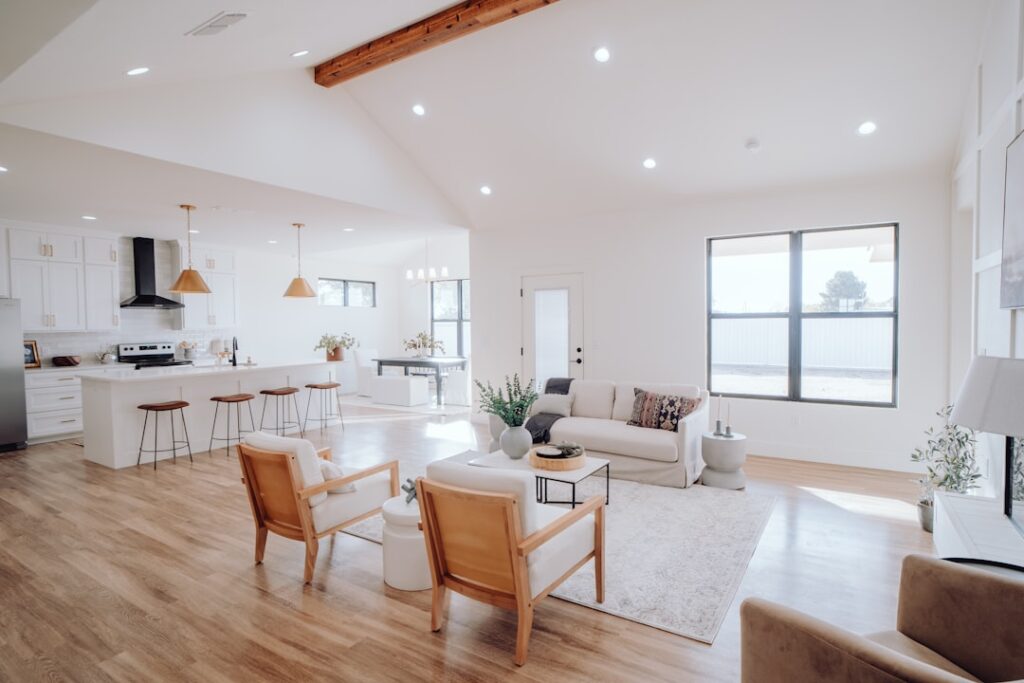
Walk through any modern farmhouse renovation or coastal new build and you will see one detail that anchors the whole look — long planks 7 to 10 inches wide running uninterrupted through open living spaces. Wide board flooring changes the visual scale of a room and reads more luxurious than traditional 2 1/4 inch strip oak, but it also moves more with humidity, costs more per square foot, and demands a flatter subfloor to install correctly. The payoff is significant when you do it right.
What Counts as Wide
The flooring industry defines “wide” as anything 5 inches or wider. The current sweet spot for new construction sits at 7 to 9 inches, with custom projects going up to 12 inches. Strip flooring (under 3 inches), plank flooring (3 to 5 inches), and traditional wide plank (over 5 inches) each have different install requirements and price points. Solid hardwood plank widths over 5 inches absolutely require nail-down installation over plywood subfloor; floating wide plank in solid hardwood will cup and gap within 2-3 humidity cycles.
Best Species for Wide Plank
- White oak: 1360 Janka, tightest grain, most dimensionally stable — the default for 7-9 inch installations.
- European white oak: similar Janka, even tighter grain, slightly more refined look. Premium price.
- Red oak: 1290 Janka, classic American look, slightly more movement than white oak.
- Eastern white pine: very soft (380 Janka) but historically authentic for wide plank in old New England homes.
- Heart pine: 1225 Janka reclaimed, dense and stable, signature look for Southern restorations.
- Walnut: 1010 Janka, premium dark tone, prone to checking — avoid in arid climates.
- Hickory: 1820 Janka, dramatic color variation, very stable — strong wide plank choice.
Solid Versus Engineered for Wide Planks
This is where most buyers should pick engineered. Wide solid hardwood (over 7 inches) gaps and cups under typical seasonal humidity swings of 30 percent to 60 percent relative humidity. Engineered construction with a 7-9 ply hardwood plywood core handles humidity swings far better — the cross-grain layers cancel expansion forces. Premium engineered wide plank from Anderson Tuftex, Hallmark Floors, Carlisle, and Stuga uses 4-6 mm sliced face veneers over 7-9 mm plywood cores, giving you genuine wood at the surface with stability the size demands. Realistic budgets: $9-$22 per sq ft for engineered wide plank versus $14-$30 per sq ft for site-finished solid wide plank.
Subfloor Flatness Is Non-Negotiable
Wide planks telegraph every subfloor flaw. The NWFA standard for any nail-down install is flatness within 3/16 inch over 10 feet, but wide plank installs typically tighten this to 1/8 inch over 6 feet. Self-leveling underlayment costs $1.50-$3 per sq ft and is often needed in 30-40 percent of older homes. Check moisture per ASTM F2170 on slabs (target under 75 percent RH at 40 percent depth) or with a pin meter on plywood (under 12 percent MC). Skip these steps and the floor will telegraph subfloor problems within 6 months.
Fastener Spacing and Technique
NWFA guidelines for solid plank wider than 5 inches require 8 inches on center fastener spacing minimum, with 1-2 inches from each end. Most pros tighten this to 6 inches on center for boards 7 inches and wider. Use 18-gauge cleats (not staples) on solid plank over 5 inches; staples concentrate stress and cause splitting. For engineered wide plank over 6 mm thick, glue-assist nail-down is the gold standard — apply Bostik BEST or Sika AcouBond as a moisture-managing adhesive bead behind each row, then nail through the tongue.
Acclimation and Humidity Control
Wide plank needs 7-14 days of on-site acclimation, double the time for narrow strip. Stack the boards in the room they will be installed in, with HVAC running at the homeowner’s normal year-round setpoint. Target 6-9 percent moisture content and within 4 percent of the subfloor. After installation, maintain indoor humidity between 35-55 percent year-round using HVAC humidification and dehumidification. Without humidity control, wide plank will cup in summer and gap in winter — the two failure modes manufacturers explicitly exclude from warranty coverage.
Expansion Gap Math
The 3/4-inch rule of thumb is too tight for wide plank. For floors over 5 inches wide, plan for 5/8 to 3/4 inch perimeter expansion. For floors over 7 inches, increase to 3/4 to 1 inch. Quarter round and base shoe must cover the gap entirely. For glue-down installs over slab, expansion gaps still apply because the floor itself expands and contracts as a unit. Cutting expansion gaps short is the second-most-common cause of wide plank failure after subfloor issues.
Pricing Reality Check
Material-only wide plank prices: 5-inch engineered oak runs $6-$9 per sq ft. 7-inch engineered runs $7-$12 per sq ft. 9-inch engineered hits $9-$16 per sq ft. Premium European white oak from Stuga or Carlisle in 10-12 inch widths reaches $18-$32 per sq ft material. Installation labor for wide plank runs $4-$7 per sq ft, higher than narrow strip because of the precise subfloor work and tighter fastener pattern. A 500 sq ft wide plank install in 7-inch engineered oak realistically costs $7,500-$11,500 turnkey.
When to Pick Wide Plank
Wide plank earns its premium in three situations. Open floor plans over 500 sq ft where the long sightlines emphasize plank length. High-end remodels where the wide plank visual is a major selling point. Historic restorations where original boards were 10-14 inches wide and a narrow strip would look wrong. For tight spaces, hallways under 4 feet wide, or budget-driven projects, narrower planks deliver 80 percent of the look at 60 percent of the cost. Match the format to the room scale and your humidity discipline, and wide plank delivers one of the most striking floors money can buy.
Prefer to explore on your own?
See how new flooring looks in your actual room in seconds — free, no signup.
Try the free Floor Studio →