
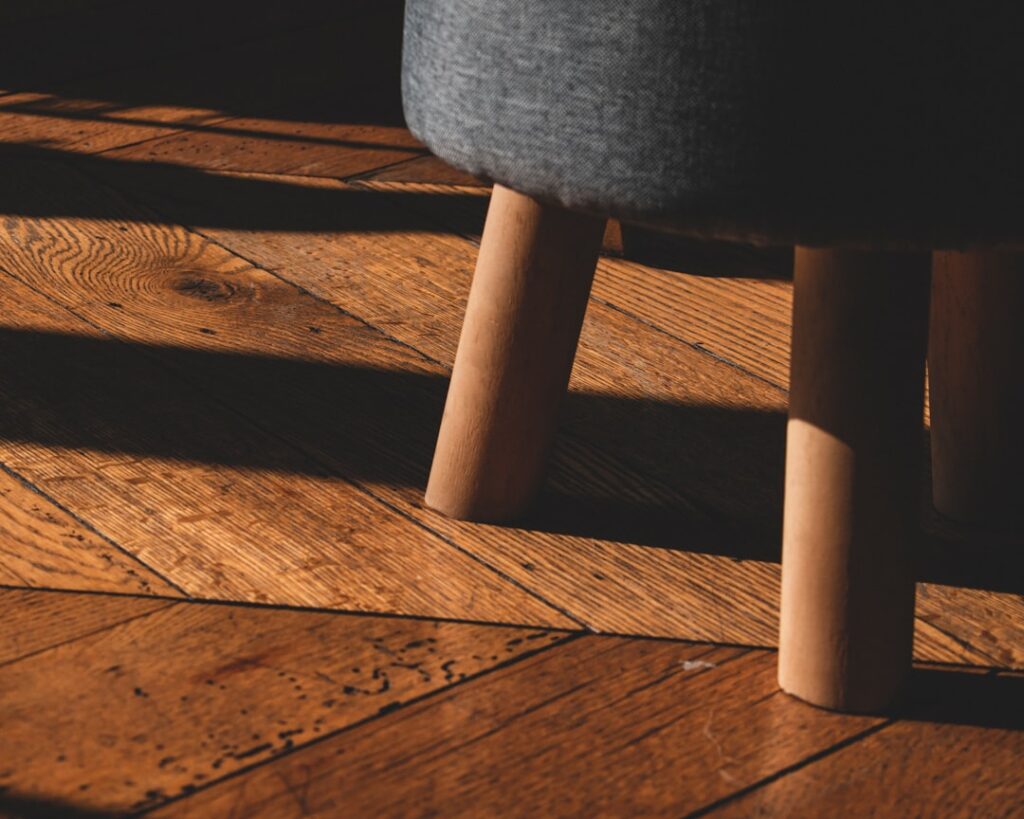
Run your hand across a cheap vinyl plank and an expensive one and you will understand the entire category in five seconds: one is a photograph under plastic, the other feels like sawn oak. What separates them is texture, and texture is the real story of wood grain vinyl flooring. The print layer gets vinyl 80 percent of the way to a wood look; the embossing — the physical grain pressed into the surface — carries the last 20 percent that fools your feet, your guests, and low-angle afternoon light. This guide focuses on that surface: how grain texture is made, what embossed-in-register means, and how to judge realism before you buy.
How Vinyl Gets Its Grain
A luxury vinyl plank is a sandwich: a rigid or flexible core, a high-resolution printed film that carries the wood image, a clear wear layer over that, and a factory finish on top. Texture enters at the wear-layer stage. During manufacturing, a textured press plate or roller stamps a three-dimensional pattern — grain lines, pores, knots, even saw marks — into the surface. The depth and pattern of that stamping determine whether the plank feels like wood or merely looks like it from across the room.
Cheaper products use a generic repeating texture, often a light orange-peel stipple or a shallow “ticking” pattern that has nothing to do with the printed image beneath it. Your eye may not name the problem, but it registers the mismatch: the picture shows a knot, the surface feels flat.
Embossed-in-Register: The Feature Worth Paying For
The premium technique is embossed-in-register (EIR), and it is the single most important term to know when shopping. EIR means the texture plate is synchronized with the printed film, so the physical grain lands exactly on top of the visual grain. Where the print shows an open oak pore, there is a real depression. Where a knot swirls, the surface swirls with it. The result is a plank that holds up under touch and under raking light — the two tests that expose fake floors.
You will find EIR on most mid-range and premium lines: Shaw’s Floorté series, COREtec, Mohawk’s SolidTech, Karndean, and the better tiers at Lifeproof and Pergo’s vinyl offerings all use it. Expect EIR products to start around $2.50 to $3 per square foot and run to $5 to $7 for the deepest, most varied textures. Non-registered embossing dominates the under-$2 shelf. If a spec sheet says only “embossed” or “textured,” assume it is not in register unless stated.
Reading Texture Styles Like a Pro
Grain texture comes in recognizable families, each mimicking a real wood treatment:
- Smooth or lightly ticked: subtle grain lines, imitating factory-finished smooth hardwood; sleek but least convincing up close.
- Wire-brushed: fine parallel striations, as if the soft grain were brushed out of oak — currently the most popular hardwood finish, and vinyl copies it well.
- Hand-scraped: long shallow troughs and sculpted edges imitating artisan-scraped planks; suits rustic and farmhouse rooms.
- Distressed or reclaimed: deep knots, cracks, and saw kerfs modeled on barn wood; the deepest embossing in the category.
Depth involves a practical trade-off nobody mentions in the showroom: deeper texture hides scratches, dents, and dust beautifully, but the deepest crevices collect grime in kitchens and entryways and want a vacuum pass before mopping. Wire-brushed textures are the sweet spot for busy households — enough relief to mask wear, shallow enough to wipe clean.
Wear Layer: Where Texture Lives or Dies
The embossing is only as durable as the clear wear layer it is pressed into. Wear layer thickness is measured in mils (thousandths of an inch), and it is the most honest quality number on the box. A 6-mil layer suits closets and guest rooms; 12 mil handles normal residential life; 20 mil is the residential-heavy and light-commercial standard; 28 to 40 mil is full commercial duty. Because the texture is formed in this layer, a floor that grinds through its wear layer loses its grain along with its protection — one more reason the 20-mil tier is the value pick for main living areas at roughly $3 to $5 per square foot.
The factory finish matters too. Look for ceramic-bead or urethane coatings (often branded, like Shaw’s ExoGuard or COREtec’s scratch-resist finishes) in a low-gloss matte. Real wood is not shiny; a glossy vinyl plank betrays itself instantly, while a matte finish with EIR texture scatters light the way sawn timber does.
Bevels, Repeats, and the Other Realism Cues
Texture is the headline, but three supporting details separate convincing floors from obvious ones. First, edges: a painted or pressed micro-bevel on all four sides reads as individual boards, where square flat edges read as sheet goods. Second, pattern repeat: quality lines print 15 to 30 unique plank faces before the image repeats; budget lines may repeat every 6 to 8 planks, and twin knots three feet apart shatter the illusion in an open room. Ask for the repeat count, or lay out a full carton in the store and hunt for duplicates. Third, plank size: longer, wider planks — 7 by 48 inches and up, with some lines at 9 by 60 — match modern hardwood proportions and reduce the pattern-density that makes floors look busy.
Where Textured Vinyl Beats the Real Thing
The case for wood grain vinyl over hardwood is practical. It is fully waterproof in rigid-core (SPC/WPC) form, which puts convincing wood texture in bathrooms, basements, and laundry rooms where oak cannot go. It installs as a floating click floor over most existing hard surfaces at DIY speed. Textured surfaces are notably slip-resistant underfoot compared with polished wood. And at $2.50 to $7 per square foot for premium EIR product versus $8 to $15 installed for hardwood, the savings are real. The trade-offs: vinyl cannot be refinished, deep gouges mean plank replacement, direct sun can fade prints over years, and resale appraisers still credit real wood more generously.
Showroom Tests Before You Buy
Order full-size samples — not chips — and put them through four tests at home. Touch test: close your eyes and trace the grain; texture should follow the image. Light test: lay the plank near a window and view it at a shallow angle in the morning or late afternoon, when raking light exposes flat spots and repeating stamp patterns. Mix test: compare three planks from different cartons for face variety. Scratch test: drag a key lightly across a corner; a quality ceramic-bead finish shrugs it off. Ten minutes of testing tells you more than any spec sheet, and it is the difference between wood grain vinyl flooring that neighbors mistake for white oak and a floor that photographs well but feels like laminate countertop underfoot.
Prefer to explore on your own?
See how new flooring looks in your actual room in seconds — free, no signup.
Try the free Floor Studio →

