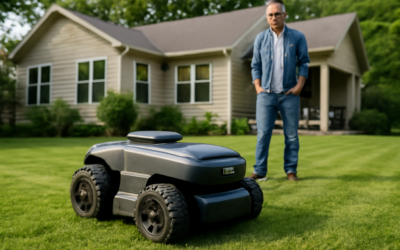
Robotic mowers have quietly gone from novelty to serious tool, and one of the most ambitious platforms takes the idea further than most. This Yarbo lawn mower review looks at the mower module of Yarbo’s modular yard-robot system, which uses one autonomous base to mow in summer, blow snow in winter, and haul or blow leaves in fall. Instead of buying three machines, you buy one robot and swap attachments, which is a genuinely different pitch from single-purpose robot mowers.
The concept is compelling, but the price is high and the system is complex. Here is an honest look at what the Yarbo mower delivers and who it actually suits.
The Modular Concept
Yarbo’s core idea is a tracked or wheeled autonomous base, the Yarbo Core, that accepts interchangeable modules. The mower module bolts on for grass season; when winter comes, you swap it for a snow blower module, and in fall a blower module clears leaves. This all-in-one approach is the platform’s biggest selling point, since a single expensive base amortizes across three seasons of work rather than sitting idle most of the year like a dedicated robot mower.
Navigation and Setup
Unlike older robot mowers that need a buried perimeter wire, Yarbo navigates with RTK GPS, using a base station and satellite positioning for centimeter-level accuracy. You set virtual boundaries in the companion app by driving or walking the machine around your property once to map it. This wire-free setup is a major convenience, especially on large or irregular lots where burying wire would be a nightmare.
The catch is that RTK GPS needs a clear view of the sky. Heavy tree cover, tall buildings, and dense canopy can disrupt the signal and cause the robot to pause or wander. Yarbo offers a vision module and antenna options to help, but buyers with heavily wooded yards should temper expectations. On open lawns, the navigation is impressively precise.
Cutting Performance
The mower module uses a rotating blade system designed for mulching, cutting a swath and returning clippings to the lawn as fertilizer. Performance highlights and considerations:
- Coverage: Designed for large properties, capable of handling up to several acres depending on configuration, far beyond typical robot mowers built for small suburban lots.
- Terrain: The tracked version climbs slopes and crosses rough ground better than wheeled robot mowers, handling grades many competitors cannot.
- Cut height: Adjustable through the app for different grass types and seasons.
- Scheduling: You set mowing schedules and zones in the app, and it returns to its dock to charge automatically.
The mulching cut keeps a large lawn consistently tidy when run on a regular schedule, which is the whole point of a robot mower: frequent light cutting rather than occasional heavy mowing.
Battery and Charging
Yarbo runs on a swappable battery system, and runtime depends on the battery size and terrain. The machine returns to its charging dock on its own when the battery runs low, then resumes where it left off. For very large properties, owners often add a second battery to extend continuous operation. Charging times and runtimes vary, but the autonomous dock-and-resume behavior means you generally set it and forget it once mapping is done.
The App and Smart Features
Control runs through the Yarbo app, where you map zones, set schedules, adjust cut height, and monitor the robot. The system includes GPS tracking and anti-theft features, useful given the machine’s value, plus obstacle detection to avoid people, pets, and objects. Yarbo pushes firmware updates that have expanded capabilities over time, though early adopters have reported that some features arrived later than promised and that the software matured gradually after launch. This is a platform that improves through updates rather than one that shipped fully polished.
Price and Value
Here is where the Yarbo demands serious thought. The Core base plus the mower module runs several thousand dollars, and adding the snow blower and blower modules pushes the full three-season system well past the price of many traditional machines combined. Rough figures:
- Core base plus mower module: around $4,000 to $6,000 depending on configuration and battery.
- Additional modules like snow blower and blower: $1,000 to $3,000 each.
- A fully equipped multi-season setup can approach or exceed $10,000.
Against that, a dedicated robot mower for a small lawn costs a fraction as much, so Yarbo only makes financial sense for large properties where its multi-season versatility and acreage capability justify the investment.
Who Should Buy It
Yarbo is not for the quarter-acre suburban lot; a cheaper single-purpose robot mower serves that far better. It targets owners of large, mostly open properties who want automation across mowing, snow, and leaves, who have the budget, and who are comfortable with a maturing tech platform. Buyers with heavily wooded yards should be cautious about the GPS navigation, and everyone should treat the software as a system that keeps improving rather than a finished appliance.
Maintenance and Long-Term Ownership
A robot mower is not maintenance-free, and the Yarbo has more moving parts than a simple robot given its modular design. The cutting blades wear and need periodic replacement to keep a clean cut, and the mower deck should be cleared of packed grass regularly, especially when cutting damp lawns. The tracks or wheels, RTK antenna, and charging contacts all benefit from occasional cleaning. Swapping modules between seasons means storing the ones you are not using, so you need dry, secure space for the mower, snow, and blower attachments. Batteries also degrade over years of charge cycles and will eventually need replacement, which is a real cost to factor into long-term ownership of any battery-powered robot.
Pros and Cons at a Glance
Weighing the platform honestly, here is where it lands:
- Strengths: Wire-free RTK navigation, genuine multi-season versatility, strong slope and rough-terrain handling, large-acreage capability, and continually improving software.
- Weaknesses: High upfront and per-module cost, reliance on clear sky for GPS accuracy, a learning curve for mapping and setup, and software that matured after launch rather than shipping fully polished.
The pattern is clear: the Yarbo trades simplicity and low cost for capability and flexibility. Whether that trade is worth it depends entirely on the size and shape of your property and your appetite for a more involved system.
Setup Experience and Learning Curve
Getting a Yarbo running takes more effort than plugging in a simple robot mower, and buyers should know that going in. You start by positioning the RTK base station where it has a clear view of the sky, then map your property by manually driving the robot around the boundaries and marking no-go zones, garden beds, and obstacles in the app. This mapping step is where most of the setup time goes, and it rewards patience: a carefully drawn map with generous margins around delicate areas produces far better results than a rushed one. Once mapped, you set zones, schedules, and cut heights. Owners consistently report that the first week involves fine-tuning as the robot reveals where it struggles, but that once dialed in, it runs reliably with little intervention. If you want a true plug-and-play appliance, this is not it; if you enjoy setting up smart-home technology, the process is manageable and even engaging.
How It Compares to Traditional Robot Mowers
Against established robot mowers from Husqvarna Automower, Worx Landroid, and Segway Navimow, the Yarbo plays a different game. Those competitors are refined, lower-cost, single-purpose mowers ideal for small to medium suburban lawns, and several now offer wire-free GPS navigation of their own. Where Yarbo pulls ahead is scale and versatility: it targets much larger properties, handles rougher terrain and steeper slopes, and does snow and leaves in addition to grass. Where it falls behind is price, simplicity, and software maturity. For a flat quarter-acre, a Navimow or Automower is the smarter, cheaper choice. For a multi-acre property owner who wants one machine to automate the whole yard across every season, the Yarbo is close to unique in what it attempts.
The Verdict
This Yarbo lawn mower review lands on a nuanced conclusion: the modular, wire-free, multi-season concept is genuinely innovative and executes well on large open lawns, with strong slope handling and precise RTK navigation. But the high cost, dependence on clear sky for GPS, and gradually maturing software mean it is a premium purchase for a specific buyer. If you have acreage, want true year-round yard automation, and can absorb the price, Yarbo is one of the most capable systems available. For a small typical yard, a conventional robot mower is the smarter buy.