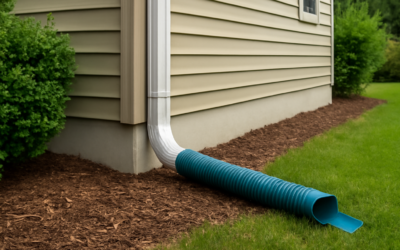
An above ground downspout extension is the simplest, cheapest way to move roof runoff away from your foundation and stop water from pooling against the house. When rain pours off the roof, your gutters collect it and funnel it to the downspouts, but if that water dumps out right at the base of the wall, it saturates the soil, seeps into the basement or crawlspace, and over time can crack or heave the foundation. An extension carries that water several feet out to where it can drain harmlessly. Unlike buried drainage systems, an above-ground extension sits on the surface, so it is easy to install yourself, easy to inspect, and easy to clear when it clogs. For most homes it is the first and most cost-effective line of defense against water intrusion.
Part of our Roofing guide — explore the full guide →
This guide covers the types available, how far to route the water, installation, drainage strategy, seasonal considerations, and the mistakes that let water find its way back to your foundation.
Why Downspout Extensions Matter
The area right around your foundation is backfilled soil that is looser and more absorbent than undisturbed ground. Water that discharges there sinks straight down along the wall and pools against the footing, which is exactly where you do not want it. The consequences build up over time:
- Wet or flooded basements and crawlspaces.
- Hydrostatic pressure that cracks foundation walls.
- Soil erosion and settling that undermines the footing.
- Damp conditions that feed mold, mildew, and wood rot.
- Ice buildup and heaving in cold climates.
Moving that water even four to six feet out dramatically reduces all of these risks, which is why building science and home inspectors consistently recommend it.
Types of Above Ground Extensions
There are several styles, each suited to different situations:
- Rigid downspout extensions: Solid aluminum or vinyl sections that match your existing downspout, extending it in a straight run. Clean-looking and durable, but they sit in the yard and can be a trip or mowing obstacle.
- Flexible/accordion extensions: Corrugated plastic tubes that bend around obstacles and can be repositioned. Convenient but they trap debris and can look messy.
- Roll-out (auto-retracting) extensions: A flat sleeve that unrolls under water pressure when it rains and rolls back up when dry, keeping the lawn clear between storms. Great for areas you mow.
- Hinged/flip-up extensions: A rigid section on a hinge you flip up to mow or walk past, then flip down. A nice compromise between rigid durability and convenience.
- Splash blocks: A simple sloped block at the base of the downspout that directs water a foot or two out. Cheap but only moves water a short distance, so best combined with an extension.
How Far Should the Water Go?
The widely recommended target is to discharge roof water at least 4 to 6 feet away from the foundation, and 10 feet is even better where the yard allows. Equally important is that the water lands on ground that slopes away from the house. The ideal grade is a drop of about 6 inches over the first 10 feet from the foundation. If your yard slopes back toward the house, an extension alone will not solve the problem; the water needs to reach a point where it can flow away, possibly into a dry well, a rain garden, or a swale.
Installation Step by Step
Installing an above-ground extension is a beginner-friendly project that takes minutes per downspout:
- Measure the downspout outlet. Standard residential downspouts are typically 2×3 inch or 3×4 inch rectangular. Match your extension or adapter to that size.
- Attach the extension. Slide the extension or a connector over the downspout outlet. Secure it with a self-tapping screw or sheet-metal screws so it does not blow off or separate under heavy flow.
- Direct it downhill. Route the extension so its discharge end sits on ground sloping away from the house. Add a splash block or a bed of gravel at the outlet to prevent erosion where the water exits.
- Confirm the flow. Run a hose into the gutter or wait for rain and watch that water actually travels the full length and discharges cleanly, not backing up or leaking at the joint.
Basic tools, a drill, and a few screws are all you need. Most homeowners can do all the downspouts on a house in an afternoon for well under $100.
What It Costs
Above-ground extensions are among the least expensive home-drainage fixes:
- Splash blocks: $5 to $20 each.
- Rigid or flexible extensions: $10 to $30 per downspout.
- Roll-out and hinged extensions: $15 to $40 each.
- Whole-house DIY: often $50 to $150 total for materials.
Compare that to a buried drainage system, which can run hundreds to a few thousand dollars installed, and the above-ground option is an easy first step that solves most problems.
Above Ground vs. Buried Drainage
Buried downspout drains route water underground through PVC pipe to a discharge point or dry well, keeping the yard clear. They look cleaner and move water farther, but they cost more, can clog invisibly, freeze in cold climates, and are hard to clear when they do clog. Above-ground extensions trade a bit of yard clutter for low cost, easy inspection, and simple maintenance. Many homeowners start with above-ground extensions and only bury drainage later if the surface routing cannot get water far enough away.
Cold-Climate and Seasonal Notes
In freezing climates, water in a downspout extension can freeze and back up, so rigid extensions with a good downhill slope drain best. Roll-out and flexible extensions can crack if walked on when frozen. Clear leaves and debris in fall so the extension is not clogged going into winter, and check that discharge points are not creating ice sheets on walkways.
Common Mistakes to Avoid
- Discharging too close to the house, only a foot or two out, which barely helps.
- Draining onto ground that slopes back toward the foundation, so water just returns.
- Not securing the connection, so the extension separates or blows away in a storm.
- Ignoring erosion at the outlet, which digs a channel back toward the house; add gravel or a splash pad.
- Letting extensions clog with leaves, especially flexible corrugated types, causing water to back up into the gutter.
- Forgetting that all downspouts need extensions, not just the visible front ones.
Combining Extensions With Good Grading
An extension only works if the water has somewhere to go once it exits, which is why grading and extensions go hand in hand. Walk your yard during a heavy rain and watch where water travels. If the ground immediately around the foundation is flat or, worse, slopes toward the house, even a long extension may just deposit water into a low spot that drains back to the wall. The fix is to build up the soil against the foundation so it slopes away, aiming for roughly a 6-inch drop over the first 10 feet, and to route the extension’s discharge onto that downhill grade or toward a natural drainage path in the yard.
Where the yard is small or flat and water has nowhere obvious to run, pair the extension with a receiving feature. A dry well, a gravel-filled pit or perforated basin buried at the discharge point, gives water a place to collect and soak into the ground slowly. A rain garden, a shallow planted depression, does the same job while looking attractive and supporting pollinators. A rain barrel at the downspout captures water for the garden and reduces the volume that needs extending away in the first place. These features work with extensions, not instead of them, catching the water once you have moved it a safe distance from the house.
Also think about where multiple downspouts converge. If two extensions dump into the same corner of the yard, they can overwhelm that spot and create a soggy area or erosion channel. Spread the discharge points out, or route them toward different parts of the yard, so no single area takes all the runoff.
An above-ground downspout extension is proof that the most effective home maintenance is often the cheapest and simplest. For the price of a few coffees per downspout and an hour of work, you move thousands of gallons of roof water safely away from your foundation, protecting the single most expensive part of your home. Pair the extensions with good yard grading, keep them clear, and make sure every downspout carries water at least a few feet out onto ground that drains away, and you will keep your basement dry and your foundation sound for years to come.