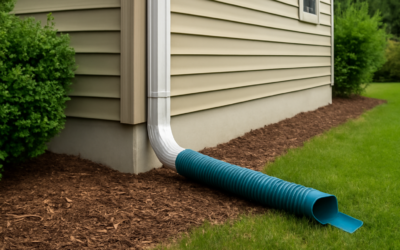
A flexible downspout extension is the bendable, accordion-style tube that attaches to the bottom of your gutter’s downspout and carries roof runoff around obstacles and away from your foundation. Where a rigid extension can only run in a straight line, a flexible one twists, turns, and stretches to route water past a walkway, around a flower bed, or down a slope, then discharges it where it can drain safely. For homeowners dealing with awkward layouts, landscaping in the path, or downspouts that dump water right against the house, a flexible extension is an inexpensive, install-it-yourself fix that protects your foundation from the erosion, basement leaks, and settling that pooled water causes. This guide covers the types, costs, installation, how far to route water, the honest pros and cons, and the mistakes that keep flexible extensions from working as well as they should.
Part of our Roofing guide — explore the full guide →
What a Flexible Downspout Extension Does
Every downspout collects the water your roof sheds and channels it to the ground. The problem is where it lets go. If the water discharges at the base of the wall, it saturates the backfilled soil around your foundation, seeping toward the footing and into basements and crawlspaces, and over years it can crack foundation walls and erode the soil that supports your home. An extension moves that discharge point several feet out. A flexible extension does this while bending around whatever is in the way, its defining advantage over rigid pipe.
Types of Flexible Extensions
There are a few variations under the “flexible” umbrella:
- Corrugated accordion tubes: The classic flexible extension, a ribbed plastic tube that stretches from a compact few inches to several feet and bends in any direction. Cheap and endlessly adjustable.
- Roll-out / auto-retracting sleeves: A flat sleeve that unrolls under water pressure when it rains and rolls back up when dry, keeping the lawn clear between storms. Technically flexible and great for mowed areas.
- Flexible with a splash block end: A bendable tube that terminates over a splash block to disperse the water and prevent erosion at the outlet.
- Adapters and connectors: Flexible elbows that connect a rigid extension to a downspout when you just need to turn a corner.
What It Costs
Flexible downspout extensions are among the cheapest home-drainage products available:
- Corrugated accordion tube: $8 to $25 each.
- Roll-out extensions: $15 to $40 each.
- Connectors and adapters: a few dollars each.
- Whole-house DIY: often $50 to $150 total.
Compared with a buried drainage system costing hundreds to thousands, a flexible extension is a low-risk first step that solves most water problems for the price of a few restaurant meals.
Installation Step by Step
This is a beginner-friendly project needing only basic tools:
- Match the size. Standard residential downspout outlets are usually 2×3 inch or 3×4 inch. Buy an extension or adapter that fits your downspout size.
- Attach the extension. Slide the flexible tube or its connector over the downspout outlet. Because flexible tubes can slip off under heavy flow, secure the joint with a self-tapping sheet-metal screw or a clamp.
- Route around obstacles. Bend and stretch the tube to run past walkways, beds, and other obstructions, keeping it heading steadily downhill.
- Aim at good drainage. End the run at least 4 to 6 feet from the foundation, on ground that slopes away from the house. Place a splash block or a bed of gravel at the outlet to prevent a wash-out.
- Test the flow. Run a hose into the gutter or wait for rain and confirm water travels the full length, does not pool inside the ribs, and discharges cleanly.
How Far the Water Should Go
The standard recommendation is to discharge roof water at least 4 to 6 feet from the foundation, with 10 feet being ideal where space allows. Just as important, the water must land on ground that slopes away from the house, ideally a drop of about 6 inches over the first 10 feet. If your grade slopes back toward the home, the extension needs to reach past that low point, or you may need to regrade, add a swale, or route to a dry well. An extension that dumps water onto ground that drains back toward the foundation does little good.
Pros and Cons of Flexible Extensions
Pros: inexpensive, easy DIY install, bends around any obstacle, adjustable length, above-ground so it is easy to inspect and clear, and the roll-out styles keep lawns mowable.
Cons: the ribbed interior of corrugated tubes traps leaves and debris and clogs more easily than smooth rigid pipe, they can look messy lying across a yard, thin plastic can crack in freezing weather or crush if stepped on, and they can separate from the downspout if not screwed on. The convenience of flexibility comes with a bit more maintenance.
Flexible vs. Rigid Extensions
Choose flexible when you need to route water around obstacles, adjust the path seasonally, or connect through a turn. Choose rigid when you have a clear straight shot and want the cleanest look, best flow, and least clogging, since smooth rigid pipe sheds debris better and lasts longer. Many homeowners combine them: a flexible elbow to turn off the downspout into a rigid run across the yard. For freezing climates, rigid or roll-out styles tend to handle winter better than thin corrugated tubes.
Maintenance
Flexible extensions need a little more attention than rigid ones because their ribbed interior catches debris. Clear leaves and grit from the tube each fall and spring, especially before winter, so it does not clog and back water up into the gutter. Check that the connection to the downspout is still secure, reposition roll-out and accordion tubes that have been kicked or mowed around, and replace any tube that has cracked or been crushed. A quick seasonal check keeps the whole system draining freely.
Common Mistakes to Avoid
- Discharging too close to the house, a foot or two out, which barely protects the foundation.
- Routing onto ground that slopes back toward the home, so water returns to the foundation.
- Not securing the tube to the downspout, so it separates under heavy rain.
- Letting the corrugated tube clog with leaves, causing gutter backups; clean it seasonally.
- Ignoring outlet erosion, which digs a channel; add a splash block or gravel.
- Leaving loops or dips in the tube where water sits and stagnates or freezes; keep it running steadily downhill.
- Forgetting some downspouts, leaving part of the foundation unprotected.
Improving Curb Appeal While Keeping Function
The most common complaint about flexible extensions is that a bright plastic tube snaking across the lawn looks unattractive. Fortunately there are ways to keep the drainage benefit while tidying up the appearance. The simplest is to choose a roll-out style that retracts flat and largely disappears between rain events, or a color that blends with your landscaping, dark green and brown tubes hide better than white. You can also tuck the extension along the base of the house and into a planting bed so it is screened by foliage on its way to the discharge point.
Another approach is to partially conceal the run. Some homeowners lay the flexible tube in a shallow trench and cover it with a bed of decorative river rock or mulch, leaving just the discharge end exposed over a splash block. This keeps the tube from being a trip and mowing hazard while masking it visually. If you go this route, keep the tube accessible enough to clear debris, and maintain a steady downhill slope so water does not pool in a buried low spot. For a fully hidden solution, many homeowners eventually transition a flexible above-ground run into a buried rigid drain line, using the flexible extension as the initial fix and upgrading later.
Whatever you choose, do not sacrifice function for looks. The whole point is to move water away from the foundation, so resist the temptation to coil a too-long tube into a tidy pile near the house, which just returns water to the wall. A clean, purposeful run that discharges several feet out on ground that drains away will always protect your home better than a good-looking but poorly routed one. With a little thought about color, screening, and routing, you can have both a tidy yard and a dry basement.
A flexible downspout extension is a small, affordable part that solves a big, expensive problem: keeping roof water away from the foundation you cannot afford to damage. Its bendable design routes water past whatever your yard throws in the way, and it installs in minutes with a screwdriver. Just remember to run it at least a few feet out onto ground that drains away from the house, secure it so it does not blow off, and clear the debris that ribbed tubes love to collect. Do that across every downspout, and you will keep your basement dry and your foundation solid, all for the cost of a few inexpensive tubes.