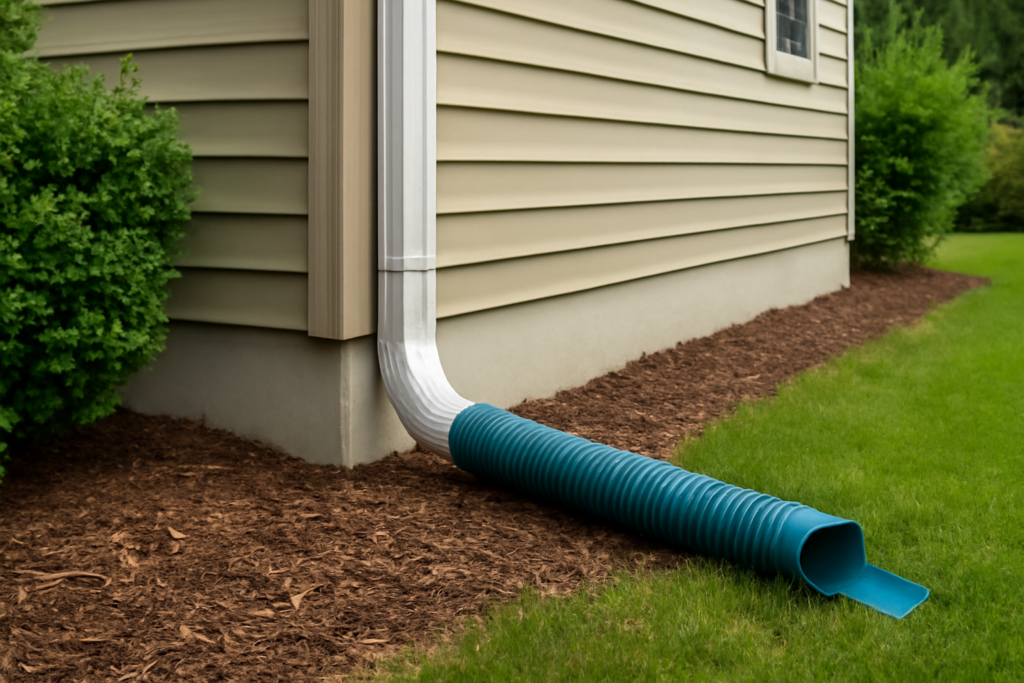
Gutters do half the job of managing roof runoff; the other half is getting that water far enough away from your house that it cannot cause damage. A downspout extension long enough to carry water well past the foundation is one of the cheapest, most effective defenses against wet basements, foundation cracks, and eroded landscaping. Too many homes dump concentrated roof water right at the base of the wall, where it seeps down against the foundation. This guide explains how far water needs to go, the extension options available, how to install them, and the mistakes that let water find its way back to your house.
Part of our Roofing guide — explore the full guide →
Why Downspout Extensions Matter So Much
A single downspout can discharge an enormous volume of water during a storm, all concentrated in one spot. When that water lands right beside the foundation, it saturates the soil, increases hydrostatic pressure against basement walls, and works its way through cracks and porous concrete. Over time this leads to basement leaks, foundation settlement and cracking, erosion, and even mosquito-friendly standing water. Extending the downspout so it releases water away from the structure spreads and relocates that discharge to a safe area, protecting the single most expensive component of your home: its foundation.
How Far Is Far Enough?
The widely recommended minimum is to discharge water at least 4 to 6 feet away from the foundation, and many experts advise 10 feet or more where possible, especially on homes with basements or poor drainage. The ground should also slope away from the house so the released water keeps moving away rather than pooling or running back. On a flat lot or one that slopes toward the house, you may need a longer extension, a buried drain line, or a dry well to move water to a safe outlet. The goal is simple: get the water past the backfill zone around the foundation, where the soil is most permeable, and onto ground that carries it away.
Types of Downspout Extensions
You have several options depending on appearance, durability, and how far you need to move the water:
- Aluminum or vinyl elbow-and-pipe extensions: rigid sections matching your downspout that direct water a few feet out. Simple, durable, and inexpensive, but a long run across the yard can be a tripping and mowing obstacle.
- Flip-up or hinged extensions: a hinged section you flip down during storms and lift up to mow. Convenient for keeping the lawn accessible.
- Roll-out (accordion) sleeves: flexible plastic tubes that automatically unroll under water pressure and retract when dry. Handy but less durable and can look untidy.
- Flexible corrugated pipe: bends around obstacles and connects to longer runs, often used to reach a distant discharge point or connect to buried drainage.
- Buried drain lines (French-style or solid pipe): the most robust solution, routing water underground in 3- or 4-inch pipe to a pop-up emitter or dry well far from the house, keeping the yard clear.
- Splash blocks: not true extensions but a simple concrete or plastic pad that disperses water; best combined with an extension, not used alone.
Installing a Long Downspout Extension
For an above-ground extension, the job is quick and requires only basic tools:
- Measure and plan the route. Decide where the water should discharge, ideally downhill and at least several feet out, avoiding walkways and neighbor property.
- Attach an elbow to the bottom of the existing downspout to redirect flow horizontally.
- Connect the extension pipe or sleeve, securing joints with sheet-metal screws or the manufacturer’s connectors so storms cannot blow them apart.
- Set the slope. Ensure the extension runs continuously downhill so water drains fully and does not sit inside, where it could freeze or breed mosquitoes.
- Anchor the end and add a splash block or stone at the outlet to prevent erosion where the water lands.
For a buried line, dig a sloped trench, lay solid PVC or corrugated pipe pitched away from the house, connect it to the downspout with an adapter, and terminate at a pop-up emitter or dry well. Buried lines look cleanest and keep the yard mowable but require more labor and careful slope to avoid clogs.
What It Costs
This is an inexpensive project with an outsized payoff. Simple above-ground extensions and roll-out sleeves cost $10 to $40 each. Flip-up and higher-quality rigid extensions run $15 to $50. A buried drain line with pipe, fittings, and a pop-up emitter costs more, roughly $75 to $200 in materials per downspout for a DIY job, or several hundred dollars per run if you hire it out, depending on trench length and difficulty. Compared to the thousands of dollars a wet basement or foundation repair can cost, extensions are cheap insurance.
Keeping Water From Coming Back
The whole point is to prevent water from returning to the foundation, and a few details make the difference. Confirm the ground genuinely slopes away from the house for the first several feet; if it does not, regrade or use a longer or buried extension. Make sure the discharge point does not send water toward a neighbor, a walkway, or a low spot that pools. Keep the gutters and downspouts themselves clean, because a clogged system overflows at the wall regardless of how good your extension is. In freezing climates, above-ground flexible extensions can ice up, so choose rigid options or ensure full drainage to prevent blockages.
Above-Ground Versus Buried: Which to Choose
Deciding between a simple above-ground extension and a buried drain line comes down to your yard, your budget, and how much the appearance bothers you. Above-ground extensions are the fastest and cheapest fix, install in minutes with no digging, and are easy to inspect and clear if they clog. Their drawbacks are cosmetic and practical: a long pipe or sleeve running across the lawn is a mowing obstacle and a tripping hazard, and flexible sleeves in particular can look untidy. For many homeowners, a hinged flip-up extension or a rigid pipe angled to a discreet discharge point strikes a good balance between function and appearance.
Buried drain lines are the premium solution when you want a clean, unobstructed yard and reliable long-distance water routing. By running solid or corrugated pipe underground to a pop-up emitter or a dry well well away from the house, you keep the surface clear for mowing and landscaping while moving water exactly where you want it. The trade-offs are cost and maintenance: buried lines require digging a properly sloped trench, they cost more in materials and labor, and if they clog with debris or roots they are harder to clear than a surface pipe. To minimize clogs, keep gutters clean so debris does not wash into the buried pipe, use solid pipe rather than perforated where you simply want to convey water, and include cleanout access or a catch basin at the connection. In freezing climates, bury the line below or design it to drain fully so it does not ice up and back water toward the foundation. For homes with chronic drainage problems or flat lots, the investment in a buried system often pays off in a dry basement and a tidy, functional yard.
Common Mistakes to Avoid
- Extending only a foot or two, which barely moves water past the vulnerable backfill zone.
- Discharging onto flat or reverse-sloping ground, letting water run right back.
- Leaving joints unsecured, so wind and water pressure blow the extension apart.
- Ignoring the outlet, creating erosion or a muddy pit where water lands.
- Routing toward a neighbor’s yard, which can cause disputes and drainage complaints.
- Forgetting gutter maintenance, so clogs cause overflow at the foundation anyway.
A downspout extension long enough to carry roof water safely away is a small, affordable upgrade that protects the most valuable and expensive part of your home. Whether you choose a simple flip-up pipe, a flexible sleeve, or a buried drain line to a pop-up emitter, the principles are the same: move the water several feet or more from the foundation, keep the ground sloping away, and secure everything so storms cannot disrupt it. Handle runoff properly and you sidestep the wet basements, cracked foundations, and eroded yards that plague homes where water is left to pool at the wall.