
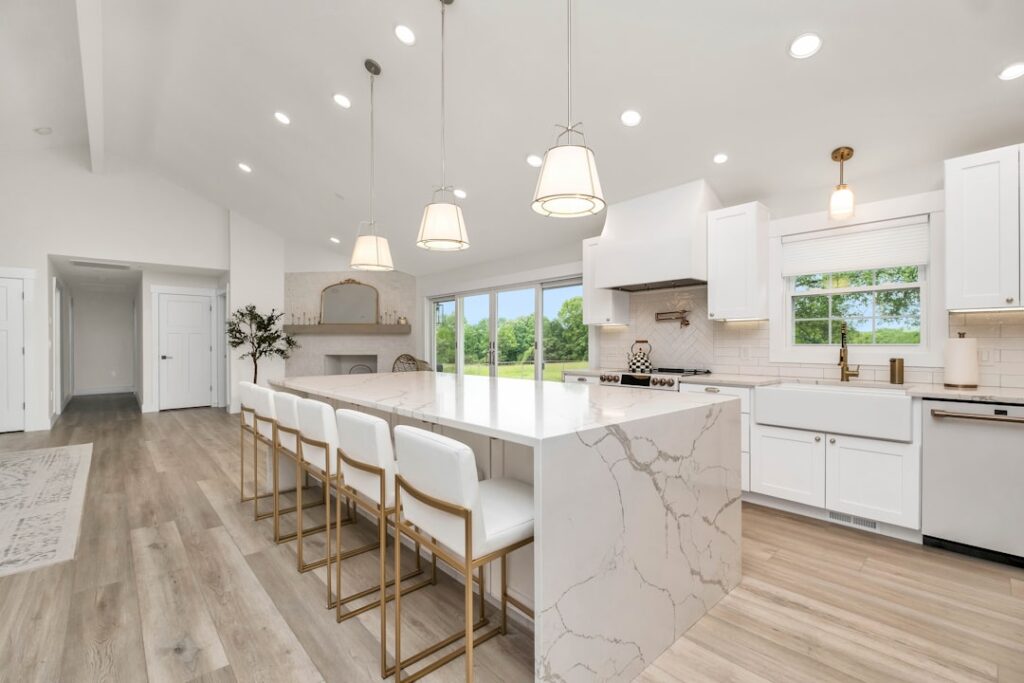
The most convincing marble-look kitchens being built today rarely use marble at all. Homeowners want that dramatic, hand-painted vein running across a bright white slab, but almost nobody wants to babysit natural stone. Arabescato quartz answers that exact wish — an engineered surface that captures the bold gray veining of classic Italian Arabescato marble while shrugging off the stains, etching, and yearly sealing that real marble demands. It has become one of the most popular patterns in the marble-look category, and for good reason.
Part of our Countertops guide — explore the full guide →
The Look: Inspired by Italian Arabescato Marble
The name comes from Arabescato marble, a prized natural stone quarried in the Apuan Alps of Italy, famous for its thick, sweeping gray veins set against a white-to-pale-gray background. Engineered arabescato quartz recreates that signature drama. Expect a bright white or soft white field crossed by bold, connected gray veins — often thicker and more architectural than the fine, wispy veining of a Carrara look.
Where a Carrara-style pattern reads soft and subtle, arabescato reads confident and graphic. The veins tend to be larger, more defined, and more directional, which makes the pattern a genuine statement on a big island or a full-height backsplash. Because it is manufactured, the best versions use varied printing and pigment techniques so the veining looks organic rather than repeated, avoiding the tell-tale copy-paste effect of cheaper marble imitations.
What It Is Made From
Engineered quartz is a manufactured surface, roughly 90 to 93 percent ground natural quartz bound with polymer resins and pigments, then pressed under vacuum into dense slabs. The white base and the gray veins are created with pigments during production, so the pattern is designed rather than mined. That is why two arabescato slabs from the same line look coordinated — a huge advantage when you are running counters, an island, and a backsplash that all need to relate.
The resin binder makes the material non-porous, which is the whole reason it outperforms the marble it imitates. No open pores means no absorbed stains, no bacteria harbored in the surface, and no sealing schedule.
How It Compares to Real Arabescato Marble
This is the comparison that sends most buyers to quartz. The two look strikingly similar from a few feet away, but living with them could not be more different.
- Etching: Natural marble is calcium-based and etches — develops dull spots — the moment acid touches it. Lemon juice, wine, vinegar, and tomato all leave marks. Arabescato quartz does not etch.
- Sealing: Marble needs sealing every year or two. Quartz never needs sealing.
- Staining: Porous marble drinks up oil and pigment. Non-porous quartz resists both.
- Consistency: Marble is a genetic lottery slab to slab; quartz gives you a predictable, matchable pattern.
- Heat: Here marble wins — natural stone shrugs off heat, while quartz resin can scorch above roughly 300°F.
For most families, the tradeoff is easy: give up a little heat tolerance to gain a surface you never have to worry about. Purists who crave the true depth and patina of natural stone will still choose marble, but they sign up for the maintenance that comes with it.
What Arabescato Quartz Costs Installed
Quartz countertops in the US typically run $50 to $120 per square foot installed. Marble-look patterns with heavy, realistic veining like arabescato usually land in the mid-to-upper part of that range because the printing and pigment work is more involved than a plain solid color. Budget roughly $65 to $110 per square foot fabricated and installed for a quality arabescato product.
- Kitchen estimate: A typical 40-square-foot kitchen runs about $3,000 to $4,800 all-in.
- Vein matching: If you want the veins to flow continuously across a seam or down a waterfall edge, expect an upcharge for the extra slab and careful layout.
- Edge and thickness: A 3cm slab with a mitered edge that makes the counter look like a thick marble block costs more than a basic 2cm eased edge.
One pro tip: buy from a slab you can see in person. Photos flatten the veining, and you want to pick the specific movement and vein density that suits your space before you sign.
Design and Styling Tips
Bold veining wants room to breathe. Arabescato looks best where the pattern can stretch out — a large island, a run of perimeter counter, or a full-height backsplash that shows the veins climbing the wall. In a small galley kitchen, the same drama can feel busy, so consider using it as an accent island top with a quieter perimeter surface.
The pattern pairs beautifully with warm metals like brushed brass or gold hardware, which play off the gray veins. White and light gray cabinetry keeps the look airy and gallery-clean, while deep navy or charcoal cabinets turn the white slab into a bright, high-contrast centerpiece. Because the base is white, it reflects light well and helps a kitchen feel larger and brighter.
Care and Maintenance
Living with arabescato quartz is refreshingly low-effort. Daily cleaning is warm water, a drop of dish soap, and a soft cloth. For stubborn spots, a non-abrasive surface cleaner does the job. Because the surface is non-porous, spilled wine or coffee wipes away without leaving a stain, and you never reach for a sealer.
A few habits keep it pristine:
- Always use a trivet under hot cookware — the resin binder can scorch above about 300°F.
- Avoid bleach, oven cleaner, and abrasive pads, which can dull the polished finish over time.
- Use a cutting board to protect both the surface and your knife edges.
- Wipe up general spills when convenient; there is no urgency, but a white field stays crispest when kept clean.
Frequently Asked Questions
Is arabescato quartz the same as Calacatta quartz?
They are cousins, not twins. Both are white marble-look patterns, but Calacatta typically shows thick, bold veins on a very bright white background, while arabescato tends toward larger, more interconnected gray veining inspired specifically by Italian Arabescato marble. The distinction varies by manufacturer, so compare actual slabs.
Does the veining pattern repeat?
Quality arabescato products use varied vein layouts to look natural, but because it is engineered you may spot some repetition across very large runs. Reviewing full slabs and planning your layout minimizes any visible repeat.
Can arabescato quartz be used for a backsplash?
Yes, and a full-height backsplash in the same slab is one of the most dramatic ways to use it. Running the veining from counter to underside of the cabinets creates a seamless, high-end marble-look wall.
Will it scratch or chip?
Quartz is very hard and resists scratching in normal use, though a sharp impact on an edge can chip it. A fabricator can fill minor chips with color-matched epoxy.
What thickness works best for the marble look?
A 3cm slab gives you the substantial, solid feel that reads most like real marble, especially with a mitered edge that makes the counter appear as a thick block of stone. Many designers build up the front edge to 4cm or more on islands to amplify that quarried-marble impression, which costs a bit more in labor but pays off visually.
Does arabescato quartz work in a bathroom?
It is an excellent bathroom choice. A vanity top and a matching shower surround or accent wall bring spa-like luxury to a primary bath, and because the surface is non-porous it stands up to water, cosmetics, and cleaning products far better than natural marble would in a wet, high-use space.
If you have been dreaming of an Italian marble kitchen but dread the upkeep, arabescato quartz is the practical answer. You get the bold gray veining and bright white drama, plus a non-porous surface that never needs sealing and never etches — the look of the quarry with the ease of engineered stone.


