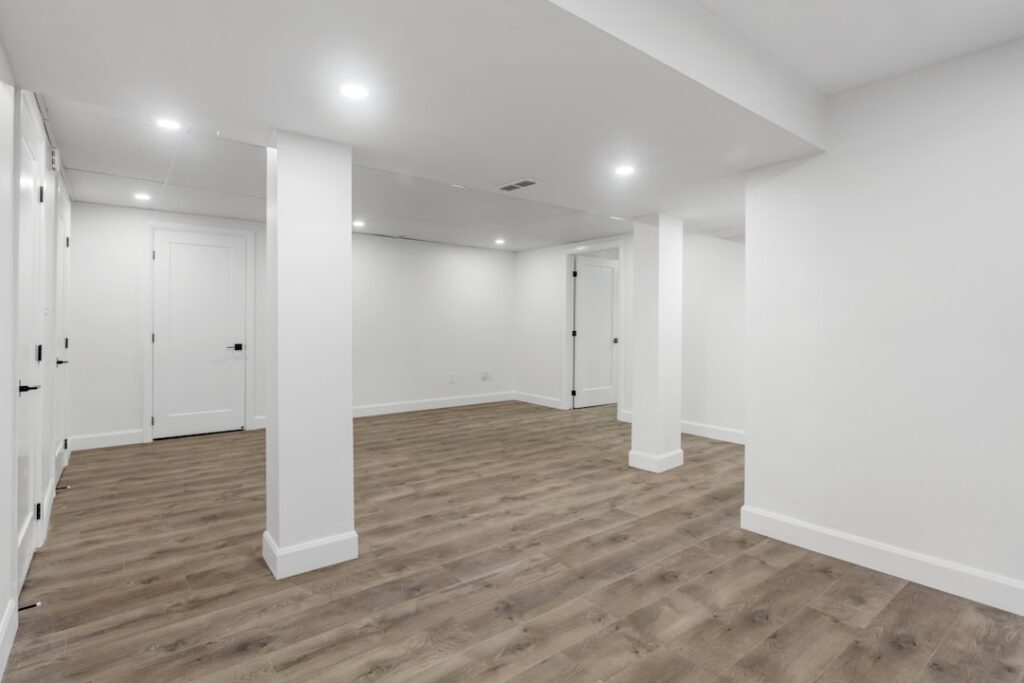
A basement that smells musty in July is leaking somewhere between 2 and 5 gallons of water vapor a day into your house. The cure is rarely a sump pump; it’s a properly sized basement dehumidifier with pump running on a humidistat and draining vertically into a utility sink or out the rim joist. Skip the bucket-emptying ritual and you protect the framing, the HVAC system, and anyone in the house with allergies.
Why a Pump Model Beats Gravity Drainage
Standard dehumidifiers rely on gravity. They drain through a hose, but only if the floor drain sits below the unit and the hose runs straight down. In real basements with concrete floors and zero pitch, that almost never works. A pump model lifts the condensate up to 16 vertical feet, which means you can route the line up and out a basement window or across the joists to a laundry sink.
The internal pump also stops the dehumidifier from shutting off when the bucket fills. A 50-pint unit can pull 6 gallons a day in a wet July; without a pump you would empty it three times daily.
How to Size a Basement Dehumidifier
The DOE rates dehumidifiers by pints removed per day at 65 degrees F and 60 percent humidity. A typical 1,500-square-foot basement with moderate dampness needs a 35- to 50-pint unit. Wet basements with visible moisture or after a flood need 50 to 70 pints. Anything labeled “30-pint” or smaller belongs in a closet or RV.
- Up to 1,000 sq ft, slightly damp: 22 to 30 pints
- 1,000 to 1,500 sq ft, moderately damp: 35 to 50 pints
- 1,500 to 2,500 sq ft, wet basement: 50 to 70 pints
- Whole-basement plus crawl space: ducted unit, 90 to 120 pints
Top Pump-Equipped Models Worth Buying
The Frigidaire Gallery FGAC5044W1 (50-pint with built-in pump) runs around $349 and consistently pulls more moisture than its rating in independent testing. The hOmeLabs HME020399N (50-pint) sits at about $299 and is the budget pick that still hits Energy Star efficiency.
For wet, finished basements with HVAC ductwork, the Aprilaire E080 or Santa Fe Compact 70 are the durability standards at $1,200 to $1,800. They run quieter, last 8 to 12 years, and have steel cabinets that don’t sweat.
Pump Capacity and Head Height
Not all pumps are equal. Cheap units lift water 6 to 8 feet, which is fine for ground-level drainage but won’t reach a window well 10 feet up. Look for a stated head height of at least 14 to 16 feet if you’re discharging through a window.
Hose length matters too. Most units ship with a 16-foot vinyl hose; if you need to run further, splice in 1/2-inch ID braided line and avoid sharp bends. Each 90-degree elbow eats about 1 to 2 feet of effective head.
Where to Position the Unit
Place the dehumidifier centrally with at least 12 inches of clearance on the intake side and 6 inches on the discharge side. Don’t tuck it into a corner; restricted airflow drops capacity by 20 to 30 percent. If the basement has multiple rooms, leave doors open or install a louvered door so air circulates.
Set the unit 4 to 6 inches off the floor on a small platform. This reduces noise transmission into the slab and protects the compressor from any future water on the floor.
Humidity Targets and Settings
The EPA recommends 30 to 50 percent relative humidity year-round. In a basement, target 45 to 50 percent. Below 40 percent the unit short-cycles and wastes electricity; above 55 percent mold spores germinate within 48 hours on drywall paper, OSB, and any wood touching the slab.
Most modern units have a built-in humidistat. If yours doesn’t, plug it into a $25 inline humidistat from Honeywell or AcuRite. Set the unit to “continuous” only after a flood or during the first month of use to dry out trapped moisture.
Drainage Setup Step-by-Step
- Identify your discharge point: utility sink, floor drain, sump pit, or window well
- Route the 1/2-inch hose with a continuous slope or rise; no sagging dips that hold water
- Secure the hose every 4 feet with cable clips so weight doesn’t pull on the pump fitting
- If discharging outdoors, exit through an existing penetration or install an exterior dryer-vent style cover
- Test by pouring a quart of water into the bucket and watching the full drain cycle
Energy Use and Operating Cost
An Energy Star 50-pint unit pulls about 600 to 700 watts. Run it 12 hours a day in summer at $0.15 per kWh and you’re spending roughly $30 a month. Non-Energy Star units cost 30 to 40 percent more to run, and the difference pays for the better unit inside two summers.
Heat is a side effect. Dehumidifiers dump 1,200 to 2,000 BTU of heat into the basement, which is welcome in spring and fall and a non-issue in a typically cool basement. If your basement runs warm, vent the exhaust into an unfinished area.
Maintenance Schedule
Pull and rinse the air filter every 30 days. A clogged filter drops capacity dramatically and is the number one reason a unit “stops working.” Check the pump drain line every 6 months for slime buildup; flush with a 1:10 bleach-water solution if you see anything.
Replace the unit every 7 to 10 years for residential models or 12 to 15 years for whole-house dehumidifiers. The compressor wears out long before the cabinet does, and refrigerant top-offs are not cost-effective on consumer units.