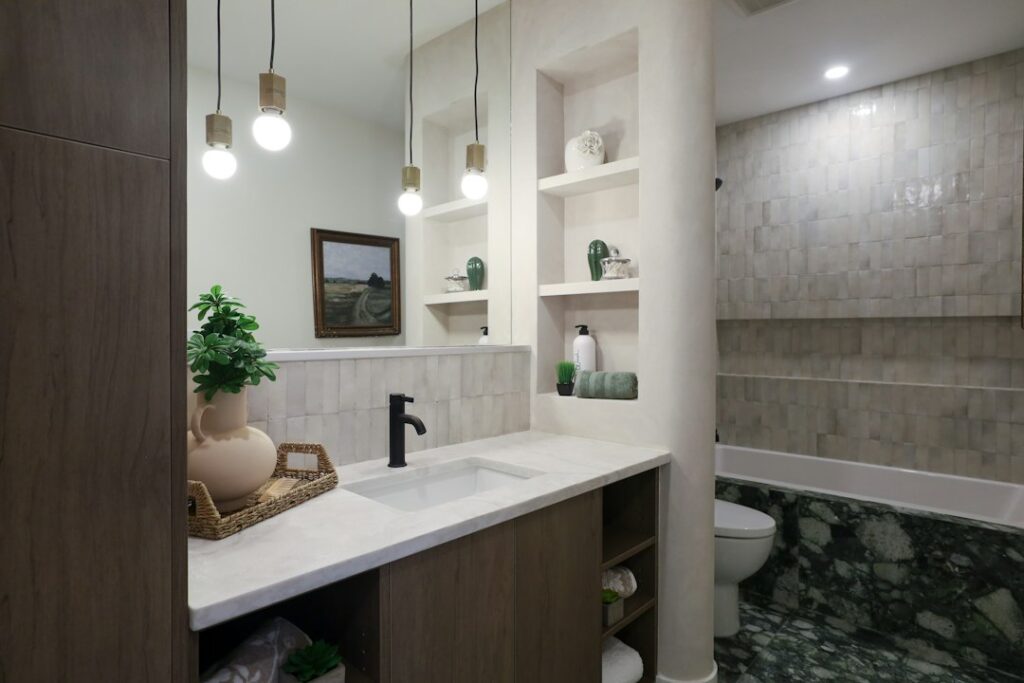
Bathrooms rarely have a good place to sit while you dry off, pull on socks or help a child out of the tub. A bathroom bench with storage gives you that seat and hides towels, bath toys or spare toilet paper underneath. The trick is finding one that fits the room without blocking the door swing and that holds up to daily steam. Plenty of benches sold for entryways warp, peel or grow mildew within a year in a humid bath.
Part of our Bathroom Remodeling & Flooring guide — explore the full guide →
Short answer: measure your clear floor space first, keep at least 21 inches (ideally 30) of walkway in front of the bench, and choose materials made for moisture such as teak, acacia with a marine-grade finish, bamboo, powder-coated metal or solid resin. Lift-top benches hide clutter; open cubbies keep towels handy and dry faster.
- Where a Bathroom Bench With Storage Works Best
- Clearances and Sizes for Small and Large Bathrooms
- Materials That Handle Humidity
- Lift-Top vs Cubby vs Basket Storage
- Choosing the Right Bench: A Quick Decision Guide
- Placement and Installation Tips
- Care, Maintenance and Troubleshooting
- Cost Ranges
- When to Call a Pro
- Frequently Asked Questions
Where a Bathroom Bench With Storage Works Best
Not every bathroom has room for a bench, but more do than you might think. A bathroom bench with storage usually lives in one of four spots:
- At the foot of a tub or beside it: a natural place to sit while running a bath or drying children.
- Outside the shower: a landing spot for a towel and robe, and a seat for drying feet.
- Under a window: often wasted wall space in larger primary baths.
- In a dressing area or walk-through: doubles as a spot to sit while dressing.
Keep it out of the direct splash zone and away from the toilet, where code and comfort both call for clear space. The bench should not interfere with opening the vanity drawers, the shower door or the room door.
Clearances and Sizes for Small and Large Bathrooms
Clearance is the deciding factor. Common bathroom planning guidelines call for about 21 inches of clear space in front of fixtures as a minimum and 30 inches as a more comfortable target. Use the same idea for a bench: you want to walk past it without turning sideways, and you need enough knee room to sit and stand.
| Bathroom size | Bench width | Bench depth |
|---|---|---|
| Small bath or powder room | 18 to 30 in | 12 to 14 in |
| Standard full bath | 30 to 40 in | 14 to 16 in |
| Primary bath | 40 to 60 in | 16 to 18 in |
A small bathroom bench 12 to 14 inches deep can tuck against a wall in spaces where a standard 16-inch bench would crowd the walkway. Seat height should be around 17 to 19 inches for comfort. Lower benches, around 15 inches, can work for children but are harder for older adults to rise from.
How to measure
- Mark the bench footprint on the floor with painter’s tape.
- Open every door and drawer nearby to see if anything hits the tape.
- Walk past it, sit on a chair placed at the tape, and stand up. If it feels tight, go narrower or shallower.
- Check baseboard heaters, floor vents and outlet locations so the bench does not block them.
Materials That Handle Humidity
Bathrooms swing between dry and steamy several times a day. Materials that absorb moisture swell, crack or delaminate. Here is how the common options hold up:
- Teak: the classic wood bathroom bench material. Natural oils resist water and rot. It can gray if left untreated, which many people like; occasional oiling keeps the honey color.
- Acacia and eucalyptus: hardwoods with decent moisture resistance when sealed. Look for a marine-grade or exterior finish and reseal yearly.
- Bamboo: affordable, light and fairly moisture tolerant when properly finished. Lower-grade bamboo with thin laminations can split over time.
- Powder-coated metal: sturdy and moisture resistant if the coating is intact. Choose rust-resistant aluminum or galvanized steel underneath.
- Solid resin, polymer or PVC: nearly waterproof and easy to clean. Often styled to look like painted wood.
- Upholstered tops: use only performance or outdoor fabric with quick-dry foam, and keep the bench away from splash zones.
Avoid particleboard, MDF and thin veneers in a full bath unless every edge is sealed. These materials swell quickly once water reaches the core, and the damage cannot be reversed. A painted solid-wood bench can work if the paint is a durable enamel and the feet are sealed, since the end grain on the legs soaks up water from wet floors.
Lift-Top vs Cubby vs Basket Storage
Lift-top benches
A hinged seat opens to a storage box inside. Good for hiding cleaning supplies, extra toilet paper, bath toys or seasonal items. Look for a soft-close or slow-drop hinge so the lid does not slam on fingers. Because the box is enclosed, add ventilation holes or store only dry items to prevent musty odors.
Open cubbies or shelves
Open shelves under the seat keep rolled towels, baskets and slippers in reach. Air circulates freely, so damp towels dry faster. The tradeoff is visible clutter; uniform rolled towels or matching baskets keep it tidy.
Basket or drawer storage
Benches with removable baskets or drawers combine both approaches. Baskets made from water hyacinth, seagrass or plastic weave are easy to pull out and wash. Drawers are tidy but can swell and stick in a humid room if made from untreated wood.
For a family bath, a cubby bench with a couple of baskets often works best. For a primary bath where you want a clean look, a lift-top bathroom storage bench hides everything.
Choosing the Right Bench: A Quick Decision Guide
- Room under 40 square feet: choose a slim bathroom bench seat 12 to 14 inches deep, open cubbies for airflow, and a moisture-resistant material.
- Kids’ bathroom: lift-top with soft-close hinge to hide toys, or cubbies with washable bins. Rounded corners help.
- Primary bath with a soaking tub: a wider teak or acacia bench at the tub’s end, possibly with an upholstered outdoor-fabric cushion.
- Aging in place: sturdy bench with a seat height around 18 to 19 inches and a grab bar nearby to help with standing up.
- Humid bath with weak ventilation: solid resin or powder-coated metal, plus an upgrade to the exhaust fan.
Styling the bench so it fits the room
Match the bench finish to something already in the bathroom, such as the vanity wood tone, the faucet metal or the frame of the mirror, so it looks planned rather than added later. In a white or gray bath, a natural teak or bamboo bench adds warmth without competing with the tile. A slim black metal frame suits modern rooms with matte black fixtures. Keep the top clear except for a folded towel or a small tray, since a cluttered bench stops being useful as a seat. If you plan to sit on it daily, a removable cushion in quick-dry outdoor fabric makes it more comfortable and can be taken out to air on humid days. Rolled towels in open cubbies look tidy and dry faster than stacked ones, and a lidded basket on one side hides the less attractive essentials like cleaning cloths and spare bottles.
Placement and Installation Tips
- Protect the floor: add felt or rubber pads to the feet so the bench does not scratch tile or vinyl and so water does not wick into wood legs.
- Keep it level: adjustable feet help on sloped or uneven tile.
- Anchor tall units: if the bench has a tall backrest or hutch with shelves, anchor it to a wall stud to prevent tipping.
- Leave air space: pull the bench a half inch from the wall so moisture does not get trapped behind it.
- Ventilate: run the exhaust fan for 20 to 30 minutes after showers. Furniture lasts much longer in a room that dries out between uses.
Care, Maintenance and Troubleshooting
- Water rings or white haze on wood: wipe spills promptly and reseal with a moisture-resistant finish once a year.
- Musty smell inside a lift-top bench: empty it, wipe with mild soap and water, let it dry with the lid open, and drill small vent holes if the design allows.
- Mildew spots: clean with a mild detergent solution, dry fully and improve ventilation.
- Swollen or peeling panels: usually a sign of particleboard or poorly sealed edges. Replace with a solid material.
- Wobbly legs: tighten hardware and replace plated screws with stainless if they are rusting.
- Rust on metal frames: sand lightly and touch up with rust-inhibiting paint before it spreads.
Cost Ranges
Simple bamboo or resin benches with cubbies often cost $40 to $150. Teak and acacia benches usually run $150 to $500, with larger or more detailed pieces reaching $800 or more. Built-in benches with custom cabinetry and a tiled or stone top can cost $800 to $3,000 installed, depending on size and finishes.
When to Call a Pro
Freestanding benches are an easy DIY addition. Consider a carpenter or cabinetmaker if you want a built-in bench under a window or between walls, especially if it involves tiling, a stone top or recessed storage. A pro can also add blocking and anchors for a bench with a backrest or wall shelves. If the room shows signs of excess moisture such as peeling paint or mold on the ceiling, have the exhaust fan and ventilation checked before investing in wood furniture.
Frequently Asked Questions
What is the best wood for a bathroom bench?
Teak is the top choice for moisture resistance. Acacia and properly finished bamboo are good, more affordable alternatives.
How deep should a small bathroom bench be?
Around 12 to 14 inches deep fits most small bathrooms while still being comfortable to sit on briefly.
How much clearance do I need in front of a bathroom bench?
Aim for at least 21 inches of walkway and ideally about 30 inches for comfortable movement.
Are lift-top benches a good idea in humid bathrooms?
Yes for dry items, but enclosed boxes can trap moisture. Store damp towels on open cubbies instead.
Can I put an upholstered bench in a bathroom?
Only with outdoor or performance fabric and quick-dry foam, placed away from splashes and in a well-ventilated room.