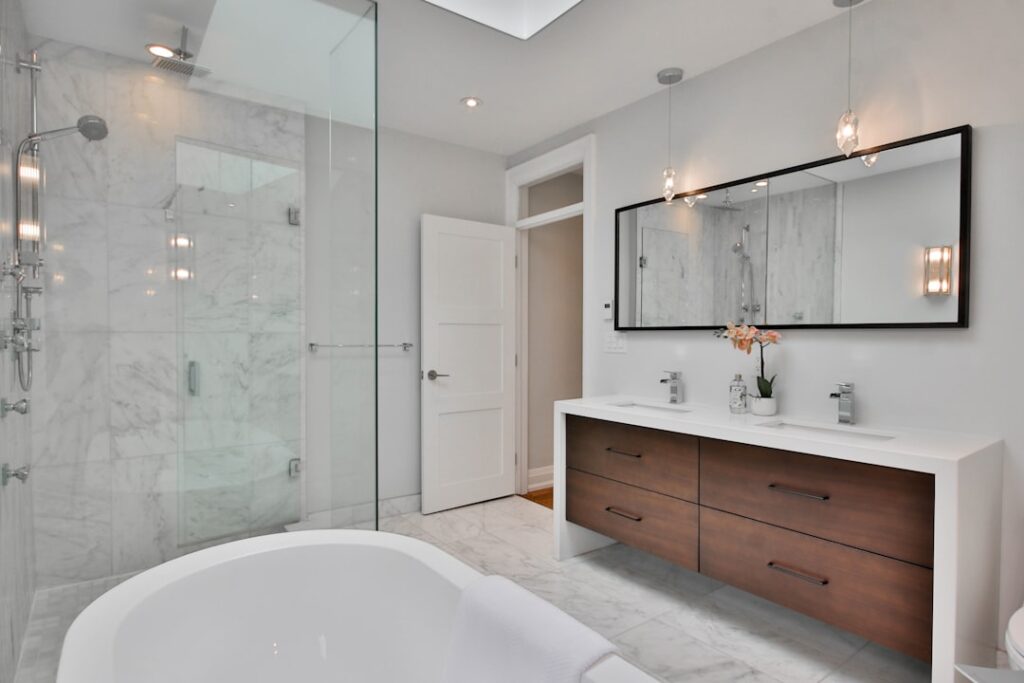
A bathroom is the one room where picking a ceiling light by looks alone can genuinely go wrong. Steam condenses inside fixtures, corrodes contacts, fogs glass from the inside, and — with the wrong fixture in the wrong spot — creates a real electrical hazard. The rules for bathroom ceiling light fixtures come down to two things: the fixture’s moisture rating (damp or wet) and where in the room it hangs. Get those right and the rest is style and brightness math. Here is how the ratings work, which fixture types suit each zone, and the numbers that make a bathroom actually pleasant to use at 6 a.m.
Part of our Bathroom Remodeling & Flooring guide — explore the full guide →
Damp vs Wet: The Ratings That Decide Everything
Every fixture carries a UL (or ETL) location listing on its box and label:
- Dry rated — indoor rooms without humidity. Fine for bedrooms; not appropriate anywhere in a bathroom.
- Damp rated — built to tolerate condensation and humid air, but not direct spray. This is the minimum standard for the general bathroom ceiling, over the vanity, and near the tub.
- Wet rated — sealed against direct water contact. Required inside the shower stall and directly over a tub or shower, and it is what you should buy anywhere steam is dense.
The National Electrical Code draws the hard line: within the shower/tub zone — 8 feet above and 3 feet out horizontally from the rim — fixtures must be rated for the location, which in practice means a wet-listed, enclosed fixture with no exposed cords, chains, or open bulbs. Hanging pendants and chandelier-style fixtures are prohibited inside that zone entirely. Outside the zone, damp-rated is the floor. When in doubt, buy wet-rated; the price difference on a recessed trim is a few dollars.
Fixture Types, Zone by Zone
General ceiling: flush and semi-flush mounts
The classic drum or dome flush mount remains the workhorse for the main ceiling — $30-150, damp-rated versions everywhere, and low enough profile for the 8-foot ceilings most bathrooms have. Semi-flush fixtures that drop 4-8 inches add presence in bathrooms with 9-foot-plus ceilings. Modern LED flush panels (the slim 1/2-inch-thick discs, $25-60) are quietly the best value in the category: fully sealed, often wet-rated, 1,500-2,200 lumens, and immune to the burned-out-bulb problem because the LEDs are integrated.
Shower and tub: recessed cans
Inside the shower zone, a wet-rated recessed light with a sealed shower trim (a gasketed frosted lens) is the standard answer — clean, code-compliant, and about $20-40 per LED unit. One 4-inch or 6-inch can centered over the shower is enough; showers are small and tile reflects well. If the ceiling above is an insulated attic, spec IC-rated, airtight housings so the can does not leak warm moist air into the insulation.
The whole-room workhorse: fan/light combos
Ventilation and lighting share the ceiling in most baths, and modern exhaust fans with integrated LED lights (Panasonic WhisperFit, Broan-NuTone, $120-300) do both jobs well. Since the exhaust fan is what actually prevents the mold and peeling paint that humidity causes, upgrading a noisy old fan to a quiet combo unit is often the highest-value ceiling change in the room. Size the fan at roughly 1 CFM per square foot of bathroom, minimum 50 CFM.
Statement pieces: where they are allowed
A small chandelier or pendant over a freestanding tub is a designer favorite — and legal only when every part of it stays outside the 8-foot/3-foot zone or the fixture is specifically wet-listed. In practice that means high ceilings. In powder rooms with no shower, anything goes: it is the one bathroom where a dry-zone decorative fixture faces nothing worse than occasional humidity.
How Bright, and What Color
Bathrooms need more light than people expect: plan on 70-80 lumens per square foot, so a 5×8 bath wants 2,800-3,200 total lumens and a 10×10 primary bath closer to 7,000-8,000 split across ceiling and vanity fixtures. Color temperature matters just as much — 3000-4000K is the sweet spot, warm enough to be flattering and cool enough for grooming accuracy, and choose bulbs or integrated fixtures with a CRI of 90+ so skin tones read true in the mirror. Put the ceiling lights on a dimmer and you get the 2 a.m. low-glare setting free.
One layout note from decades of contractor callbacks: a single centered ceiling fixture lights the top of your head and shadows your face in the mirror. Ceiling fixtures set the room’s ambient level; the vanity still needs its own sconces or bar at face height. Treat the ceiling light as half of a two-layer system.
Installation and Wiring Notes
Bathroom lighting circuits follow the same rules as any ceiling fixture — power off at the breaker, verified dead with a non-contact tester, fixture grounded, and connections in a proper box. Two bathroom-specific additions: fixtures within reach of water may be required to sit on a GFCI-protected circuit depending on your local code cycle, and every fixture’s gasket or seal must actually be installed (the sealed trim only seals with its gasket seated). Swapping a flush mount like-for-like is a confident-DIYer job of about 30 minutes; new circuits, fan ducting, or anything involving the shower zone is licensed-electrician territory, typically $150-400 per fixture installed.
Renters with a dated bathroom fixture have a lighter option: a screw-in LED retrofit or a better bulb upgrades output instantly, and for rooms outside the bathroom entirely, our guide to plug in ceiling light options covers no-wiring fixtures — though note those swag-style lights are not rated for shower steam and belong outside the bath.
Integrated LED or Replaceable Bulbs?
The category has split into two camps, and the choice has real consequences. Integrated-LED fixtures (sealed panels, most fan/light combos, many modern flush mounts) offer better moisture sealing — no bulb socket means one less place for steam to reach — plus higher efficiency and rated lifespans of 25,000-50,000 hours, which is 15-plus years of bathroom duty. The catch: when the LED array or driver eventually fails, you replace the fixture, not a bulb. Socketed fixtures keep the $5 bulb-swap repair path and let you tune brightness and color temperature by changing lamps, at the cost of slightly weaker sealing and whatever bulb quality you feed them. A sensible split: integrated LED in the shower zone and fan combo where sealing matters most, socketed fixtures for the general ceiling and vanity where you may want to adjust light quality over time.
If you go socketed, spend the extra two dollars per bulb on name-brand LEDs rated for enclosed fixtures — cheap LEDs overheat inside sealed glass domes and die in months, which gets blamed on the fixture. And whichever camp you buy, confirm dimmer compatibility: LED flicker on old dimmers is the most common post-install complaint, solved by a $25 LED-rated dimmer (Lutron Caseta and similar work reliably).
Quick Buying Checklist
- Rating first: wet-rated in the shower zone, damp-rated minimum everywhere else.
- Lumens: 70-80 per square foot, split between ceiling and vanity layers.
- Color: 3000-4000K, CRI 90+, dimmable.
- Fan combo: if the exhaust fan is old, replace both in one opening.
- Finish: match faucet and hardware — chrome, brushed nickel, and matte black all have deep fixture selections.
Budget expectations: a solid damp-rated flush mount runs $40-90, wet-rated recessed LED trims $20-40 each, quality fan/light combos $150-300, and a small wet-listed chandelier for over the tub $200-600. A full lighting refresh on a standard bath — two ceiling points plus the fan — typically lands under $500 in fixtures.
For fixture styles, sizing formulas, and the broader category beyond the bathroom, our complete ceiling light guide picks up where the moisture rules leave off. Buy the rating, then buy the look — in that order, a bathroom ceiling fixture is a 15-year decision you make once.