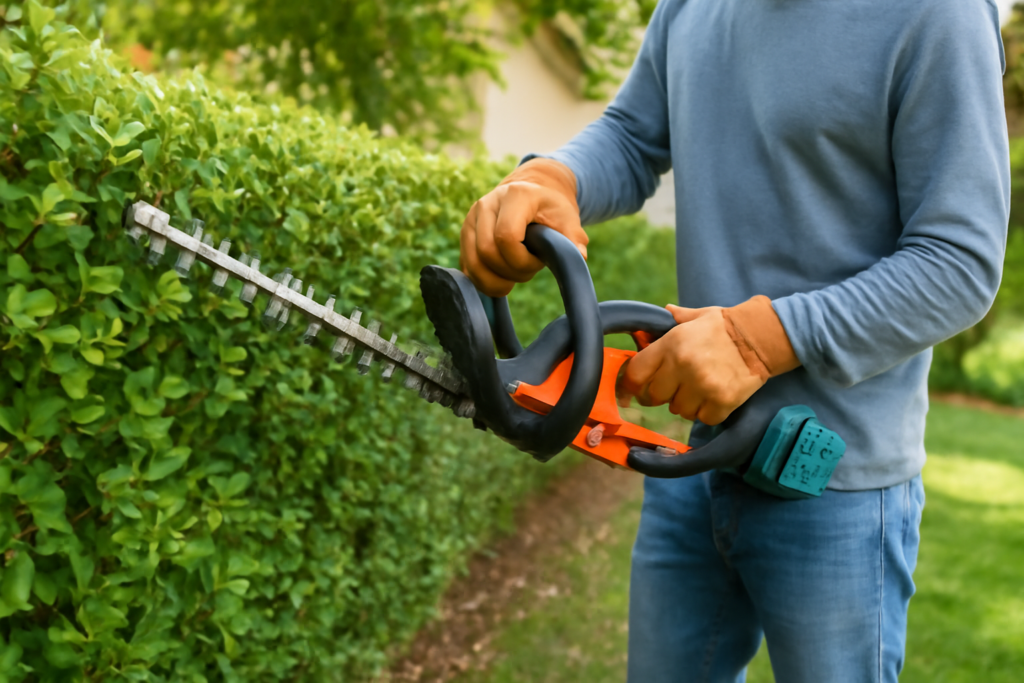
The gas hedge trimmer is on its way out, and for good reason. Modern battery operated hedge trimmers now match the cutting power of a small gas unit for typical residential hedges while eliminating the pull-start ritual, the gas-oil mixing, the fumes, and most of the noise and vibration. You grab it off the shelf, squeeze the trigger, and go. But battery trimmers vary wildly in cutting capacity, run time, and weight, and buying on price alone leaves you with a underpowered tool that stalls in a mature privet. Here is how to pick one that actually cuts.
Why Homeowners Are Switching From Gas
For an average yard with a few hedges, a cordless trimmer has decisively won on convenience. There is no engine to maintain, no ethanol gumming up a carburetor over winter, no mixing two-stroke oil, and no starting a warm engine that floods. Cordless trimmers are markedly quieter — you can trim early on a Saturday without waking the neighborhood — and they weigh less because there is no engine block, just a motor and a battery. The only real advantages gas retains are marathon run time and raw torque for thick, woody growth on large properties, which most homeowners simply don’t need.
Against corded electric, cordless trims the cord — literally. No extension cord to drag, snag on branches, or accidentally cut, and no tether limiting your reach to the far corner of the yard.
Voltage: What the Numbers Mean
Battery voltage is the rough proxy for power, and the market splits into tiers:
- 18V/20V-max: lightweight homeowner trimmers, great for boxwoods, small hedges, and touch-up work. They handle branches up to about 1/2 to 5/8 inch and share batteries with other tools in that platform.
- 40V: the sweet spot for most yards. Enough torque for established hedges and 3/4-inch stems, still reasonably light, with practical run times.
- 56V, 60V, 80V: near-gas performance for big, dense, or woody hedges and larger properties. Heavier and pricier, but they don’t bog down.
Higher voltage is not automatically better for a small yard — it adds weight and cost you may not need. Match the voltage to the toughest hedge you actually cut, not the biggest one you can imagine.
Blade Length and Tooth Gap
Two blade specs decide what the trimmer can do. Blade length controls how much hedge you cover per pass — 18 to 20 inches is versatile for most homes, 22 to 24 inches speeds up long runs of tall hedge, and short 16-inch or under blades give control for detailed shaping and topiary. Longer blades cover ground faster but are heavier and harder to maneuver on tight forms.
Tooth gap (the cutting capacity between blade teeth) determines the maximum branch thickness the trimmer will cut cleanly. A 3/4-inch gap handles thicker, woodier growth than a 3/8-inch gap. If your hedges get away from you between trims, a wider gap saves you from switching to a lopper. Also favor dual-action blades — where both blades move — because they vibrate far less than single-action designs.
Run Time and Battery Strategy
Run time depends on battery amp-hours (Ah) and how hard you push the tool. A 2.0Ah pack might give 30 to 45 minutes of light trimming, while a 4.0Ah or 5.0Ah pack runs 60 to 90 minutes and powers through denser growth. For most yards, one good battery plus a spare on the charger means you never stop working — trim on one pack while the other recharges.
The smartest money move is buying into a battery platform you already own. If your drill, blower, and mower share a battery system, a bare-tool trimmer on that platform saves you $80 to $150 because you skip buying another battery and charger. Battery interchangeability is a real, underrated buying factor.
Weight and Ergonomics
You hold a hedge trimmer at arm’s length, often overhead, so weight matters more than the spec sheet suggests. A 6-to-7-pound trimmer feels fine for a quick trim; a 10-pound unit wears out your shoulders on a long hedge. Look for a wrap-around front handle that lets you keep a comfortable grip whether cutting flat tops or vertical sides, and a rotating rear handle helps enormously on the sides of a hedge. A tool that fatigues you leads to sloppy, uneven cuts, so try to handle it before buying if you can.
Safety Features Worth Having
Good trimmers include a two-handed safety switch that requires both hands engaged to run the blade, a hand guard to deflect debris, and a blade brake that stops the teeth within a second of releasing the trigger. That fast blade stop is the feature that prevents most serious injuries — when a branch surprises you and you let go, you want the blade to halt immediately. Always wear eye protection and cut-resistant gloves, and clear the hedge of hidden wire, ties, and old plant labels before you start.
Cordless vs. Corded vs. Gas, and Blade Care
To buy confidently, it helps to see where battery sits against the alternatives. Corded electric trimmers are the lightest and cheapest, deliver unlimited run time, and never lose power as a battery drains — but the extension cord tethers you, limits reach, snags on branches, and creates the real hazard of cutting through your own cord. They suit small yards near an outlet where mobility isn’t an issue.
Gas trimmers still lead on raw torque and marathon run time, making them the choice for acres of thick, woody hedge or professional crews working all day. The costs are noise, fumes, vibration, weight, the pull-start, and ongoing maintenance — mixing two-stroke oil, cleaning carburetors, and winterizing fuel. For the average homeowner, those downsides now outweigh the benefits. Battery trimmers land in the sweet middle: cordless freedom, near-corded convenience, quiet operation, and enough power for typical residential hedges, with the only real limits being battery run time and slightly less torque than gas. For the vast majority of yards, cordless is simply the right tool in 2026.
A little maintenance keeps a cordless trimmer cutting cleanly for a decade, and it’s far simpler than gas upkeep since there’s no engine. The core habit is caring for the blade. After each use, brush off clippings and sap, then wipe the blade with a rag. Sticky plant resin builds up fast and makes the trimmer drag and tear rather than slice; a spray of resin-dissolving blade cleaner or even a wipe with a little solvent clears it. Then apply a light coat of machine oil or a dedicated blade lubricant along the teeth to prevent rust and keep the blades gliding — do this every few uses, not just at season’s end.
Sharpen the blades once or twice a season with a flat file following the factory bevel, or have them professionally sharpened; dull blades bruise and shred branches, which invites disease into the hedge and makes the motor work harder. For the battery, store it indoors at room temperature and around a half charge if you’re putting the tool away for winter — lithium packs degrade faster stored full, empty, or in a freezing shed. Keep the charger and battery out of extreme heat and cold, and a quality pack will hold strong capacity for years of seasonal trimming.
What You’ll Pay in 2026
Cordless trimmers span a wide range. A basic 18V/20V homeowner kit with battery and charger runs about $80 to $150. A capable 40V trimmer lands around $130 to $250 as a kit. High-voltage 56V-to-80V near-gas performers run $200 to $400 with a large battery. Bare tools (no battery) on a platform you already own can be had for $60 to $180. For most homeowners with normal hedges, a 40V kit with a 4.0Ah battery, an 18-to-22-inch dual-action blade, and a fast blade brake is the value sweet spot — enough power for real work without gas-tool hassle or weight. Bought smart, quality battery operated hedge trimmers will handle a decade of seasonal trimming with almost no maintenance beyond wiping and oiling the blade.