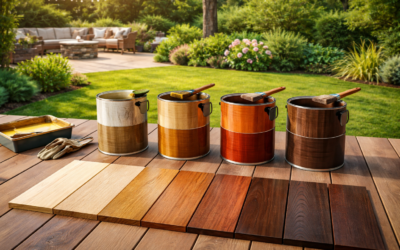
Most people pick a deck stain by color name and get surprised by the result. The behr stain color chart is really several charts stacked together, one per opacity level, and the same color name can look very different depending on which product it is mixed into. A “Cedar Naturaltone” in a clear-leaning transparent finish lets the grain do most of the talking, while a solid stain in a similar tone hides the grain almost completely.
So the first decision is opacity, not color. Behr’s exterior wood stains run from a transparent waterproofing wood finish, through a semi-transparent waterproofing stain and sealer, to a solid color waterproofing stain and sealer, with a thicker resurfacer coating sitting above that for rough, older decks. Each step up adds pigment, hides more of the wood, and, according to the maker’s own figures, lasts longer between recoats.
- Behr Stain Color Chart by Opacity
- Transparent Shades: Natural, Cedar Naturaltone and Redwood
- Semi-Transparent Colors: The Middle of the Chart
- Solid Stain Colors: Maximum Coverage
- Tools and Materials
- How to Pick a Color From the Behr Stain Color Chart
- Applying the Stain
- Safety When Using Exterior Stains
- Troubleshooting Common Stain Color Problems
- General Costs and When to Call a Pro
- Behr Exterior Stains by Surface: Decks, Fences, Siding and Furniture
- Frequently Asked Questions
Once you know how much grain you want to see and how weathered your wood is, the color choice gets much easier. Here is each opacity, with the named colors the maker lists for it, how long it is rated to last, and how to test a shade before you commit a whole deck to it.
Behr Stain Color Chart by Opacity
The figures in this table come from Behr’s product pages for each line. Color counts and durability ratings change from time to time, so check the current product page or label before buying.
| Product type | Grain visibility | Colors offered | Maker’s durability claim | Best for |
|---|---|---|---|---|
| Transparent Waterproofing Wood Finish | Full grain, light tint | Natural (clear), Cedar Naturaltone, Redwood, plus a short list of custom tints | Up to 4 years on decks, up to 6 on fences and siding | New or nearly new wood in good shape |
| Semi-Transparent Waterproofing Stain & Sealer | Grain visible, noticeable color | About 60 colors | Up to 6 years on decks, up to 8 on fences and siding | New to moderately weathered wood (0 to 10 years of exposure) |
| Solid Color Waterproofing Stain & Sealer | Grain hidden, texture shows | A large tintable range (the maker cites up to 1,600 custom colors) | Up to 10 years on decks, up to 25 on fences and siding | New to heavily weathered wood (0 to 15+ years of exposure) |
| Resurfacer coating (DeckOver) | Grain and small cracks covered | About 54 colors, smooth or textured | Varies by product version, check the label | Rough, splintery older decks that stain alone will not fix |
Notice the trade-off. The more pigment you add, the longer the coating lasts, but the less the wood looks like wood. Transparent finishes need recoating most often, and solid stains last longest but behave more like paint, including peeling if the surface prep is poor.
Transparent Shades: Natural, Cedar Naturaltone and Redwood
The transparent waterproofing wood finish is the lightest touch in the lineup. Its three pre-mixed colors are Natural, which dries clear and simply shows off the grain, Cedar Naturaltone, which adds a warm honey-orange glow, and Redwood, which pushes the wood toward a reddish brown. Behr also lists a handful of custom tints for this line, including Cordovan Brown, Barn Red, Chocolate, Golden Honey, Antique Oak and Natural Sequoia.
Because so little pigment is involved, the base color of your boards matters more than the chip. Pressure-treated pine with a green cast will shift a Cedar Naturaltone toward olive, while real cedar or redwood boards will make the same finish look rich and even. If someone searching for a Behr redwood stain wants a deep red deck on pale pine, a transparent finish will probably disappoint, and a semi-transparent Redwood gets closer.
Expect to recoat more often with this opacity. The maker’s claim is up to 4 years on decks and up to 6 years on vertical surfaces, and horizontal boards in full sun usually sit at the short end of any rating.
Semi-Transparent Colors: The Middle of the Chart
The semi-transparent waterproofing stain and sealer is where most of the named colors live, roughly 60 of them. It colors the wood clearly while letting the grain pattern show through. On the maker’s chart the codes start with ST, for example:
- ST-101 Atlantic: a very dark navy-charcoal
- ST-102 Slate: a cool gray
- ST-103 Coffee: a dark brown
- ST-104 Cordovan Brown: a reddish dark brown
- ST-105 Padre Brown: a mid brown
- ST-106 Bordeaux: a wine-red brown
- ST-107 Wedgewood: a muted blue-gray
- ST-210 Ultra Pure White: a whitewash look
Other names on the semi-transparent chart include Forest, Barn Red, Woodbridge, Colony Blue, Sandal and Stonehedge, plus wood tones built on Redwood, Cedar Naturaltone, Chocolate, Russet and Cordovan Brown tint bases. The maker rates this product for new to moderately weathered, unsealed wood with up to about 10 years of exposure, and claims up to 6 years on decks and 8 years on fences and siding.
Be aware that Behr sells more than one semi-transparent product. A budget line and a penetrating oil version share some color names but use different color numbers and carry shorter or different ratings. When you match a color from a neighbor’s deck, confirm the exact product, not just the name.
Solid Stain Colors: Maximum Coverage
The solid color waterproofing stain and sealer hides the grain and most minor flaws, leaving the wood’s texture visible under an even coat of color. Named shades include Atlantic, Slate, Cordovan Brown, Barn Red and Ultra Pure White, and the paint desk can tint the base into a far wider range of custom colors. The maker lists 1,600 custom colors on its product page, though its curated stain palette is much smaller.
Solid stain is rated for new to heavily weathered or cracking wood, up to and beyond 15 years of exposure, with claims of up to 10 years on decks and up to 25 years on fences and siding. Coverage is listed at roughly 200 to 400 sq ft per gallon for the first coat and 400 to 800 sq ft for the second, since the first coat soaks in. It is self-priming on most woods, with one important exception: redwood, cedar, cypress and other tannin-rich “bleeding” woods can discolor white and pastel colors, so prime those first.
Solid stain looks great on fences and siding for years, but on a walking surface it wears like paint. High-traffic paths and stair treads will show wear first, and touch-ups rarely blend perfectly once the rest of the deck has weathered.
Tools and Materials
- Wood cleaner and, for previously stained wood, a stripper suited to the old coating
- Stiff nylon scrub brush and a garden hose (pressure washer only on a low, wide setting)
- Stain applicator pad on an extension pole for deck boards
- 2 to 3 inch synthetic brush for rails, edges and gaps
- Paint tray, stir sticks and painter’s tape
- Drop cloths or plastic sheeting for siding, plants and patio stones
- Nitrile gloves, safety glasses and a respirator per the product label
- Scrap boards from the same project for color tests
The maker recommends a pad applicator over large deck areas because it lays down an even film and pushes stain into the board surface faster than a brush. Rollers work on siding and fences but tend to leave too much product on flat deck boards.
How to Pick a Color From the Behr Stain Color Chart
- Judge the wood first. Sprinkle water on the boards. If it soaks in within a few minutes, the wood will accept a penetrating stain. If it beads, there is still a sealer or mill glaze, and you need to clean or strip before color matters.
- Pick the opacity by condition. Newer, attractive boards suit transparent or semi-transparent finishes. Gray, patchy or checked boards look better under solid stain. Splintery, cracked decking may need a resurfacer.
- Narrow to three colors. Choose colors that work with your house trim, roof and siding. A cool gray stain beside warm brick, for example, can look disconnected.
- Test on real boards. The maker notes that chips are simulated and can differ from the stained surface depending on wood species. Apply each candidate to a cleaned scrap or an out-of-the-way board and let it dry fully.
- Check in daylight. Look at the samples in morning and late afternoon sun. Reds and oranges intensify in warm evening light.
- Buy enough from one batch. Calculate your square footage, add 10 to 15 percent, and have all the cans mixed at once so the color stays consistent.
Applying the Stain
Apply only within the label’s temperature window, which for these lines is 35 to 90°F, and the temperature needs to stay above 35°F for 12 hours afterward. Avoid direct midday sun on dark boards, which dries the stain before it penetrates and causes lap marks. Work two or three boards at a time along their full length, keeping a wet edge so you never stop in the middle of a board.
Semi-transparent stain should not be over-applied: what does not soak in sits on top and can peel. Solid stain usually takes two coats, and the maker says it resists rain about 4 hours after application. Keep foot traffic off the deck for at least a day, and longer before you set furniture back on it.
Safety When Using Exterior Stains
Stains, strippers and cleaners are chemicals, so treat them that way. Work with good ventilation, wear the respirator the label calls for when spraying or using solvent-based products, and protect your hands and eyes with nitrile gloves and safety glasses. Never mix cleaners, brighteners or strippers with each other unless the label says it is safe, since some combinations release harmful gases. Keep any flammable products and their vapors away from pilot lights, grills and other ignition sources.
If you use an oil-based or penetrating oil stain, lay used rags and pads flat outdoors to dry or soak them in water in a sealed metal can. Bunched oily rags can heat up and catch fire on their own.
Troubleshooting Common Stain Color Problems
- Color much darker than the chip: soft or very porous wood soaked up extra pigment. Test on scrap first, and wipe back excess while wet.
- Blotchy color: uneven cleaning or leftover old coating. Strip or clean the whole surface evenly and restain.
- Peeling within a year: too much semi-transparent stain sat on the surface, or solid stain went over dirty, damp or glazed wood.
- Pink or orange tint on white solid stain: tannin bleed from cedar or redwood. Prime with a stain-blocking primer and recoat.
- Gray patches returning fast: UV and water reaching bare spots. Check that the end grain and board edges were coated.
General Costs and When to Call a Pro
Exterior stain typically costs somewhere in the range of $30 to $60 per gallon for premium semi-transparent and solid products, and a typical 300 sq ft deck needs about 2 to 4 gallons depending on opacity, number of coats and wood condition. Add cleaner, brushes and a pad applicator and a DIY job usually lands in the low hundreds of dollars. Professional cleaning and staining often runs a few dollars per square foot, more when stripping or board replacement is involved.
Call a pro if the deck is high off the ground, has rotted or loose boards, or carries an old coating that will need heavy stripping. A pro is also worth it on two-story siding, where the ladder work is the hardest part of the job.
Behr Exterior Stains by Surface: Decks, Fences, Siding and Furniture
Behr exterior stains are rated differently for walking surfaces and vertical surfaces, so the same color lasts longer on a fence than on a deck. Choose the product by surface first, then narrow the Behr exterior stain chart to colors that suit that use. Lighter, more transparent finishes favor newer wood, while solid colors suit older boards and siding.
Matching the Opacity to the Surface
| Surface | Usual opacity | Maker’s rating | Color tip |
|---|---|---|---|
| Deck boards | Semi-transparent or solid | Up to 6 years semi, up to 10 years solid | Mid browns hide dirt and wear best |
| Fences | Semi-transparent or solid | Up to 8 years semi, up to 25 years solid | Grays and dark browns blend into landscaping |
| Siding and trim | Solid | Up to 25 years solid | Coordinate with roof and window trim |
| Pergolas and railings | Match the deck color | Follows the product used | Use the same color code as the deck |
| New cedar or redwood | Transparent | Up to 4 years decks, 6 vertical | Cedar Naturaltone or Redwood shows the grain |
Ratings come from the maker’s product pages and change from time to time, so check the current label.
How Behr Exterior Stain Colors Change Outdoors
Outdoor stain colors fade and shift once sun and rain hit them. Reds and oranges tend to fade first in full sun, and pale colors show mildew and dirt sooner on shady decks. Very dark colors such as Atlantic or Coffee absorb heat, so deck boards can feel hot underfoot in summer; a mid brown or gray is often more comfortable on a south-facing deck.
Reading the Behr Exterior Stain Chart Correctly
- Check the product line printed on the chart. Semi-transparent and solid colors share some names but carry different codes.
- Note the color number, not just the name, when matching an existing deck or fence.
- Remember that chips are printed simulations; the real color depends on the wood species and its age.
- Expect the first coat on old, dry wood to look darker than the chip because the boards absorb more stain.
Outdoor Furniture and Small Projects
Wood benches, planters and picnic tables can share the deck color for a coordinated yard. Use the same product and color code, sand rough spots first, and let each piece dry fully before use. Keep stain-soaked rags flat outdoors to dry, since oily rags can heat up and catch fire.
Frequently Asked Questions
How many colors are on the Behr stain color chart?
It depends on the product. The transparent finish has three pre-mixed colors plus a few custom tints, the semi-transparent stain and sealer has about 60, and the solid stain can be tinted to a very large custom range.
Is there a Behr solid stain color chart separate from the semi-transparent one?
Yes. Solid and semi-transparent colors are listed separately, and some names appear on both with different codes and very different looks, so match by product and color number.
What does the Behr redwood stain look like?
In the transparent finish it adds a light reddish tone over the grain. In semi-transparent and solid versions it reads as a stronger reddish brown. Test on your own wood, because the base board color changes the result.
Which Behr stain opacity lasts longest?
Solid color stain carries the longest maker ratings, up to 10 years on decks and 25 on fences and siding, while transparent finishes carry the shortest.
Can I put semi-transparent stain over solid stain?
No. A semi-transparent stain needs bare wood to soak into. Over a solid stain, use another solid stain or strip the old coating first.