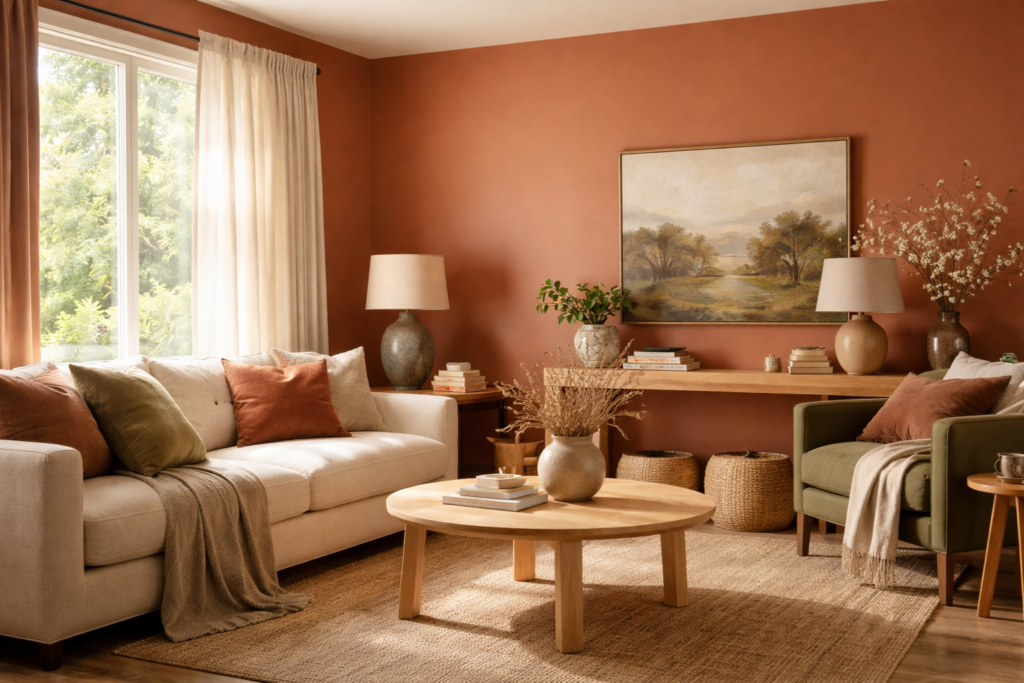
Terracotta paint looks easy on a chip and surprisingly strong on four walls. Benjamin Moore baked terracotta, listed by the manufacturer as Baked Terra Cotta 1202, is a medium-deep clay color with orange and brown undertones, so it reads warmer and earthier than a brick red and calmer than a bright pumpkin. That balance is why it shows up on accent walls, dining rooms and front doors in homes with wood, leather and natural fiber decor.
The short version: Baked Terra Cotta has a light reflectance value (LRV) of 20.93, sits in the orange color family and belongs to the Benjamin Moore Classics collection. It will make a room feel cozier and slightly smaller, especially in low light. Pair it with a soft warm white on trim and you get a sun-baked, Mediterranean look; pair it with a deep charcoal and the room turns moody and modern.
- Benjamin Moore Baked Terracotta Specs at a Glance
- Undertones: Why It Reads Clay, Not Red
- Rooms Where Baked Terra Cotta Works
- Coordinating Trim and Accent Colors
- Compared With Similar Terracotta and Orange Shades
- How to Sample It Properly
- Is Benjamin Moore Baked Terracotta Right for Your Home?
- Painting Tips for a Deep Warm Color
- Troubleshooting Common Complaints
- General Cost Ranges
- When to Hire a Painter
- Frequently Asked Questions
Note the spelling: Benjamin Moore writes the name as three words, “Baked Terra Cotta.” Asking for “Baked Terracotta” at the paint counter will still get you the right color, but the number 1202 is the surest way to order it.
Benjamin Moore Baked Terracotta Specs at a Glance
| Spec | Value | What it means |
|---|---|---|
| Official name | Baked Terra Cotta | Three words on the manufacturer’s color page and fan deck |
| Color number | 1202 | Use this number when ordering or matching |
| LRV | 20.93 | Medium-dark; absorbs most light and deepens in dim rooms |
| Color family | Orange | Filed with oranges, not reds |
| Undertones | Orange and brown | Earthy and grounded rather than fiery |
| Collection | Benjamin Moore Classics | A long-running core collection; confirm the product line you want can be tinted to it |
| Manufacturer-suggested pairings | Acadia White OC-38, Straw Hat 270, Classic Gray OC-23, Chelsea Gray HC-168 | Ready-made trim, ceiling and accent partners |
LRV runs on a scale from 0 (black) to 100 (pure white). Most designers consider anything under about 30 a dark or saturated choice, so at roughly 21 this color needs good lighting and confident pairing. Always verify numbers against the current color page, since manufacturers occasionally reformulate or retire colors.
Undertones: Why It Reads Clay, Not Red
Benjamin Moore describes the color as having orange and brown undertones that lend it a grounding quality. In practice that means it never tips into the pink side that some terracottas do. Under warm incandescent or 2700K LED bulbs it glows like fired clay pottery. In cool north light the brown comes forward, and the wall can look closer to a rusty cinnamon.
Sunny south and west rooms bring out the orange, sometimes more than people expect at 4 p.m. If you want the color to stay steady through the day, choose a matte or eggshell finish; higher sheens reflect more light and exaggerate the orange in strong sun.
Rooms Where Baked Terra Cotta Works
Dining rooms
A medium-dark warm color around a table feels intimate under a pendant or chandelier. Pair it with white trim and a wood table and the room feels instantly finished.
Accent walls and alcoves
One wall behind a sofa or bed is the lowest-commitment way to use the color. Built-in shelving painted in Baked Terra Cotta makes books and ceramics pop.
Kitchens with wood or cream cabinets
On a single wall, a range hood surround or an island base, this shade complements oak, walnut and cream-painted cabinets. It also sits well beside clay tile, saltillo floors and warm-toned wood or wood-look floors.
Front doors and exterior accents
Against cream, sand or soft gray siding, a terracotta front door reads welcoming without the shout of a fire-engine red. It is a natural fit for Spanish revival, adobe and craftsman exteriors.
Where to be cautious
Small windowless rooms such as powder rooms can feel cave-like unless you embrace the drama with good lighting. Bedrooms work for some people, but test it at night with your actual lamps before committing.
Coordinating Trim and Accent Colors
Benjamin Moore suggests four partners on the color’s own page, and each produces a different mood:
- Acadia White OC-38: a warm white for trim, doors and ceilings that keeps the scheme soft and sunny.
- Straw Hat 270: a rustic tan neutral (LRV 57.12) that builds a layered, Southwestern-leaning palette.
- Classic Gray OC-23: a light warm gray for adjoining rooms, which calms the orange.
- Chelsea Gray HC-168: a deep gray for cabinets, an island or exterior shutters, giving a more modern contrast.
Beyond paint, natural materials are the easiest partners: oak and walnut, rattan, linen, aged brass, olive greens in textiles and creamy stone. Cool stark whites and blue-gray floors tend to fight the warmth, so lean toward cream and beige neutrals instead.
Compared With Similar Terracotta and Orange Shades
The manufacturer lists several shades as similar. Knowing how they differ helps if your sample looks a touch too bright or too brown.
| Color | Code | How it compares |
|---|---|---|
| Baked Terra Cotta | 1202 | Balanced orange-brown clay; the middle ground |
| Colonial Brick | 2093-30 | LRV 19.58; a touch deeper, filed in both the red and orange families, so it leans more brick-like |
| Audubon Russet | HC-51 | LRV 20.95; a Historical Colors terra-cotta at almost identical depth, filed with browns and oranges |
| Spiced Pumpkin | 034 | LRV 18.68; slightly deeper, an earthy orange deepened by a hint of red |
All four sit within about 2.5 LRV points of each other, so the differences are in undertone more than depth. If you are torn, paint all the finalists on the same wall in large patches so you judge them under identical light.
How to Sample It Properly
- Get large samples. Peel-and-stick paint swatches or a sample pot brushed onto poster board give a far better read than a tiny chip.
- Place them at eye level and near the floor. Floors and furniture reflect color onto walls, and a warm floor will push the orange further.
- Check morning, afternoon and night. Look under daylight, then with your normal bulbs on.
- Compare against trim. Hold your trim white next to the sample so you see the real contrast.
- Live with it 48 hours. Deep warm colors can feel bold the first day and perfect by day three, or the reverse.
Is Benjamin Moore Baked Terracotta Right for Your Home?
It is a good fit if your home already has warm wood, clay or brass finishes and you want a color with presence that still feels natural. It is a weaker fit in rooms dominated by cool gray tile, blue-white light or chrome fixtures, where the orange can feel out of place. Benjamin Moore baked terracotta also works as a bridge color in an open plan: use it on one defined zone, such as a dining nook or a reading corner, and keep surrounding walls in a soft warm white so the space stays connected. For a lower-commitment start, paint a front door, a bookcase back or a powder room vanity and see how you feel after a few weeks.
Painting Tips for a Deep Warm Color
Darker, saturated colors usually need a tinted primer and two full coats for even coverage. Ask the store to tint the primer toward the topcoat; it reduces the chance of a blotchy, streaky wall. Keep a wet edge, work one wall at a time and roll in consistent “W” patterns so lap marks do not show. Touch-ups on deep colors flash more easily, so keep a labeled sample of the exact product and sheen for later.
For finish, matte or eggshell suits most walls. Satin or semi-gloss belong on doors, trim and cabinetry. On exteriors, use an exterior product in a satin or low-luster finish and expect some fading on sun-exposed elevations over the years, which is common with warm saturated colors.
Troubleshooting Common Complaints
- “It looks too orange.” The room may get strong warm light. Try a flatter finish, warmer-but-softer bulbs, or step toward Audubon Russet for more brown.
- “It looks muddy.” Cool north light or cool white bulbs can deaden the color. Switch to 2700K to 3000K bulbs, or choose a slightly brighter neighbor.
- “The wall looks patchy.” Add another coat and use a tinted primer next time.
- “The room feels smaller.” Keep ceilings and trim a light warm white and limit the color to one or two walls.
General Cost Ranges
Sample pots and peel-and-stick swatches are inexpensive, usually a few dollars to under ten each. Premium interior paint commonly runs in the mid to high range per gallon, and a typical 12 by 14 foot room with two coats takes about 2 gallons plus primer. Professional painting for a single room usually lands in the few-hundred to low-thousand range depending on prep, ceiling height and trim work.
When to Hire a Painter
Deep colors are less forgiving than whites, so a pro is worth it for open stairwells, tall ceilings, exterior walls or cabinets. If your home was built before 1978, test for lead paint before sanding or scraping old layers, and follow lead-safe practices or hire a certified contractor.
Frequently Asked Questions
What is the LRV of Benjamin Moore Baked Terra Cotta?
Benjamin Moore lists Baked Terra Cotta 1202 with an LRV of 20.93, which makes it a medium-dark color that absorbs most of the light hitting it.
What undertones does Baked Terra Cotta have?
The manufacturer describes orange and brown undertones. It reads as an earthy clay rather than a pink or red terracotta.
Is it Baked Terracotta or Baked Terra Cotta?
The official name is Baked Terra Cotta, color number 1202. Both spellings refer to the same color, but use the number when ordering.
What trim color goes with Baked Terra Cotta?
A warm white such as Acadia White OC-38 is a reliable trim choice. Chelsea Gray HC-168 works for darker contrast on doors or cabinets.
Can Baked Terra Cotta be used outside?
Yes. Benjamin Moore lists the color as available for exterior use, so it can be tinted into exterior products; confirm the specific line at the store. It suits front doors, shutters and accents against cream or sand siding.