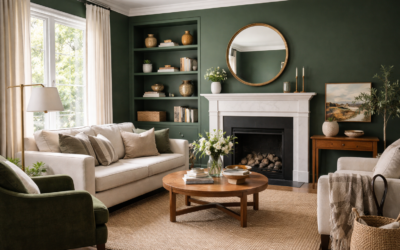
Dark green walls can look rich and enveloping or flat and gloomy, and the difference usually comes down to undertone. Benjamin Moore Caldwell Green (HC-124) lands on the rich side. The manufacturer describes it as an attractive hunter green with a subtle slate undertone, and it belongs to the Historical Colors collection, a palette rooted in traditional American architecture.
With a light reflectance value (LRV) of 16.27 on the maker’s US color page, it is a genuinely dark color. That depth makes it a strong pick for libraries, dining rooms, offices, cabinetry, front doors and shutters, where you want a moody, grounded look. The slate undertone stops it from reading too yellow or too bright, so it pairs well with crisp whites, warm woods and aged brass.
- Benjamin Moore Caldwell Green Specs at a Glance
- Undertone, LRV and Lighting Behavior
- Best Rooms and Uses for Caldwell Green
- Coordinating Trim and Accent Colors
- Caldwell Green Compared With Nearby Greens
- Sheen Choices for a Dark Green
- How to Test and Apply Caldwell Green
- Cost and When to Hire a Painter
- Frequently Asked Questions
Benjamin Moore Caldwell Green Specs at a Glance
Here is what the manufacturer’s color page confirms, along with what each spec means in practice. Check the current chip or spec sheet before buying in quantity, since collections and data are occasionally updated.
| Spec | Value | What it means |
|---|---|---|
| Color code | HC-124 | The code to give the paint counter |
| Collection | Historical Colors | A traditional, architecture-inspired palette |
| Color family | Green | Listed under greens on the maker’s site |
| Undertone | Subtle slate (gray-blue) | Cools and mutes the green so it reads sophisticated |
| LRV | 16.27 | Reflects about 16 percent of light; a dark color |
| Maker’s coordinating picks | Silver Satin OC-26, Stonington Gray HC-170, Coastal Fog 976, Barley Harvest 1070 | Soft neutrals and a warm accent to balance the depth |
| Sheen picks | Matte or eggshell on walls; satin or semi-gloss on cabinets, doors and trim | Low sheen deepens the color; higher sheen adds durability |
Undertone, LRV and Lighting Behavior
Hunter greens traditionally lean either yellow (olive and moss territory) or blue (forest and spruce). Caldwell Green’s slate undertone tips it toward the cooler, grayer side of hunter green. You get a clear, saturated green in good light, but it never looks like a bright kelly or a muddy olive.
An LRV of 16.27 means the color absorbs most of the light that hits it. On a wall, that creates a cocooning, intimate effect. In a large, bright room the green shows its full character. In a small, dim room it can look nearly black-green, which some people love for a den or powder room and others find too heavy.
How light direction changes it
- North light: the slate undertone comes forward and the color can look deep gray-green, especially on cloudy days.
- South light: warm sun brings out the hunter green, making it richer and more clearly green.
- East and west light: expect a cooler look in the morning on east walls and a warmer glow in late afternoon on west walls.
- Lamps and fixtures: warm white bulbs around 2700K to 3000K flatter dark greens at night. Very cool daylight bulbs can make it look harsh and gray.
Best Rooms and Uses for Caldwell Green
Dining rooms and libraries
Dark green is a classic choice for rooms used mostly in the evening. Under warm lamp light, Caldwell Green looks enveloping and traditional. Pair it with white or cream trim, wood furniture and brass lighting.
Home offices and dens
A dark wall color helps a workspace feel focused and reduces glare on screens. Built-in shelving painted the same green as the walls in a satin finish gives a tailored, custom look.
Kitchen cabinets and islands
Painted cabinetry is one of the most popular uses for deep greens. Caldwell Green on lower cabinets or an island, with white uppers or open shelving, adds color without darkening the whole kitchen. Use a cabinet-grade enamel in satin or semi-gloss, and prime properly over existing finishes.
Bathrooms and powder rooms
Small rooms can handle dark color well because you are not trying to make them feel large anyway. Pair the green with white tile, marble-look surfaces and brass or nickel fixtures. Use a moisture-resistant bath paint.
Front doors, shutters and exterior accents
Historical colors come into their own outside. Caldwell Green suits front doors and shutters on white, cream, gray or red brick homes. Strong sun lightens dark exterior colors, so view a sample on the actual door before buying. Choose an exterior-grade paint with a satin or semi-gloss finish for doors.
Coordinating Trim and Accent Colors
The manufacturer’s coordinating picks show the range of what works. Silver Satin (OC-26) and Stonington Gray (HC-170) are soft, cool neutrals that echo the slate undertone. Coastal Fog (976) adds a gentle middle neutral, while Barley Harvest (1070) brings a warm golden accent that plays off the green.
- Trim: a soft white such as White Dove (OC-17, LRV 83.16) gives a classic look. A creamier white feels more traditional; a very bright white makes the green look crisper and more modern.
- Color-drenched look: paint walls, trim and doors in Caldwell Green, using a higher sheen on trim for subtle contrast. This works well in dens and powder rooms.
- Adjoining rooms: a soft gray or warm greige keeps transitions calm.
- Accents and textiles: camel leather, rust, ochre, blush and cream all look good against hunter green.
- Metals and wood: aged brass, bronze and medium to dark wood tones suit its traditional character.
Caldwell Green Compared With Nearby Greens
The LRVs here come from the manufacturer’s color pages. Comparing depth and character helps you choose between similar dark greens.
| Color | LRV | How it differs |
|---|---|---|
| Caldwell Green HC-124 | 16.27 | Hunter green with a subtle slate undertone |
| Cushing Green HC-125 | 17.98 | Slightly lighter; described as a balanced dark green |
| Hale Navy HC-154 | 8.36 | Much darker navy; a common alternative for doors and cabinets |
Cushing Green sits right next to Caldwell Green in the Historical Colors deck and is very close in depth. Many people view them side by side and choose based on which reads truer in their room. If you are deciding between green and navy for an island or a front door, Hale Navy is noticeably darker, so the green will feel livelier.
Sheen Choices for a Dark Green
Sheen changes how deep colors look more than it changes light ones. A matte or flat finish makes Caldwell Green look velvety and slightly darker, with almost no glare, which suits bedrooms, dining rooms and libraries. Eggshell adds a soft glow and is easier to wipe, so it is a sensible choice for hallways and family rooms. Satin and semi-gloss reflect more light, which lightens the color slightly and highlights texture, so reserve them for trim, doors and cabinetry, where durability matters most. Keep in mind that higher sheens also show every dent and patch on walls, so good surface prep matters more as the sheen goes up.
How to Test and Apply Caldwell Green
- Sample big. Peel-and-stick paint sample sheets or a sample pot on large poster board show the color far better than a chip.
- Check both day and night. Dark colors change dramatically under lamps, so view samples after dark.
- Use a tinted primer. A gray-tinted primer helps deep colors cover in two coats rather than three or four.
- Keep a wet edge. Dark paints show lap marks. Roll full-height sections and work from one corner to the next without stopping midwall.
- Box your paint. Mix all gallons together in a larger bucket so the color is uniform across the room.
Troubleshooting
- Streaky finish: usually lap marks or a thin coat. Apply another full coat with consistent pressure.
- Room feels too dark: add warm lighting, a lighter ceiling and lighter rugs, or use the color on lower walls or cabinets only.
- Touch-ups look shiny: sheen differences show on dark colors. Repaint wall to wall corner instead of spot-patching.
- Looks too gray: north light or cool bulbs; try warmer 2700K bulbs.
Cost and When to Hire a Painter
Expect roughly 2 gallons for two coats on the walls of an average 12 by 12 foot room, plus primer. Deep colors sometimes need a dedicated deep-tone base, which can cost a little more than standard bases. Professional painting of a single room often runs from a few hundred dollars to around a thousand, and painting a full set of kitchen cabinets is a larger project that commonly runs into the thousands.
Benjamin Moore Caldwell Green is very forgiving on walls, but cabinets and doors reward skilled spraying and careful prep. Hire a pro for cabinet refinishing, two-story foyers, or exterior work above a single story. In homes built before 1978, test existing paint for lead before sanding and follow lead-safe practices or hire a certified renovator.
Frequently Asked Questions
What undertone does Caldwell Green have?
The manufacturer describes it as a hunter green with a subtle slate undertone, so it leans slightly cool and gray rather than yellow.
What is the LRV of Benjamin Moore Caldwell Green?
The manufacturer’s US color page lists an LRV of 16.27, which makes it a dark color that absorbs most of the light in a room.
Is Caldwell Green good for kitchen cabinets?
Yes. It is a popular deep green for lower cabinets and islands. Use a cabinet-grade enamel in satin or semi-gloss and prime the existing finish properly.
What white goes with Caldwell Green?
Soft whites such as White Dove work well for trim. Creamier whites look more traditional, while brighter whites give a crisper, modern contrast.
Can I use Caldwell Green on a front door?
Yes. It suits front doors and shutters, especially on white, gray or brick homes. Use an exterior paint and view a sample in full sun first.
What is the difference between Caldwell Green and Cushing Green?
They are close neighbors in the Historical Colors deck. Cushing Green is slightly lighter, with an LRV of 17.98, versus 16.27 for Caldwell Green.