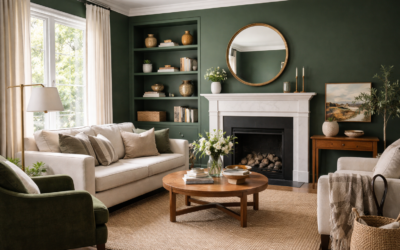
A deep green wall can make a small study feel like a library or turn plain kitchen cabinets into the focal point of the house. The catch is that every Benjamin Moore dark green behaves differently: some lean blue, some go almost black at night, and some glow with emerald saturation. Pick by undertone and light reflectance value (LRV), not by a tiny chip on a screen.
Part of our Paint & Walls guide — explore the full guide →
This roundup covers only deep greens: forest, hunter, emerald and green-black shades with LRVs under about 18. Every code, LRV and description in this roundup was checked against the manufacturer’s own color pages. LRV runs from 0 (black) to 100 (white), so a color at 6 reflects very little light, while one at 15 still reads clearly green in an average room.
- Benjamin Moore Dark Green Swatch Table
- Green-Black Shades: Essex Green, Salamander and Regent Green
- Hunter and Forest Greens
- Emerald Greens
- How to Choose Among These Deep Greens
- Painting With Dark Greens: Practical Tips
- Troubleshooting Dark Green Paint
- Cost and When to Hire a Painter
- Frequently Asked Questions
If you want a near-black green with drama, start with the lowest LRVs. If you want a green that stays green in a dim room, look at the colors in the 9 to 18 range.
Benjamin Moore Dark Green Swatch Table
Colors are listed from darkest to lightest. “Undertone” summarizes the manufacturer’s description in plain terms.
| Color and code | LRV | Undertone and character | Best use |
|---|---|---|---|
| Essex Green HC-188 (also PM-11) | 5.64 | Nearly black green, historic | Front doors, shutters, moody dining rooms |
| Salamander 2050-10 | 5.72 | Black, blue and green mix; shifts with light | Libraries, bedrooms, built-ins |
| Regent Green 2136-20 | 6.16 | Deep pine green verging on black | Exterior trim, cabinets, accent walls |
| Hunter Green 2041-10 | 6.39 | Classic dark green, cool lean | Studies, cabinetry, traditional rooms |
| Forest Green 2047-10 | 7.58 | Grounded dark green, slightly blue | Kitchen islands, powder rooms |
| True Green 2042-10 | 9.43 | Rich emerald | Statement walls, bars, doors |
| Tarrytown Green HC-134 | 9.71 | Deep pine with a cool cast | Exteriors, mudrooms, trim |
| Deep Green 2039-10 | 9.73 | Dark, saturated true green | Accent walls, furniture |
| Peale Green HC-121 | 14.15 | Earthy, classic forest green | Whole rooms, cabinetry |
| Cushing Green HC-125 | 17.98 | Balanced dark green, flexible | Living rooms, exteriors |
Paint makers occasionally adjust or retire colors, and LRVs are measured values that can differ slightly between regional sites. Confirm the current code at the paint counter before ordering, especially for Essex Green, which also appears under a second code in another collection.
Green-Black Shades: Essex Green, Salamander and Regent Green
These three sit at the very bottom of the LRV scale, so they read almost black in low light and reveal their green only in daylight or under a lamp.
Essex Green HC-188
Part of the manufacturer’s Historical Colors collection, Essex Green is described as a nearly black shade of green. It is the go-to for front doors and shutters on colonial and Georgian houses, and it makes a dramatic dining room. Coordinating colors listed by the manufacturer include Simply White and Powell Buff, which give it a crisp or warm historic frame.
Salamander 2050-10
The manufacturer calls Salamander a deep, dark mix of black, blue and green and a chameleon. That blue component means it can look navy in north light and green under warm bulbs. Use it in a bedroom or library where you want a cocooning feel, and sample it on at least two walls to see the shift.
Regent Green 2136-20
Regent Green is a deep pine green that verges on black. Interestingly, the manufacturer files it in its blue family, which hints at the cool undertone. It is a strong exterior trim and door color against white or gray siding, and it works on cabinets when you want something softer than true black.
Hunter and Forest Greens
Hunter Green 2041-10 is the classic: a timeless dark green, per the manufacturer, with enough depth for paneled studies and traditional kitchens. The manufacturer lists Simply White, Cloud White and Grant Beige among its coordinating colors, which tells you it pairs best with warm whites and soft beiges rather than stark gray.
Forest Green 2047-10 is a touch lighter at 7.58 and is described as a dark green with a grounding yet sophisticated presence. It reads slightly blue-green next to Hunter Green. That makes it a good kitchen island color against white perimeter cabinets and a strong choice for powder rooms with brass fixtures.
For a softer forest look that still reads unmistakably green, step up to Peale Green HC-121 (14.15) or Cushing Green HC-125 (17.98). Both live in the Historical Colors collection and are easier to live with on all four walls of a main room.
Emerald Greens
True emerald is about saturation, not just darkness. True Green 2042-10 is described as a dark hue with ultra-rich emerald tones, and Deep Green 2039-10 is described as a dark and distinguished green that makes a statement. Both are lighter than the green-blacks (LRVs around 9.4 to 9.7), so the color stays vivid even in a dim corner.
Emerald works best in small doses or high-gloss applications: a front door, a home bar, a dining room with brass lighting, or a painted dresser. On four walls of a large room, saturated emerald can feel intense, so sample a big swatch first. Tarrytown Green HC-134, at 9.71, is the cooler, more muted alternative, described as a deep pine green with a slightly cool cast.
How to Choose Among These Deep Greens
- Check your light direction. North-facing rooms push greens cooler and grayer; pick a warmer green like Hunter Green or Peale Green there. South-facing rooms can handle the blue-leaning colors like Salamander and Forest Green.
- Decide how dark you can live with. Under LRV 7, the room will feel enveloping and need good lamp lighting. Between 9 and 18, the green stays visible.
- Look at fixed finishes. Warm wood floors and brass favor warmer greens. Gray tile, chrome and cool white counters favor the blue-leaning greens.
- Sample big. Peel-and-stick paint sample sheets let you move a large swatch around the room without painting test patches on the wall.
- Pick the sheen for the job. Matte or eggshell for walls (hides flaws), satin or semi-gloss for trim and cabinets, high gloss for doors and lacquered statement pieces.
- Plan the trim. Decide whether trim is white (contrast) or the same green (color drenching) before buying paint.
Painting With Dark Greens: Practical Tips
Any Benjamin Moore dark green, like other deep colors, is made with a lot of colorant in a darker base, so they behave differently from whites. Ask for a gray-tinted primer if you are covering a light or patchy wall; it reduces the number of finish coats. Plan on two full coats at minimum and sometimes three with very saturated emerald shades.
Keep a wet edge and paint a full wall in one session. Dark colors show lap marks and touch-ups more than light ones, especially in eggshell or satin. Box your paint, meaning mix all gallons for the room into one bucket, so slight batch differences do not show as stripes.
Dark green cabinets need a durable finish. Use a cabinet-grade enamel, sand and degrease thoroughly, and allow the full cure time listed on the can before rehanging doors and loading drawers.
Troubleshooting Dark Green Paint
- It looks black, not green: the room is too dim for that LRV. Add warm lamps or step up to a lighter green like Peale Green.
- It looks blue: cool light or a blue-leaning color. Switch to warmer bulbs or a warmer green like Hunter Green.
- Streaks and flashing: usually from back-rolling over drying paint. Roll top to bottom in one pass per section and keep a wet edge.
- Touch-ups show: repaint from corner to corner instead of spot touching.
- Burnished spots on matte: high-traffic areas need a more scrubbable sheen.
Cost and When to Hire a Painter
Premium interior paint commonly runs about $50 to $100 per gallon, and a 12 by 14 foot room usually needs 2 to 3 gallons for two coats on the walls. Professional interior painting often falls around $2 to $6 per square foot of wall area depending on prep, ceiling height and trim detail. Dark colors may add cost for an extra coat.
Hire a pro for cabinets, tall stairwells, high ceilings or any job where you want a flawless, brush-mark-free finish on a deep color. Homes built before 1978 may have lead paint under the current layers, so test before sanding old trim or doors.
Frequently Asked Questions
What is the darkest Benjamin Moore dark green?
Among the colors in this list, Essex Green HC-188 has the lowest LRV at 5.64, followed closely by Salamander at 5.72.
What is a good Benjamin Moore emerald green?
True Green 2042-10 is described by the manufacturer as having ultra-rich emerald tones. Deep Green 2039-10 is a close, saturated alternative.
Is Hunter Green warm or cool?
It reads as a classic dark green with a slightly cool lean, so it pairs best with warm whites, beiges and wood tones.
Which dark green works on a front door?
Essex Green and Regent Green are popular because they read nearly black from a distance and green up close.
Do dark greens make a room feel smaller?
They can make walls recede visually and feel cozy. Many small rooms actually look more intentional painted dark, as long as lighting is good.
What sheen should I use for dark green cabinets?
Satin or semi-gloss in a cabinet-grade enamel holds up to cleaning and hides fewer flaws than matte, so prep carefully.