Nothing anchors a kitchen quite like the high-contrast drama of black and white quartz. Whether you want a snowy slab threaded with charcoal veins or a near-black surface flecked with bright mineral, this palette reads as modern and timeless at the same time. Because engineered quartz is manufactured rather than quarried, the black-and-white look comes in dozens of consistent patterns you can actually shop for by name. This guide walks through the most popular styles, what they cost, how they hold up, and how to pair them so your countertop looks intentional instead of busy.
Part of our Countertops guide — explore the full guide →
Why Choose Quartz Over Natural Stone
Quartz countertops are built from roughly 90 to 94 percent ground natural quartz bound with resins and pigments. That composition is what gives them their signature durability. Unlike marble, which delivers a similar black-and-white veined appearance, engineered quartz is nonporous, so it never needs sealing and shrugs off wine, coffee, and lemon juice that would etch a natural stone.
The practical payoff shows up every day. You can set a hot pan trivet down, roll out dough directly on the surface, and wipe up spills with a damp cloth and a drop of dish soap. For families who cook often, that low-maintenance behavior is usually the deciding factor. The trade-off is heat sensitivity, since the resin binders can scorch above roughly 300°F, so trivets remain non-negotiable for pots straight off the burner.
Popular Black and White Quartz Patterns
Manufacturers give their slabs proprietary names, so it helps to know what you are actually looking at on a showroom floor. A few families of pattern dominate the black-and-white category, and recognizing them makes it far easier to compare quotes across fabricators who carry different brands.
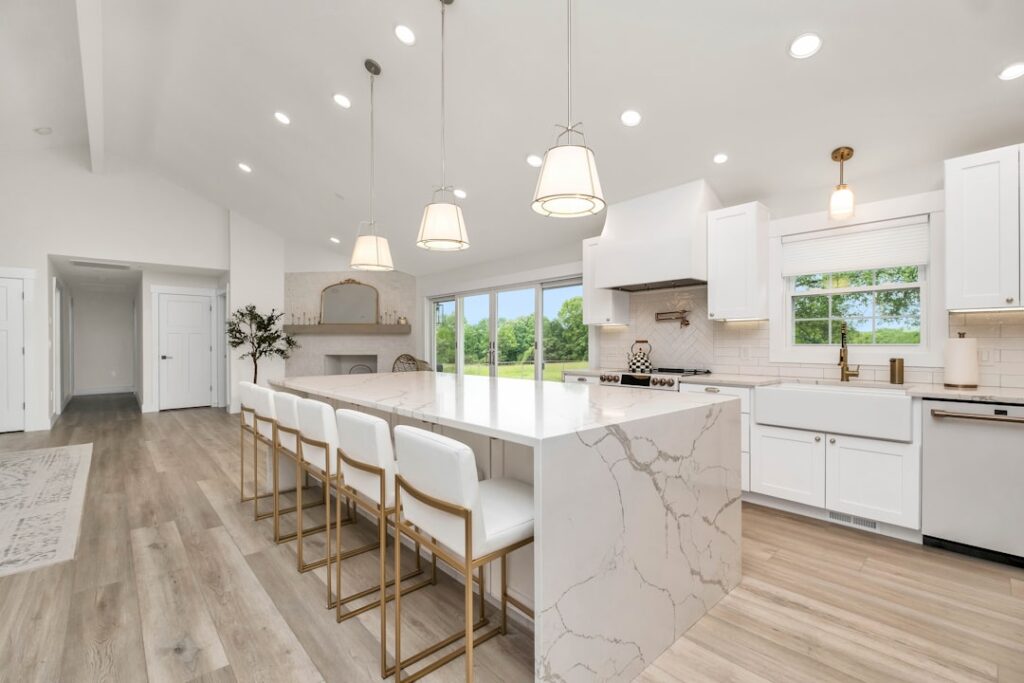
- Marble-look whites with black veining — a bright or warm-white base crossed by dramatic dark veins that mimic Calacatta and Statuario marble. This is the most requested look for open-concept kitchens.
- Salt-and-pepper — a mid-tone field of tiny black and white specks that hides crumbs and fingerprints beautifully. It suits busy family kitchens and traditional cabinetry.
- Solid black with white flecks — a deep charcoal or true-black base scattered with mirror-like mineral chips that catch the light. Bold, and best in rooms with plenty of natural light.
- High-contrast large-scale veining — sweeping ribbons of black on a white ground, often bookmatched across an island so the pattern mirrors down the seam.
If your heart is set on a specific movement, always view the full slab in person rather than a two-inch sample. Veining is not printed uniformly, and a section that looks balanced on a chip can be crowded across an eight-foot run.
What Black and White Quartz Costs
Pricing depends on the brand tier, slab thickness, and the complexity of your layout. As a working budget, most homeowners land somewhere in the ranges below for material and standard installation combined.
- Entry-level engineered quartz: roughly $50 to $65 per square foot installed.
- Mid-range designer patterns: roughly $70 to $90 per square foot installed.
- Premium marble-look and bookmatched slabs: $100 to $120 or more per square foot installed.
For a typical kitchen with about 40 square feet of countertop, expect a realistic project total between $2,800 and $4,800 once you include the sink cutout, edge profile, and template work. Waterfall island ends, mitered thick edges, and full-height backsplashes add meaningfully to that number because they consume extra material and fabrication labor. Ask your fabricator to itemize the quote so you can see where the cost lives.
Matching Cabinets, Floors, and Hardware
The reason black and white quartz photographs so well is contrast, but contrast needs a plan. A white slab with bold black veins gives you freedom to go either direction on cabinets. Pair it with crisp white shaker doors for a bright, airy kitchen, or ground it with deep navy or matte-black lowers for a more dramatic, gallery-like feel.
Undertone matters more than most people expect. Pure, cool whites in the stone can make creamy or off-white cabinets look dingy by comparison, so bring a door sample to the slab yard. On flooring, mid-tone wood and warm gray porcelain both bridge the two colors nicely and keep the room from feeling stark. For hardware, brushed brass and warm gold read especially well against black-and-white quartz because the metal reintroduces warmth that an all-monochrome scheme can lose.
Caring for Your Countertop
Daily upkeep is genuinely simple. Wipe the surface with warm water and mild dish soap, then dry with a microfiber cloth to prevent water spotting, which is more visible on dark slabs than light ones. Skip abrasive scouring pads and bleach-heavy or high-alkaline cleaners, since over time they can dull the resin and, on solid-black surfaces, leave a hazy film that is hard to reverse.
For dried-on food, let a damp cloth sit for a minute to soften the residue rather than scraping with a metal blade. A plastic putty knife lifts hardened messes without scratching. Because quartz is nonporous, you will never need to seal it, but you should still protect it from direct heat and from prolonged UV exposure, as some resins can yellow slightly in a sun-drenched window over many years.
Is Black and White Quartz Right for You
Edge Profiles and Seam Placement
Two details that homeowners often overlook have an outsized effect on how a black-and-white quartz counter looks in person. The first is the edge profile. A simple eased or square edge reads clean and modern and shows the layered structure of the slab honestly, while a mitered edge builds up a thick, dramatic border that makes the countertop look like a solid slab and dresses up the whole kitchen at a higher fabrication cost. On a boldly veined white slab, a thicker mitered edge lets more of that veining wrap the corner, which can look spectacular. The second detail is seam placement. Because slabs come in finite sizes, most kitchens need at least one seam, and a good fabricator plans it where it is least visible and least stressed, avoiding seams over dishwashers and in the middle of long runs when possible. On strongly patterned black-and-white quartz, ask how the veining will flow across the seam, since a well-matched seam nearly disappears while a careless one interrupts the pattern jarringly. Discussing both of these before fabrication is the difference between a countertop that looks custom and one that looks assembled.
This palette rewards homeowners who want a statement surface without the fragility of real marble. The white-dominant patterns brighten small or north-facing kitchens, while the black-dominant slabs feel luxe and moody in spaces with strong light. Both hide the two extremes of everyday mess differently, so think about your habits: solid black shows dust, crumbs, and dried water droplets, whereas busy salt-and-pepper camouflages nearly everything.
If you cook constantly, chase low maintenance, and love a graphic, high-contrast look, black and white quartz is one of the safest premium choices you can make. Order a full-slab viewing, confirm your fabricator’s seam placement plan, and pick an edge profile that suits the room. Do that homework and you end up with a countertop that looks custom, cleans up in seconds, and still looks current a decade from now.
Planning a Layout for Quartz With Black Veins
Bold veining is the reason people choose this look, and it is also the part that goes wrong most often. Quartz with black veins demands more layout planning than a speckled or solid slab, because every cut, seam, and sink opening interrupts lines your eye naturally follows. A little planning before fabrication keeps the pattern flowing instead of looking chopped up.
Through-Body Versus Surface Veining
Not all veining runs through the full thickness of the slab. In some products, the dark veins are concentrated on the top face, so a cut edge, sink cutout, or mitered corner may show a plain white core where the vein suddenly stops. Through-body veining carries the pattern deeper, which makes edges and cutouts look more natural. Ask to see a cut edge sample or an offcut with an undermount cutout. If the veining is mostly on the surface, a simple eased edge hides the difference better than a thick mitered edge.
Vein Direction and Matching at Corners
Decide whether the veins should run along the length of each run or diagonally, and keep that direction consistent across the kitchen. At an L-shaped corner, the veins on the two pieces will meet at an angle; many fabricators now use digital slab layouts that photograph your actual slabs and let you place each piece on screen before cutting. Request that view and approve it in writing. For an island, centering a strong vein or running it toward the seating side often looks more deliberate than letting it fall where the cutting is easiest.
Cutouts, Outlets, and Appliances
A dramatic black vein running straight into a cooktop cutout or ending at the sink edge can look accidental. Shift the template slightly to move strong veins away from openings, or let a vein run cleanly past them. Consider where quartz with black veins will meet a full-height backsplash, since continuing the same slab up the wall lets veins climb from the counter for a striking effect. Leave enough slab for that before cutting smaller pieces.
Lighting, Backsplash, and Practical Notes
Under-cabinet lights with a neutral color temperature render white backgrounds crisply without turning them yellow, and they make dark veins look sharp rather than muddy. Pair a heavily veined top with a quiet backsplash, such as plain white tile with light gray grout, so the two surfaces do not compete. Remember that strong veining hides crumbs on the white areas but shows dust on wide black streaks. Engineered quartz contains crystalline silica, so all cutting and polishing should happen at the fabrication shop with wet methods and dust controls, never as a dry cut in your kitchen. Budget a bit extra for slab waste, because careful vein placement often uses more material than a random layout.