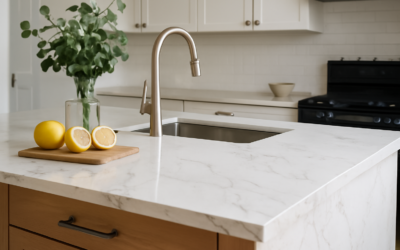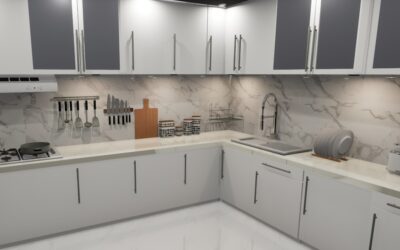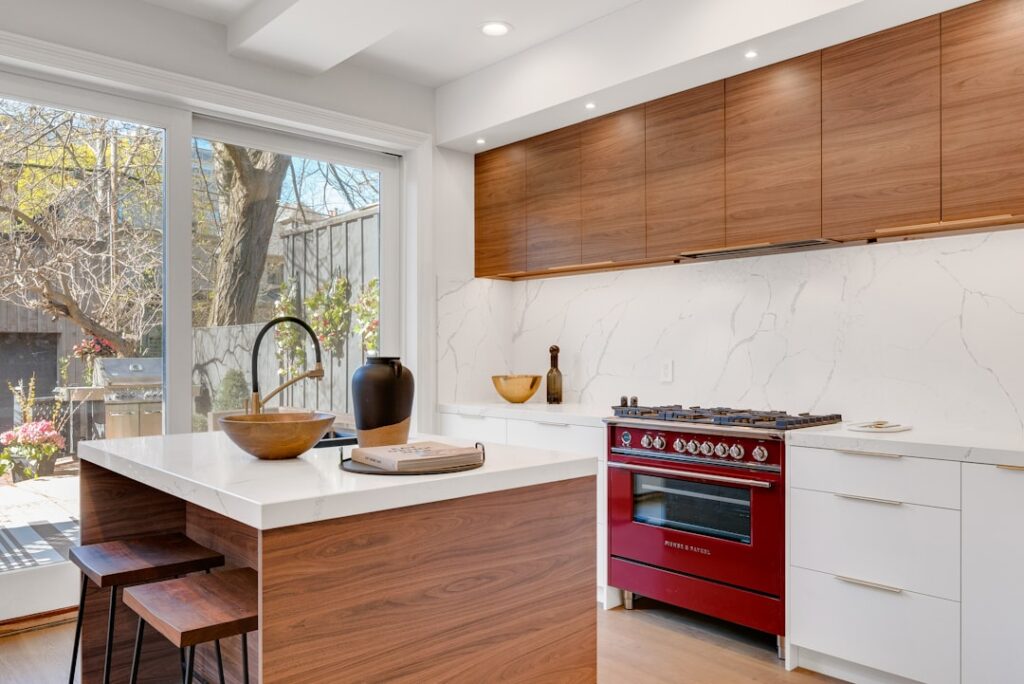
Quartz kitchen counter tops have quietly overtaken granite as the most-requested surface in American remodels, and the reason isn’t just looks. Engineered quartz combines roughly 90 percent ground natural quartz with resins and pigments, producing a slab that’s non-porous, stain-resistant, and virtually maintenance-free. For a busy kitchen where wine, coffee, and tomato sauce are daily hazards, a surface you never have to seal is a genuine upgrade over natural stone. This guide walks you through costs, colors, brands, and the practical trade-offs so you can decide with confidence.
Part of our Countertops guide — explore the full guide →
Unlike granite or marble, which are cut straight from the earth, quartz is manufactured. That matters because it gives you consistency: the slab you approve looks like the counter you get, with no surprise veining or soft spots. It also means quartz can mimic almost anything, from the crisp white of Carrara marble to the movement of soapstone, without inheriting those materials’ fragility.
What Quartz Counter Tops Actually Cost
Installed quartz typically runs $50 to $120 per square foot, including fabrication and installation. Where you land depends on the brand tier, color complexity, edge profile, and how much cutting your layout requires. A straightforward mid-tier quartz averages around $70 to $90 installed. Here’s how the pricing generally breaks down:
- Entry-level solids and simple speckles: $50 to $65 per square foot installed.
- Mid-range marble-look patterns: $70 to $95 per square foot installed.
- Premium designer veining (Calacatta looks): $100 to $150+ per square foot installed.
For a typical 40-square-foot kitchen counter run, expect a total project cost of $2,800 to $4,800 for mid-grade material. Add an island and you’re often looking at $4,000 to $7,000. Compared with high-end natural stone or the constant re-sealing of marble, quartz offers a strong balance of upfront cost and long-term value.
Why Homeowners Choose Quartz Over Granite
The headline advantage is that quartz is non-porous. Granite and marble have microscopic pores that absorb liquids, which is why they need sealing every one to three years. Skip that maintenance and you get stains and bacteria harborage. Quartz sidesteps the issue entirely: nothing soaks in, so a damp cloth handles almost everything, and there’s no annual sealer to buy or apply.
Quartz is also slightly more forgiving of impact than granite, which can chip at edges and corners. And because it’s engineered, color consistency is far better for large or multi-slab kitchens where matching natural stone can be maddening. Granite still wins on one front: heat. Natural stone shrugs off a hot pan, while quartz resins can scorch or discolor above about 300°F. Always use trivets on quartz, and you’ll never see a problem.
Popular Colors and Patterns
White and gray dominate current kitchens. Bright whites with subtle gray veining read clean and timeless, pairing with nearly any cabinet color. Warmer creams and greiges suit transitional and farmhouse designs. Dramatic Calacatta-style quartz, with bold gray or gold veins on a white field, delivers luxury-marble looks without marble’s staining risk, which is why it commands premium pricing.
For a modern, low-maintenance look that hides crumbs and water spots, mid-tone grays and speckled patterns are the practical workhorses. Deep charcoal and near-black quartz make a striking statement on islands but show dust, fingerprints, and dried water more readily, so weigh drama against daily upkeep.
Edge Profiles and Thickness
Standard slabs come in 2cm and 3cm thicknesses. Most kitchens use 3cm (about 1.25 inches) for a substantial look that needs no plywood backing. Edge profile shapes the personality of the counter:
- Eased or straight edge: Clean, modern, and usually included at no extra cost.
- Beveled: A crisp angled cut, subtly traditional.
- Bullnose and half-bullnose: Softly rounded, family-friendly with fewer sharp corners.
- Ogee and mitered waterfall: High-end profiles that add $10 to $30 per linear foot.
Choosing a Brand and Fabricator
Major quartz brands include Caesarstone, Cambria, Silestone, MSI Q, and Corian Quartz. Cambria is American-made and known for dramatic marble-look patterns; Silestone offers antimicrobial technology; MSI tends to be the value leader. Honestly, the fabricator often matters more than the brand. A skilled shop produces tight, nearly invisible seams and clean sink cutouts, while a careless one leaves visible joints and chipped edges regardless of the slab’s quality.
Ask any fabricator for local references, look at their seam work in person, and confirm the warranty is transferable and covers both material and installation. Get the specific brand and color in writing on your quote so no substitution slips in.
Living With Quartz Day to Day
Maintenance is about as easy as countertops get. Wipe with mild soap and water or a pH-neutral cleaner; avoid abrasive pads and harsh chemicals like bleach or oven cleaner, which can dull the finish over time. Use cutting boards to protect both your knives and the surface, and always set hot cookware on trivets. Follow those three habits and quartz kitchen counter tops will look as good in fifteen years as the day they were installed, with none of the sealing chores that natural stone demands.
Matching Quartz to Your Cabinets and Backsplash
The countertop rarely lives in isolation, so it pays to think about how the quartz plays against your cabinets, flooring, and backsplash before you fall in love with a slab. A busy, heavily veined quartz wants quiet surroundings: pair it with solid-color cabinets and a simple backsplash so the counter can be the star, otherwise the room reads chaotic. A calm, solid, or lightly speckled quartz gives you room to introduce a patterned tile backsplash or a bolder cabinet color without overwhelming the space. White and gray quartz are the most flexible, working with white shaker cabinets for a classic look, with navy or green cabinets for a current two-tone kitchen, and with warm wood tones for a transitional feel. When in doubt, bring a cabinet door sample and a backsplash tile to the slab yard and view them together under natural light, because showroom lighting can shift how the undertones read.
Seams, Overhangs, and Design Details
A few technical decisions shape how finished your quartz looks. Seams are unavoidable on larger kitchens because slabs have size limits, so ask your fabricator where the seams will fall and request that they be placed in less conspicuous spots, such as at a sink or an inside corner rather than across a wide open run. Skilled fabricators color-match the seam filler so the joint nearly disappears. For islands and breakfast bars, plan your overhang carefully: a standard seated overhang is about 12 inches, and anything beyond 10 to 12 inches typically needs concealed steel brackets or corbels to support the weight, since quartz is heavy and unsupported spans can crack. Deciding these details up front, rather than on installation day, is how you get a countertop that not only performs well but also looks custom and intentional throughout the kitchen.