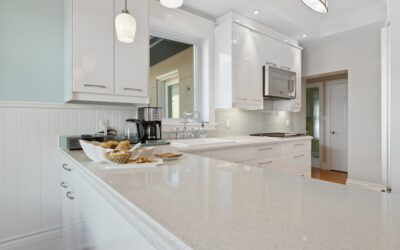
Two slabs labeled the same color from the same quarry can look like different stones entirely, and that surprises almost every homeowner shopping for the first time. A granite kitchen countertop is cut from natural rock, so every slab carries its own veining, pitting, and movement. That variation is exactly why a well-chosen granite kitchen countertop feels custom in a way engineered surfaces rarely do, but it also means you should always approve the actual slab, not just a two-inch sample chip. This guide covers how to choose, what to pay, and how to keep the stone looking new for 30 years.
Part of our Countertops guide — explore the full guide →
- Why Homeowners Still Choose Granite
- Understanding Granite Colors and Movement
- Thickness and Edge Profiles
- What a Granite Kitchen Countertop Costs
- Sealing and Long-Term Care
- Granite vs Quartz: A Quick Comparison
- Choosing a Fabricator and Approving Your Slab
- Understanding Seams and Overhangs
- Handling Chips, Cracks, and Repairs
- Finishes Beyond Polished
Why Homeowners Still Choose Granite
Granite has lost some market share to quartz, but it holds a loyal following for good reasons. It is one of the hardest countertop materials, ranking 6 to 7 on the Mohs scale, so it resists scratches from knives and cookware. It handles heat well; you can set a 400°F pan on it briefly without the discoloration or scorching that plagues laminate and even some quartz. And because it is a natural material, no two kitchens look identical.
The trade-off is porosity. Granite must be sealed, and darker, denser stones need it less often than lighter, more porous ones. That single maintenance task, which I will detail below, is the price of admission for a genuinely natural stone surface.
Understanding Granite Colors and Movement
Granite ranges from nearly uniform blacks and grays to wild multicolor slabs with dramatic veining. The pattern is called movement, and it is a matter of taste and kitchen size.
- Consistent grains like Absolute Black or Steel Gray read calm and modern, great for busy kitchens
- Speckled patterns like Uba Tuba and New Venetian Gold hide crumbs and coffee rings
- Bold movement like Blue Bahia or Fantasy Brown becomes the room’s centerpiece
In a small kitchen, heavy movement can feel busy, so a tighter grain often looks cleaner. In a large kitchen with plenty of cabinet space, a dramatic slab can anchor the whole design. Always view the full slab under the same lighting your kitchen has, because granite shifts noticeably between warm and cool bulbs.
Thickness and Edge Profiles
Granite slabs come in two standard thicknesses: 2 centimeters (roughly three-quarters of an inch) and 3 centimeters (about an inch and a quarter). The 3 cm slab is the modern standard for kitchens because it can span cabinets without plywood support and gives a substantial edge. Save the 2 cm for backsplashes or vertical applications.
Edge profile changes both the look and the price. A standard eased or straight edge is included in most quotes. Upgraded profiles add $10 to $30 per linear foot:
- Eased/straight: clean, contemporary, usually free
- Beveled: a 45-degree cut, timeless
- Bullnose and half-bullnose: rounded, family-friendly
- Ogee: an S-curve, traditional and formal, most expensive
What a Granite Kitchen Countertop Costs
Installed granite typically runs $40 to $100 per square foot in 2026, materials and labor combined. Entry-level colors sit at the low end, while exotic imported slabs with heavy movement climb toward $150 per square foot. A typical kitchen with 40 to 50 square feet of counter lands between $2,000 and $4,500 installed.
Granite is sold in tiers or groups, often labeled 1 through 5 or A through D, priced by rarity rather than durability. A Level 1 stone performs just as well as a Level 4; you are paying for the pattern. Fabrication extras like undermount sink cutouts ($100 to $250), cooktop cutouts, and premium edges add up, so get an itemized quote.
Sealing and Long-Term Care
Sealing is the maintenance step that intimidates people, but it takes 15 minutes. Test whether your granite needs sealing with a simple water test: pour a tablespoon of water on the surface and wait 15 minutes. If the stone darkens where the water sat, it is absorbing and needs sealer. Dense blacks may never fail this test; porous whites may need sealing twice a year.
To seal, clean and dry the surface, apply a penetrating stone sealer with a soft cloth, let it soak 5 to 10 minutes, then buff off the excess before it dries. For daily cleaning, use warm water with a drop of dish soap or a pH-neutral stone cleaner. Avoid vinegar, lemon, bleach, and generic abrasive sprays, all of which etch or dull the finish over time.
Granite vs Quartz: A Quick Comparison
Buyers almost always weigh granite against quartz. Quartz is engineered, nonporous, and never needs sealing, and it offers consistent patterns. Granite offers genuine natural stone character, better heat resistance, and often a lower entry price. Quartz can discolor under a hot pan and fades in direct sun over years; granite shrugs off both. If you want zero maintenance and a uniform look, quartz wins. If you want a one-of-a-kind natural surface and do not mind a twice-yearly seal, granite is the better fit.
Choosing a Fabricator and Approving Your Slab
The fabricator matters as much as the stone. Ask to see recent installs, confirm they template with a laser rather than by hand for tight seams, and read reviews specifically about seam quality and cleanup. A good shop makes seams that you have to hunt for; a poor one leaves a visible, mismatched line.
Insist on visiting the slab yard to approve your exact slabs, and if your job needs two slabs, approve both together so the movement flows across the seam. Mark where you want features, like a dramatic vein, to land on the island. This 30-minute step is the difference between a countertop you love and one that merely functions. Done right, a granite kitchen countertop will outlast the cabinets under it and still look striking decades from now.
Understanding Seams and Overhangs
Even the best fabricator cannot make a large kitchen seamless, so it helps to know where seams go and what to expect. Slabs come in sizes around 9 to 10 feet by 5 to 6 feet, so a run longer than that requires a seam. A good fabricator places seams in the least conspicuous spots, often at an inside corner or near a sink, and color-matches the epoxy so the joint is tight, usually about 1/16 inch, and hard to spot. On busy, speckled granite, seams nearly disappear; on solid colors like Absolute Black, they are more visible, so discuss placement in advance.
Overhangs matter for islands and breakfast bars. A standard countertop overhang past the cabinet face is about 1.5 inches. For seating, you want 12 to 15 inches of overhang for knee room, and any overhang beyond 10 inches on 3 cm granite needs support, either corbels, brackets, or a steel plate, to prevent cracking. Plan the support during design, not after the stone is set.
Handling Chips, Cracks, and Repairs
Granite is tough, but it is not indestructible, and knowing how to handle damage keeps a countertop looking new for decades. Small chips along an edge, usually from a dropped pot or a cabinet door, can be filled with a color-matched epoxy or acrylic repair kit, priced around $15 to $40, and buffed flush. Larger chips or a cracked section may call for a professional stone repair, but true structural cracks are rare in properly supported granite.
- Minor chips: fill with tinted epoxy, cure, and polish flush
- Dull spots or etching: a stone polishing compound can restore shine
- Stubborn stains: a poultice of baking soda and water draws out oil-based stains overnight
- Loose seams: a pro re-epoxies rather than a DIY patch
Prevent most damage with simple habits: use a cutting board rather than knifing directly on the stone, set trivets under very hot pans even though granite tolerates heat, and wipe up acidic spills like wine and citrus promptly before they can sit on a less-sealed area.
Finishes Beyond Polished
Polished is the default, but granite comes in other finishes that change the whole feel of a kitchen. A honed finish is matte and smooth, softening the look and hiding fingerprints, though it can show oil marks more and may need sealing more often. A leathered finish adds a subtle textured, low-sheen surface that hides smudges and water spots beautifully and has become popular on darker granites. Each finish performs a little differently, so ask to see samples of your chosen stone in polished, honed, and leathered before deciding, since the same slab can look like three different materials depending on how the surface is finished.