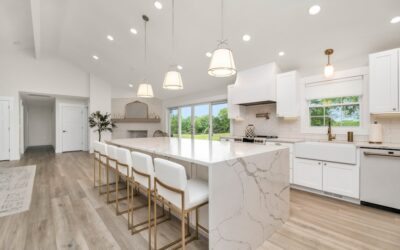
The island is the hardest-working surface in most kitchens, taking on prep, homework, buffet duty, and everything in between, so the material you put on top of it matters more than anywhere else. A kitchen island quartz top has become the default choice for good reason: engineered quartz is non-porous, scratch-resistant, never needs sealing, and comes in patterns that convincingly imitate marble and granite. Whether you are designing a new island or replacing a tired laminate slab, understanding thickness, overhang support, edge profiles, and pricing will help you get a top that looks custom and lasts for decades.
Part of our Countertops guide — explore the full guide →
Why Quartz Suits an Island
Engineered quartz is made from roughly 90 percent ground natural quartz bound with resins and pigments, producing a slab that is denser and less porous than natural stone. That non-porous surface is the killer feature for an island, where spills of wine, oil, coffee, and juice happen constantly. Unlike granite or marble, quartz never needs sealing, resists staining, and does not harbor bacteria in surface pores. It is also highly scratch- and chip-resistant, standing up to the daily abuse a busy island absorbs. Brands like Caesarstone, Cambria, Silestone, and MSI Q offer hundreds of colors, including dramatic waterfall-ready patterns.
Cost of a Quartz Island Top
Quartz typically runs $50 to $120 per square foot installed, with the spread driven by brand, pattern complexity, and edge work. An average island top of 25 to 40 square feet therefore lands somewhere between roughly $1,500 and $4,000 installed. Premium designer patterns with heavy veining or a waterfall edge that pours the stone down the sides push toward the top of that range and beyond. Because an island is a standalone piece, it is a popular spot to splurge on a bolder, more expensive quartz pattern than you would run across all your perimeter counters.
- Standard quartz: roughly $50 to $80 per sq ft installed
- Premium designer patterns: roughly $80 to $120+ per sq ft installed
- Waterfall edges: add material and fabrication cost for the vertical panels
Choosing Thickness and Edge Profile
Quartz slabs come primarily in 2 centimeter (about 3/4 inch) and 3 centimeter (about 1 1/4 inch) thicknesses. For an island, 3 centimeter is the popular choice because it feels substantial and can span overhangs with less support. If you want the look of thickness on a 2 centimeter slab, fabricators can build up the edge with a mitered laminated profile so it appears chunkier than it is.
The edge profile sets the personality of the island. A clean eased or square edge reads modern and minimalist, while a beveled, bullnose, or ogee edge leans traditional. A waterfall edge, where the quartz runs vertically down the ends of the island to the floor, is the showstopper option that turns the island into a design centerpiece. Each step up in edge complexity adds fabrication cost, so weigh the look against the budget.
Overhang and Support: The Detail People Forget
Most islands include a seating overhang, and this is where an otherwise beautiful kitchen island quartz top can go wrong. Quartz is strong but not infinitely so, and an unsupported overhang beyond roughly 10 to 12 inches on a 3 centimeter top risks cracking under the weight of someone leaning on it. For deeper overhangs, you need support: steel angle brackets, hidden countertop supports let into the cabinet, or decorative corbels. Plan the support with your fabricator before installation, because retrofitting brackets after the slab is set is awkward and rarely as clean.
Color and Pattern Selection
Because the island often anchors the room visually, many designers use it to introduce contrast. A common approach pairs light perimeter counters with a darker or more heavily veined island top, or vice versa. White quartz with soft gray marble-look veining remains the most requested pattern for its timeless appeal, while bold dark quartz with dramatic white veining makes a striking statement. Whatever you choose, view a full-size slab or at least a large sample in your own kitchen lighting, since quartz patterns can look very different under warm home light than under showroom fluorescents.
Installation Considerations
Quartz island tops are heavy; a 3 centimeter slab weighs roughly 25 pounds per square foot, so a full island top can exceed 800 pounds and requires professional handling and a sturdy, level cabinet base. Fabricators template the island precisely, cut and polish the slab in the shop, and set it with silicone adhesive. If your island includes a sink or cooktop, the cutouts are made in the shop from the template. Seams on an island are usually avoidable because most island tops fit within a single slab, one of the advantages of the compact footprint compared to long perimeter runs.
Adding a Sink, Cooktop, or Waterfall Edge
Many islands do more than provide surface area, and each added feature affects the top. If you plan a prep sink or a main sink in the island, an undermount sink is the cleanest look with quartz, mounted below the surface so you can sweep crumbs straight into it, and the cutout is fabricated in the shop from your template. A cooktop in the island requires a heat-tolerant layout and adequate clearance, and because quartz can scorch, keep hot pans on trivets rather than resting them on the surface beside the burners. Downdraft vents and pop-up outlets can also be integrated, but each cutout should be planned before fabrication.
A waterfall edge deserves extra thought because it doubles as design and structure. Running the quartz vertically to the floor on one or both ends creates a dramatic, seamless look where the veining ideally continues, or bookmatches, down the panel. Achieving that vein continuity requires a skilled fabricator and a slab with enough material, so discuss it early. Waterfall panels also protect the cabinet ends from scuffs and add a substantial, furniture-like presence to the island.
Care and Longevity
Living with quartz is nearly effortless. Wipe it with mild soap and water or a gentle non-abrasive cleaner; you never seal it. The one caution is heat: like most engineered surfaces, quartz resins can scorch or discolor under a hot pan, so use trivets rather than setting cookware straight from the stove onto the top. Avoid harsh chemicals like oven cleaner and bleach on colored quartz. Treated with that basic respect, a kitchen island quartz top will look showroom-fresh for 15 to 20 years or more, making it one of the best long-term values in the kitchen.